
Intra-workout nutrition for hybrid athletes means fueling differently depending on what you’re doing in that session — a 30–60g/hour carb strategy built for a long run will slosh and cramp you during a heavy squat session, and a bodybuilder’s intra-workout pump drink won’t prevent the bonk on a 90-minute tempo run. The right approach adjusts to the session in front of you, not a single fixed formula.
If you’ve ever tried to run off a gel that was dialed in for lifting days, or felt your stomach turn during a tempo run because you drank the same sports drink you use in the gym, you already know why generic intra-workout advice doesn’t hold up for hybrid training. Most guides are written for one discipline. Bodybuilding-focused intra-workout products are built to sit relatively still in your stomach while you lift — which is exactly the problem when that same fluid is sloshing around at 7-minute-mile pace. Pure endurance fueling, on the other hand, is built for sustained aerobic output and doesn’t account for the amino acid demands of a heavy resistance session.
Hybrid athletes need a protocol that flexes with the session — one setup for a heavy lower-body day, a different one for a threshold run, and a third for the days both happen within a few hours of each other. That’s what this guide breaks down.
If you haven’t already, start with our hybrid athlete nutrition guide for your daily calorie, carb, and protein targets — this article assumes those are dialed in and focuses entirely on what to consume during training itself.
Why Standard Intra-Workout Protocols Fail Hybrid Athletes
The gap is simple: lifting-focused intra-workout products and endurance fueling products are solving two different problems, and most hybrid athletes are only using one of them.
Bodybuilding intra-workout drinks are typically built around higher-osmolality carbohydrate blends meant to sit in the stomach and slowly feed a lifting session — fine when you’re moving in short, controlled bursts between sets, much less fine when that same fluid is bouncing around during a run and causing cramping or nausea. Pure endurance gels and drinks solve the opposite problem: they’re built for continuous aerobic output and rapid absorption, but most weren’t designed with any amino acid content to protect against muscle breakdown during a long session that’s also asking your body to recover from yesterday’s squat day.
A hybrid athlete’s actual need changes by session. A heavy lower-body lift, a lactate-threshold run, and a two-hour double-session day each call for a different mix of carbs, electrolytes, and amino acids — which is the rest of this guide.
How Is Intra-Workout Fueling Different for Lifting vs. Endurance Sessions?
The mechanism differs by session type, and understanding it is what lets you build a protocol instead of guessing.
In endurance sessions, the primary goal is substrate replacement — maintaining blood glucose and sparing liver and muscle glycogen for as long as possible. When blood glucose drops too low during sustained output, it contributes to central nervous system fatigue: the “heavy legs, foggy head” feeling that shows up well before your muscles are actually out of fuel. Feeding carbohydrate during the session delays that.
In lifting sessions, the priority shifts. You’re less concerned with sustaining aerobic output and more concerned with managing the hormonal environment around a high-force, intermittent effort — blunting excessive cortisol response, supporting circulating insulin to help offset muscle protein breakdown, and maintaining cellular hydration (the “fullness” that supports force production during heavy sets). A meta-analysis of resistance-training studies found average muscle glycogen depletion of roughly 104 mmol/kg dry mass per session, with more sets and longer sessions driving greater depletion — so even a lifting-only day is pulling meaningfully on the same glycogen stores your running depends on, just through a different mechanism (Hamidvand et al., 2025).
That’s the real argument for treating hybrid fueling as its own category: you’re not just splitting the difference between two protocols, you’re managing two different physiological demands that both draw from an overlapping fuel pool.
How Fast Do You Actually Deplete Fuel in Each Type of Session?
This is where “it depends” is the honest answer, but there’s still a useful framework.
Generally, the rate of substrate depletion tracks with intensity and duration together, not either alone. A heavy resistance session typically doesn’t require intra-workout carbohydrate until you’re past the 45–60 minute mark, since shorter sessions rely more heavily on stored ATP-PC and glycolytic energy that intra-workout carbs won’t meaningfully speed up anyway. Easy, aerobic (Zone 2) running burns through glycogen more slowly and can often go 75–90 minutes before intra-fuel meaningfully helps. Tempo and threshold running efforts burn glycogen considerably faster because of the higher relative intensity, and coaches and athletes commonly report needing to start fueling by the 30–45 minute mark on those sessions. Long endurance efforts past two hours benefit from starting intra-workout carbohydrate early — generally within the first 30 minutes — rather than waiting until you feel depleted, since by the time you feel it, glycogen and blood glucose are already dropping.
Take the specific gram-per-minute oxidation numbers you’ll see floating around fitness content (including in some drafts of this article) with a grain of salt — those figures vary by athlete, fitness level, and conditions, and the underlying research is far more consistent on timing thresholds than on precise burn rates. Use the windows above to decide when fueling starts mattering for a given session, then dial in how much based on your own gut tolerance and performance feedback.
What’s the Best Intra-Workout Carbohydrate Source to Avoid GI Distress?
Osmolality — essentially, how concentrated a solution is relative to your blood — determines how fast a carbohydrate source clears your stomach, and that matters more during running than during lifting.
High-osmolality drinks (thick, sugar-dense mixes) empty from the stomach more slowly and can cause sloshing, bloating, or nausea when your gut is being jostled at running pace. This is the core reason a carb mix that felt fine sitting on a bench between sets can wreck your stomach on a run twenty minutes later.
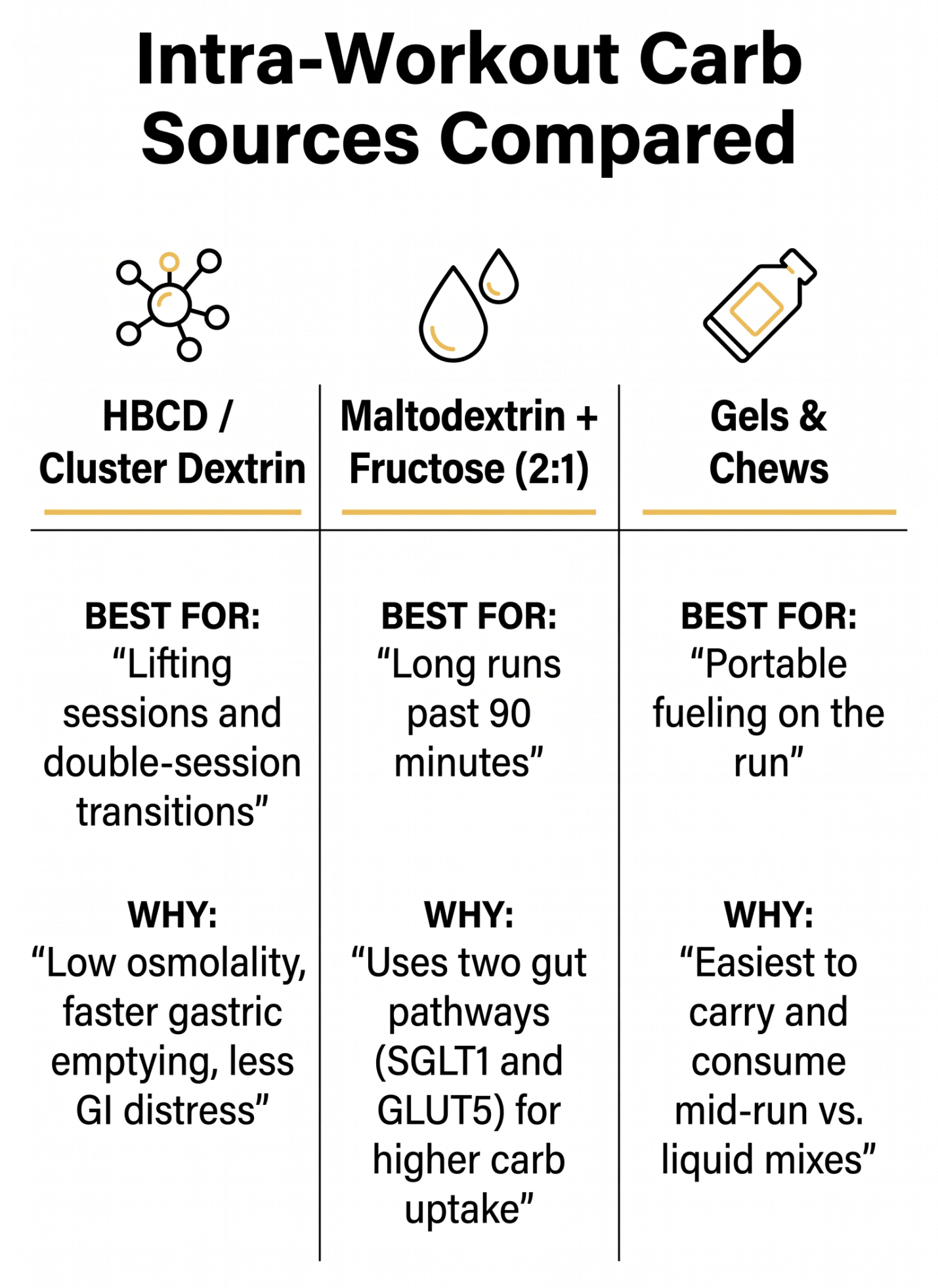
Highly branched cyclic dextrin (HBCD), sometimes labeled cluster dextrin, is a glucose polymer with a notably higher molecular weight and lower osmolality than standard maltodextrin. Research on HBCD has found faster gastric emptying compared to glucose- or maltodextrin-based drinks, along with lower reported perceived exertion during prolonged exercise (Furuyashiki et al., 2014; multiple subsequent reviews). In plain terms: it moves through your stomach faster and tends to sit better, which makes it a reasonable choice both for lifting sessions and for the transition period on a double-session day, where GI comfort matters more than raw carbohydrate density.
Maltodextrin combined with fructose, generally in a roughly 2:1 ratio, solves a different problem: total absorption ceiling. Glucose is absorbed through the SGLT1 transporter, which saturates at around 60g per hour regardless of how much more you drink — past that point you’re not absorbing faster, you’re just adding GI risk. Fructose is absorbed through a separate transporter (GLUT5), so combining the two lets you access both pathways at once. Research on these “multiple transportable carbohydrate” blends has shown meaningfully higher oxidation rates — some studies report up to 50% higher carbohydrate oxidation with a 2:1 glucose:fructose blend compared to glucose alone (Jentjens & Jeukendrup, 2005; Currell & Jeukendrup, 2008). This is the better choice specifically for runs pushing past 90 minutes, where your body needs to process more total carbohydrate per hour than a single-source glucose drink can handle.
Gels and chews are the practical, portable version of either of the above and are generally the easiest option to carry on a run; liquid carb mixes are usually the more practical option in the gym, where you’re not carrying anything and can sip steadily between sets.
Do You Need Amino Acids or Protein During Training?
Situationally, yes — and the mechanism is worth understanding before you decide whether it applies to you.
Exercise increases blood flow to working muscle, which flushes intracellular amino acids out into circulation. When the amino acid pool inside the muscle cell drops, the rate of muscle protein breakdown increases to compensate (Blomstrand & Saltin, 1999-era research through more recent EAA studies). Standard BCAA products only supply three of the nine essential amino acids, which is part of why research has increasingly favored full-spectrum essential amino acids (EAAs) or hydrolyzed protein sources — they supply everything needed to actually support muscle protein synthesis rather than just two or three building blocks.
Where this earns its place for a hybrid athlete: during long endurance efforts (generally 90+ minutes) or on double-session days, where you know a lifting session is still ahead of you and want to blunt unnecessary muscle tissue breakdown along the way. A reasonable starting range, based on the doses used in the research on EAA supplementation around exercise, is 5–10g of EAAs or a hydrolyzed protein source added to your intra-workout fluid. For a standard lifting session under an hour, or a shorter easy run, this step is optional — you’re not depleted enough for it to move the needle much, and it’s an added cost and GI variable for limited return.
How Much Sodium and Fluid Do You Actually Need Intra-Workout?
Sodium matters — but the way most intra-workout content frames hydration gets the bigger risk backwards.
Water alone during heavy sweat losses dilutes plasma sodium and can degrade neural drive and performance. Replacing some of what you lose in sweat, generally in the range of 500–1,000mg of sodium per liter of fluid, is a reasonable target for extended or hot-weather sessions, and individual losses vary widely — some athletes lose two to three times more sodium in sweat than others under identical conditions, which is why generic electrolyte tablets can underdose some people and overdose others.
Here’s the part most intra-workout guides skip: exercise-associated hyponatremia — dangerously low blood sodium — is caused far more often by overdrinking than by under-salting. Current sports-medicine guidance points toward thirst-driven fluid intake as the safer default, rather than forcing a fixed volume target regardless of how you feel (Hew-Butler et al., 2017; NCBI StatPearls review on exercise-associated hyponatremia). Practically, that means: prioritize getting sodium into what you do drink, but don’t treat “drink more” as automatically safer. If you’re someone who finishes sessions drenched while your training partner barely sweats, you likely need more sodium relative to your fluid intake — not just more total fluid.
Intra-Workout Fueling Protocols by Session Type
These are starting points, not prescriptions — adjust based on your own gut tolerance, sweat rate, and how you actually feel in training.
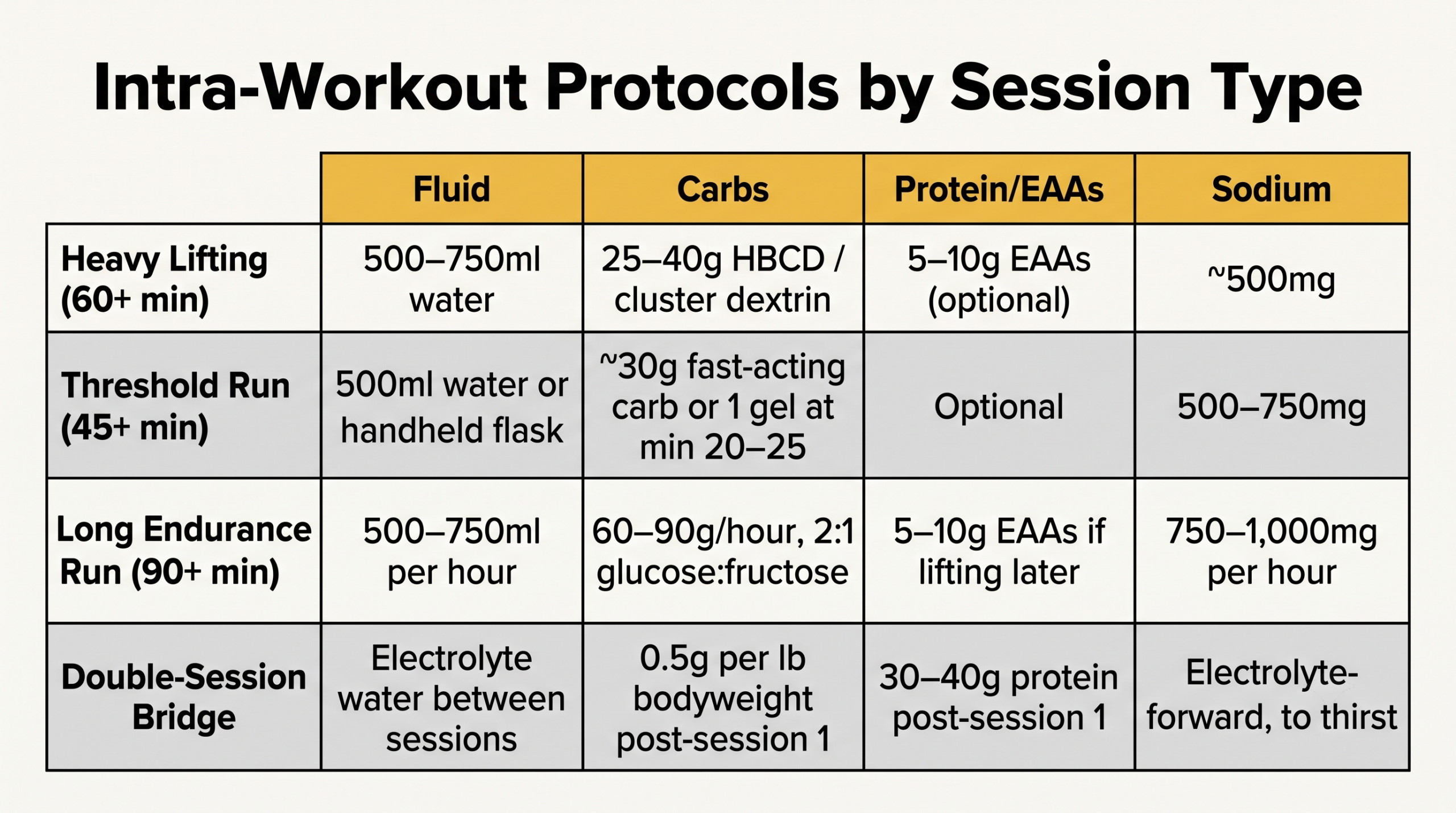
→ Heavy lifting session (60+ minutes): 500–750ml water, 25–40g HBCD or cluster dextrin, optionally 5–10g EAAs if the session is unusually long or glycogen-depleted from the day before, roughly 500mg sodium.
→ Threshold or tempo run (45+ minutes): 500ml water or a handheld flask, roughly 30g of fast-acting liquid carbohydrate or a single gel around the 20–25 minute mark, 500–750mg sodium.
→ Long endurance run (90+ minutes): 500–750ml fluid per hour, 60–90g carbohydrate per hour using a roughly 2:1 glucose:fructose blend to get past the single-transporter ceiling, 750–1,000mg sodium per hour, and 5–10g EAAs if you have a lifting session later that day.
→ The double-session bridge (lift AM → run PM, or the reverse): prioritize a fast-digesting recovery meal after session one — roughly 0.5g of carbohydrate per pound of bodyweight alongside 30–40g protein — then focus on electrolyte-forward fluid through the gap before session two rather than trying to cram a full meal right before you train again.
None of these numbers are meant to be followed blind. Start near the middle of each range, track how your stomach and performance respond over a few weeks, and adjust from there. That’s coaching, not guessing.
What Does This Actually Look Like for a Real Hybrid Athlete?
Frameworks are useful, but it’s worth seeing how someone who’s actually lived through the lifter-to-endurance transition dialed in their own numbers.
Michael Donatelli, who documented his shift from lifting-focused training into Ironman-distance triathlon on his Building Mike newsletter, landed on a similar structure through months of trial and error rather than a formula he read somewhere. For long endurance sessions past two hours, he settled on roughly 1,000mg of sodium and 40oz of water, adjusted down for less sweat-heavy athletes; ahead of lifting sessions, about 500mg sodium and 32oz of water in the 30 minutes prior. For cardio sessions over 60 minutes, he targets 30–60g of carbohydrate per hour from gels, blocks, or energy bars — a range that lines up closely with the general endurance guidance above — and for lifting sessions, 15–30g of carbohydrate immediately after his main lifts, often from something as simple as honey. On the protein side, he prioritizes 10–20g before longer cardio sessions and 30–50g after, on top of a daily target around 1–1.2g of protein per pound of bodyweight (Donatelli, “My Approach to Hybrid Training, Part 2: Nutrition Methods,” 2023).
His own conclusion is worth repeating here because it matches everything above: nutrition is individualized, his numbers are a starting point, and the real work is refining your own protocol through feedback, not copying someone else’s exactly.
Common Intra-Workout Fueling Mistakes for Hybrid Athletes
→ Using one protocol for every session. The same carb mix and sodium target for a heavy squat day and a tempo run ignores that the two sessions are solving different physiological problems. What sits fine during lifting can wreck your stomach at running pace.
→ Chasing a fixed fluid number instead of drinking to thirst. More water isn’t automatically safer — overdrinking relative to your actual sweat losses is a real driver of exercise-associated hyponatremia, not a minor footnote.
→ Ignoring intra-workout fueling on lifting days because “it’s not cardio.” A hard lifting session still depletes meaningful glycogen. Treating intra-workout carbs as a running-only tool leaves recovery and next-session performance on the table.
→ Copying someone else’s exact numbers without testing them. The protocols and case study above are starting points. Gut tolerance, sweat rate, and session demands are individual — dial your own numbers in during training, not on a day that matters.
For a full breakdown of all the most common mistakes associated with Hybrid Training, check out our article on the “6 Common Mistakes Lifters Make When Switching To Hybrid Training”.

Hybrid-Athlete Intra-Workout Nutrition FAQ |
| What should I drink during a hybrid workout that combines lifting and running? It depends on which part of the session you’re in — a lower-osmolality carbohydrate source like HBCD/cluster dextrin tends to sit better across both modalities than a standard high-osmolality sports drink, especially during the running portion. Add sodium (roughly 500–750mg per liter) and, on longer or double-session days, 5–10g of EAAs to help offset muscle breakdown. |
| How many carbs do I need during a long run if I’m also lifting that day? For runs past 90 minutes, 60–90g of carbohydrate per hour using a roughly 2:1 glucose:fructose blend is a reasonable target, since that ratio uses two separate absorption pathways instead of maxing out on one. If you have a lifting session later that day, adding 5–10g of EAAs to that mix can help protect muscle tissue in the meantime. |
| Is cluster dextrin better than maltodextrin for hybrid training? Cluster dextrin (highly branched cyclic dextrin) generally empties from the stomach faster and causes less GI discomfort than standard maltodextrin, making it a reasonable default for lifting sessions and the transition period between two sessions in the same day. For very long runs past 90 minutes, a maltodextrin-fructose blend may support higher total carbohydrate absorption per hour. |
| How much sodium do I need during intra-workout fueling? A common range is 500–1,000mg of sodium per liter of fluid, but individual sweat and sodium losses vary widely, so this is a starting point rather than a fixed rule. Drinking to thirst rather than forcing a fixed fluid volume is the more important safety factor, since over-hydration — not under-salting — is the more common cause of exercise-associated hyponatremia. |
| Do I need amino acids or protein during a workout? Generally only for longer sessions — 90+ minutes of endurance work, or double-session days where a lifting session follows later — where 5–10g of EAAs or a hydrolyzed protein source can help offset muscle protein breakdown. For a standard lifting session under an hour or a short easy run, it’s an optional add-on rather than a necessity. |

Building Your Own Intra-Workout Protocol
None of this needs to be complicated once you understand the mechanism behind it. Match your carb source to the session — lower-osmolality options for anything involving running, higher total-carb blends for long endurance work — get sodium into what you drink instead of just drinking more, and layer in amino acids only when the session actually calls for it.
This level of detail is exactly where hybrid athletes tend to either get it right through months of self-experimentation, like Donatelli did, or stay stuck guessing indefinitely. If you’d rather shortcut the trial-and-error and have your intra-workout protocol built around your actual training split, sweat rate, and event calendar, that’s part of what our coaches do inside TCM’s online coaching.