
Creatine Monohydrate Dosage: Do Advanced Lifters Need More Than 5 Grams?
Most people only need 3–5g of creatine monohydrate a day to fully saturate their muscle stores — taking more won’t build additional muscle once you’re there. But brain tissue holds creatine differently and is much harder to saturate. Lifters with significant muscle mass, high training volume, or chronic sleep debt may have a legitimate case for pushing toward 8–10g/day.
Ask ten people how much creatine to take and nine of them will give you the same answer: 5 grams a day, forever, don’t overthink it. For most lifters, that answer is correct. It’s also the most misunderstood correct answer in supplementation, because “correct for most people” quietly gets treated as “correct for everyone, always, no exceptions.”
It isn’t. If you’re carrying real muscle mass, training at a volume that would break a beginner, and running your brain hard all day — work, kids, decisions, more work, not enough sleep — the standard dose might not be doing everything it could for you. Not because the muscle math changes. It doesn’t. Because there’s a second tissue in your body that stores creatine on completely different terms, and almost nobody talks about it.
What’s the Standard Creatine Monohydrate Dosage?
There are two ways to get to full muscle saturation, and they land in the exact same place.
| Protocol | Daily Dose | Duration | Time to Full Saturation |
|---|---|---|---|
| Loading | 20g/day (four 5g doses) | 5–7 days | ~5–7 days |
| Continuous | 3–5g/day | Indefinite | ~3–4 weeks |
Loading isn’t a hack or a shortcut — it’s the same saturation curve, just compressed. You’re not getting anywhere the slow protocol won’t eventually get you; you’re just paying for it with more GI stress along the way. If you’ve got a competition or a shoot in ten days, load. If you don’t, skip it and let 3–5g/day do the job over the next month. After 30 days, strength, muscle fullness, and performance are indistinguishable between the two approaches.
For a full breakdown of what creatine does and why it’s worth taking in the first place, our creatine monohydrate guide covers the fundamentals — this article picks up where that one leaves off.
Why More Creatine Doesn’t Build More Muscle Past a Certain Point
Here’s the part most “just take more, it can’t hurt” advice gets wrong: your muscles have a storage limit, not a preference for volume.
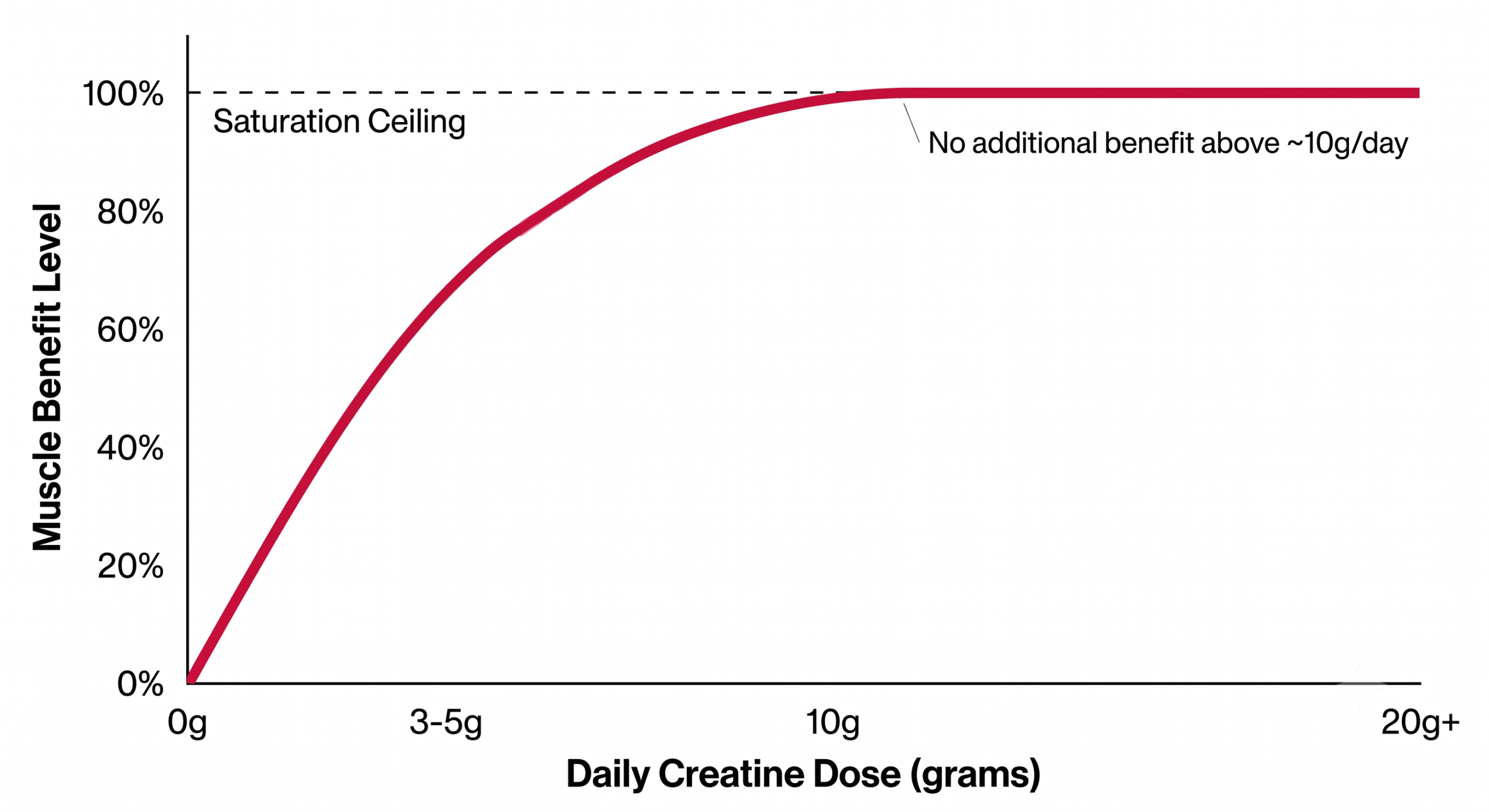
Resting skeletal muscle holds roughly 120 mmol/kg of dry tissue in creatine under normal conditions. Supplementation raises that toward a physiological ceiling of about 140–160 mmol/kg — a 20–40% increase that improves ATP resynthesis (how fast your muscles regenerate usable energy between reps) and short-burst work capacity. That’s the mechanism behind creatine’s strength and power benefits, and it’s real.
Once you hit that ceiling, though, the story stops. Your body naturally breaks down creatine into creatinine at about 1.5–2% per day, and anything you take beyond what’s needed to replace that loss doesn’t raise intramuscular creatine any further. It gets filtered by your kidneys and excreted in urine. You’re not building anything with it — you’re just paying for expensive pee.
This is the ceiling effect, and it’s why doubling or tripling your dose past 10g/day produces zero additional muscle growth. The saturation point doesn’t move because you decided to take more.
Does Body Size Change How Much Creatine You Need?
Yes — and this is where “just take 5 grams” starts to break down for advanced lifters.
The 3–5g standard was built around average body weight and average muscle mass. Creatine is stored almost entirely (about 95%) in skeletal muscle. A lean, 175-pound lifter carrying 155 pounds of that as muscle has meaningfully more storage capacity than a 175-pound person carrying 120 pounds of muscle and the rest as fat. More tissue to saturate means more creatine needed to saturate it.
Research settings account for this by dosing relative to body weight rather than using a flat number — commonly 0.1g per kilogram of body weight per day. For an 80kg (175lb) muscular athlete, that works out to roughly 8g/day.
What the research actually shows:
- Regional muscle hypertrophy. A 2023 meta-analysis in Nutrients (Burke et al.) looked at resistance-trained individuals using relative dosing protocols — typically 0.1g/kg/day, landing around 7–10g/day for average-to-larger lifters. Creatine plus resistance training consistently outperformed placebo for both upper- and lower-body muscle growth. The plain-English translation: the extra growth came from these lifters finally hitting full saturation with a dose sized to their actual muscle mass, not from exceeding saturation.
- Strength adaptation. A 2024 meta-analysis in Nutrients (Wang et al.) evaluated strength gains across different dosing strategies in adults under 50. It found significant strength increases across the board, with a trend toward slightly greater lower-body strength gains in higher-total-dose protocols — particularly among male lifters doing high-volume lower-body training.
If you’re a bigger, leaner, harder-training lifter, 6–8g/day isn’t excess. It’s the dose that actually matches your tissue. Below that, you may be under-saturated on a “standard” dose that was never built with your body composition in mind.
The Real Reason to Consider 10 Grams: Your Brain Doesn’t Play by the Same Rules
This is the part that changes the conversation for high performers, and it has nothing to do with muscle.
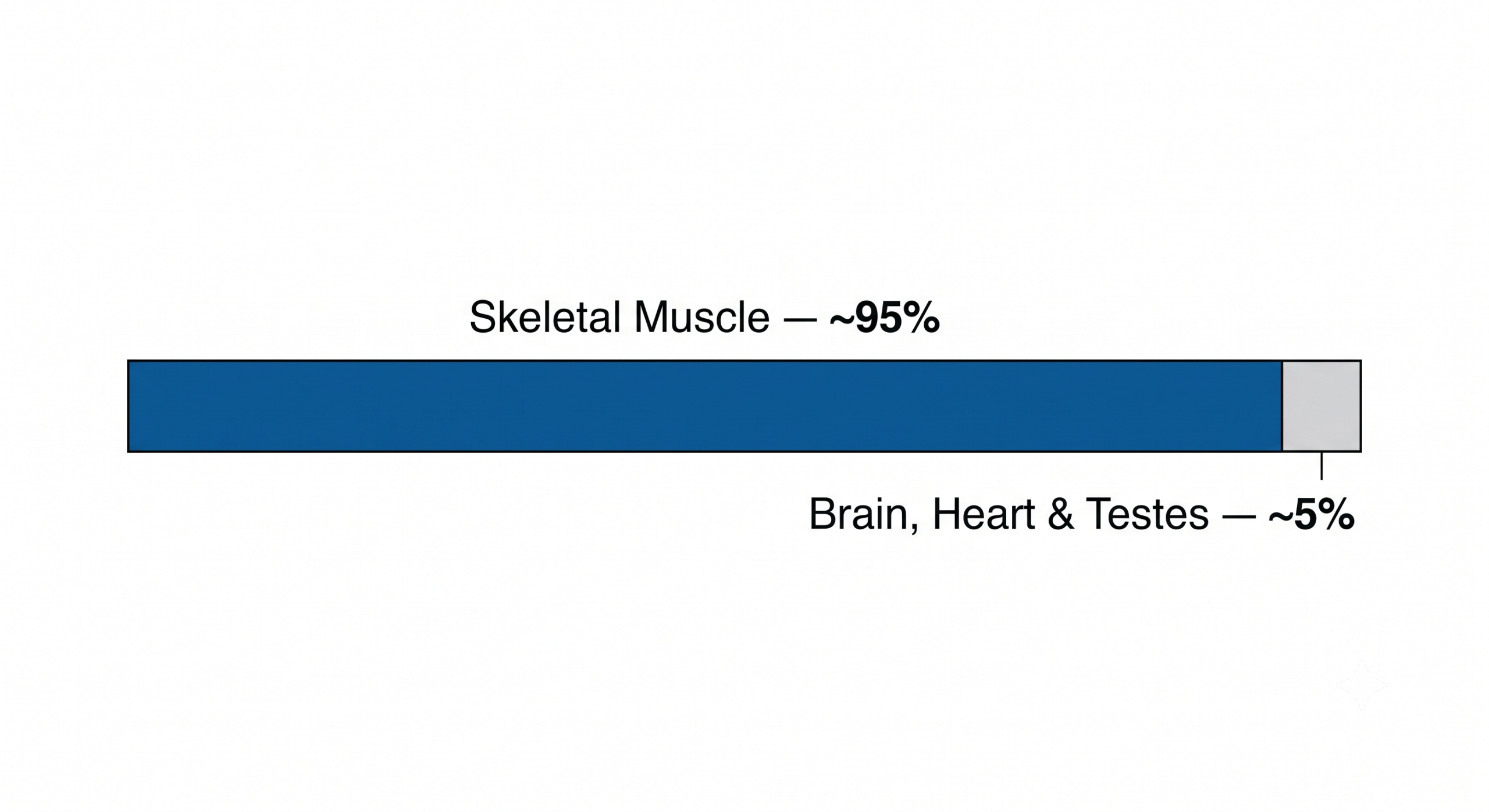
Of your body’s total creatine pool, about 95% sits in skeletal muscle. The brain holds an estimated 1–2%. That’s not because your brain doesn’t need creatine — it’s because the brain plays by a different set of physiological rules entirely.
Two things make the brain harder to saturate than muscle:
- It makes its own. Unlike muscle, brain tissue can synthesize a baseline supply of creatine locally, using enzymes called AGAT and GAMT. It’s partially self-sufficient, which makes it more resistant to outside dosing.
- The blood-brain barrier restricts uptake. The transporter that moves creatine into the brain (CRT1) operates near saturation under normal conditions and has low permeability to circulating creatine. Even when your blood levels are elevated from supplementation, only a fraction gets through.
The result: standard doses (3–5g/day) can raise muscle creatine by 20–40%, but they typically only raise brain creatine by 5–10%, even with long-term use. Getting a meaningful bump in brain creatine takes a higher, sustained circulating dose — which is where 10g/day enters the research.
One myth worth killing here: your muscles aren’t “stealing” creatine from your brain, and your brain doesn’t pull reserves out of muscle tissue. Skeletal muscle functions as a one-way vault — it has no mechanism to release stored creatine back into your bloodstream to feed other organs. Muscle and brain each get their own separate supply lines. Going higher on your dose isn’t robbing Peter to pay Paul; it’s just giving your brain’s stubborn, low-permeability entry point more raw material to work with.
What Actually Counts as “Severe Stress” for Brain Creatine Benefits?
Not “I have a lot going on.” That’s not what the clinical research is measuring.
In the literature, brain-relevant stress means metabolic stress — conditions that measurably deplete brain energy (ATP and phosphocreatine), not just general psychological overwhelm. The research defines it through four categories:
- Sleep deprivation. Acute all-nighters or chronic restriction to 4–5 hours a night measurably drains brain phosphocreatine stores.
- Extreme cognitive fatigue. Hours of uninterrupted, high-demand mental work — complex decision-making, multitasking under time pressure.
- Physical and environmental exhaustion. Strenuous training combined with physical depletion, or low-oxygen conditions.
- Neurological damage. Concussions, mild traumatic brain injury, or age-related cognitive decline.
So does a demanding life actually qualify — running a business, raising kids, and training hard on top of it? Yes, but only under a specific condition: it has to be costing you sleep and stacking real mental and physical exhaustion, not just filling your calendar. If your schedule has you sleeping 5–6 hours instead of 7–8, and you’re combining high-intensity training with sustained decision-making all day, that’s a legitimate compound metabolic drain — not a stretch of the research, an actual match for it.
Sleep deprivation trials specifically show that higher-dose creatine supplementation helps attenuate — not eliminate — the drops in working memory and reaction time that come with 24–36 hours of sleep debt. I’ve seen this pattern constantly in clients who run businesses or manage households on top of serious training: the training volume alone isn’t what’s wrecking their recovery and focus. It’s the training stacked on four hours of sleep and a day of back-to-back decisions. That’s the population this research actually applies to.
How to Take 10 Grams a Day Without Wrecking Your Stomach
Higher doses come with a real tradeoff: gastrointestinal side effects scale with how much you take in a single sitting, not with your total for the day.
A single dose of 5g or less carries very low risk of stomach discomfort. Push past 10g in one sitting and you meaningfully raise the odds of cramping, nausea, and osmotic diarrhea. The fix is straightforward — split it.
Practical protocol for a 10g/day target:
→ 5g in the morning with breakfast → 5g in the afternoon or evening, ideally with a meal → Water intake kept high throughout the day, since higher doses increase intracellular fluid retention
Splitting the dose gets you the same daily total without asking your gut to process 10 grams at once.
Who Should Actually Consider Going Beyond 5 Grams?
Not everyone, and that’s not a hedge — it’s the honest answer.
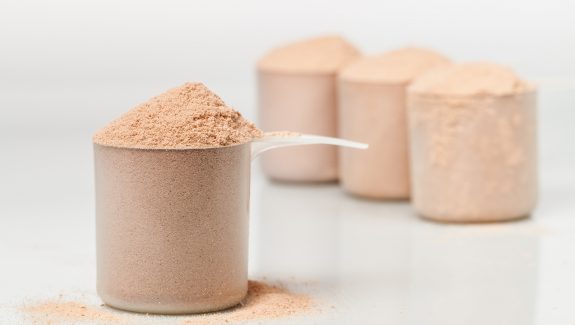
If you’re an average-sized lifter training a normal volume, 3–5g/day is genuinely enough. You’re not leaving anything on the table, and more won’t change that. This section isn’t for you, and pretending otherwise would be selling you a bigger scoop for no reason.
The case for more applies to two overlapping groups:
→ Larger, leaner, high-volume lifters — think 175lb+ with well-above-average muscle mass — where 6–8g/day (roughly 0.1g/kg) is what it actually takes to hit full muscle saturation, based on your tissue, not the average person’s.
→ That same group, when they’re also under real, sustained metabolic stress — chronic short sleep, heavy cognitive load, high training volume stacked together — where 10g/day (split into two 5g doses) is where the brain-specific research lives.
Outside of those two situations, more creatine is just more trips to the bathroom, not more progress. That’s the whole “no shortcuts” reality of this supplement: there isn’t a dose that substitutes for training volume you’re not doing or sleep you’re not getting. Creatine amplifies a system that’s already working hard. It doesn’t create one.
Blunt plug, but it’s a relevant one here: figuring out where you actually fall on this — your training volume, your body composition, your real sleep numbers — is exactly the kind of individualization we work through with coaching clients instead of guessing at a generic number. If you want that dialed in for you specifically, that’s literally what our coaches do.
Creatine Monohydrate Dosage FAQ
| Is it safe to take more than 5 grams of creatine monohydrate a day? For most healthy adults, doses up to 10g/day split into two servings are well tolerated in the available research, with the main risk being gastrointestinal discomfort at high single-serving sizes rather than any organ-level concern in healthy individuals. Splitting a 10g total into two 5g doses with meals and adequate water largely avoids the cramping and nausea that come with taking it all at once. Anyone with existing kidney issues should talk to a physician before increasing their dose. |
| Do I need to do a creatine loading phase? No — loading (20g/day for 5–7 days) and a continuous 3–5g/day protocol reach the exact same muscle saturation point, just on different timelines. Loading gets you there in about a week; skipping it and taking 3–5g/day daily gets you there in roughly three to four weeks. After a month, the two approaches produce indistinguishable results, so loading is a timing choice, not a superior method. |
| How much creatine should I take for brain and cognitive benefits? Standard doses of 3–5g/day only raise brain creatine by an estimated 5–10%, because the blood-brain barrier restricts uptake far more than muscle tissue does. The research on cognitive resilience — particularly under sleep deprivation — typically uses higher sustained doses around 10g/day, often split into two 5g servings to improve tolerance. |
| Can everyday stress from work and parenting justify a higher creatine dose, or does it have to be physical? It can, but only when that stress is actually costing you sleep and stacking real mental and physical exhaustion — not simply because your schedule is full. Running a business, raising a family, and training hard can qualify if it consistently cuts your sleep to 5–6 hours and combines heavy cognitive load with high training volume, which matches the metabolic stress conditions used in the underlying research. |
| Will taking 20 grams of creatine build more muscle than 5 grams? No. Once muscle creatine stores reach their physiological ceiling — generally achieved with 5–10g/day depending on body size — additional creatine provides zero extra muscle growth or strength benefit. The excess is broken down and excreted rather than stored, so anything meaningfully above what your muscle mass requires is not building anything. |
Creatine dosing isn’t a personality or a loyalty test to a number on the scoop. It’s math based on your muscle mass, your training volume, and how much you’re genuinely asking your brain to carry in a given day. Get honest about those three things before you get precious about 5 grams.
References and Scientific Sources
Muscle Dosing, Physiology, and Hypertrophy
-
Burke, R., et al. (2023). The effects of creatine supplementation combined with resistance training on regional measures of muscle hypertrophy: A systematic review with meta-analysis. Nutrients, 15(9), 2116. Link: https://pubmed.ncbi.nlm.nih.gov/37432300/
-
Hultman, E., et al. (1996). Muscle creatine loading in men. Journal of Applied Physiology, 81(1), 232–237. Link: https://pubmed.ncbi.nlm.nih.gov/8828839/
-
Kreider, R. B., et al. (2017). International Society of Sports Nutrition position stand: Safety and efficacy of creatine supplementation in exercise, sport, and medicine. Journal of the International Society of Sports Nutrition, 14, 18. Link: https://pubmed.ncbi.nlm.nih.gov/28615996/
-
Wang, Z., et al. (2024). Effects of creatine supplementation and resistance training on muscle strength gains in adults <50 years of age: A systematic review and meta-analysis. Nutrients, 16(21), 3665. Link: https://pubmed.ncbi.nlm.nih.gov/39519498/
Brain Bioenergetics and Cognitive Performance
-
Candow, D. G., et al. (2023). “Heads Up” for creatine supplementation and its potential applications for brain health and function. Sports Medicine, 53(Suppl 1), 49–65. Link: https://pubmed.ncbi.nlm.nih.gov/37368234/
-
Dolan, E., et al. (2019). Beyond muscle: The effects of creatine supplementation on brain creatine, cognitive processing, and traumatic brain injury. European Journal of Sport Science, 19(1), 1–14. Link: https://pubmed.ncbi.nlm.nih.gov/30086660/
-
Gordiahn, et al. (2024). Single-dose creatine reduces sleep deprivation-induced deterioration in cognitive performance. Nutrients, 16(8), 1192. Link: https://pubmed.ncbi.nlm.nih.gov/38674984/
-
McMorris, T., et al. (2006). Effect of creatine supplementation and sleep deprivation, with mild exercise, on cognitive and psychomotor performance, mood state, and plasma concentrations of catecholamines and cortisol. Psychopharmacology, 185(1), 93–103. Link: https://pubmed.ncbi.nlm.nih.gov/16416332/
-
Roschel, H., et al. (2021). Creatine supplementation and brain health. Nutrients, 13(2), 586. Link: https://pubmed.ncbi.nlm.nih.gov/33578876/