
The Interference Effect in Exercise: The Real Science Behind “Does Cardio Kill Your Gains?”
Short answer: No — cardio does not shut off muscle growth. The interference effect exercise research fears is real in a narrow, dose-dependent sense, but whole-muscle hypertrophy and strength are largely preserved when training volume, session timing, and nutrition are managed correctly. The myth comes from one badly designed 1980 study, not a biological law.
Here’s the tension nobody resolves cleanly: half the internet will tell you cardio “kills your gains,” and the other half will tell you it’s a total non-issue. Both are wrong, or at least both are oversimplifying. The truth sits in the mechanism — and once you understand what’s actually happening at the cellular level, you’ll know exactly why some hybrid athletes stall out while others build visible muscle while training for a marathon at the same time.
I’ve coached both. I’ve had clients go from Ironman finishers to stepping on a men’s physique stage. I’ve personally gone the other direction — competed in physique, then trained for and ran a half marathon and a Hyrox race without losing muscle mass. That’s not luck, and it’s not genetics. It’s programming around a mechanism that most coaches never bother to actually explain.
Where the “Cardio Kills Your Gains” Myth Actually Came From
In 1980, researcher Robert Hickson published the study that’s still cited, more than 40 years later, as proof that cardio and lifting don’t mix. Subjects did heavy leg strength training five days a week and intense running six days a week — for ten straight weeks. That’s eleven hard sessions a week on the same body, with almost no recovery built in.
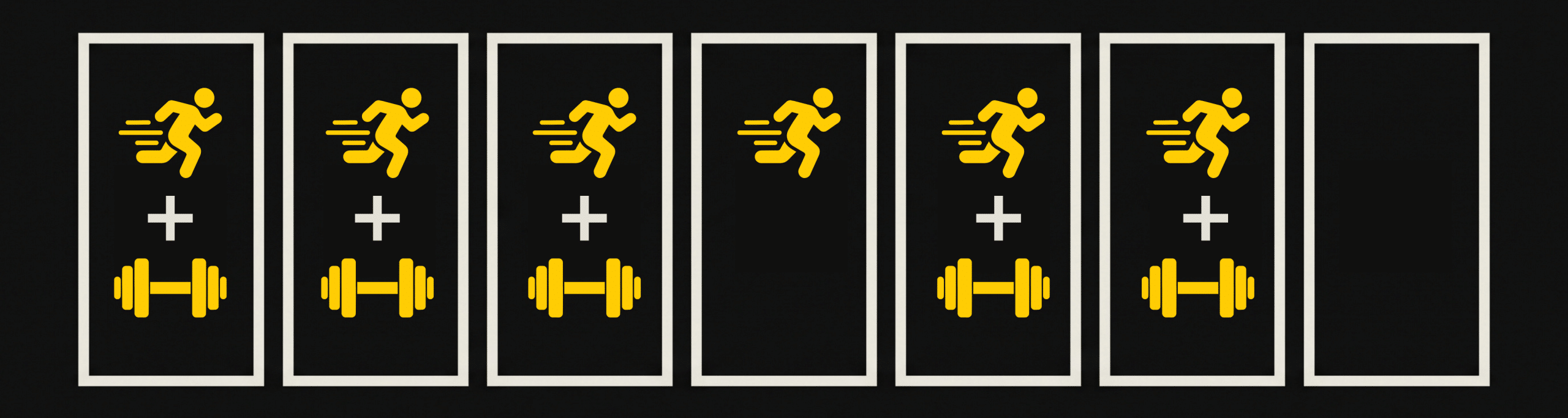
Around week seven, the group doing both modalities saw their leg strength plateau and then drop, while the lifting-only group kept improving. That result got generalized into a rule: concurrent training interferes with strength and muscle.
Here’s the problem with that leap. Hickson didn’t test what happens when a normal person adds cardio to their training — he tested what happens when you drive someone into a recovery deficit. In several cases, the strength and endurance sessions were done in the same session, separated by roughly two hours. We now know high-intensity endurance work performed shortly before lifting can reduce force production for at least six hours afterward, and cut into higher-volume lifting capacity for up to eight. Two hours isn’t close to enough separation for that to clear.
What Hickson actually measured was systemic overreaching. Not a biological ceiling on doing both.
What Actually Determines Whether You Keep or Build Muscle
Muscle mass is governed by the balance between muscle protein synthesis (MPS) and muscle protein breakdown (MPB). Resistance training activates mTOR signaling, mechanical tension, and satellite cell activation regardless of whether you also run or cycle. Concurrent training doesn’t switch that off.
As long as weekly training volume is sufficient, progressive overload exists, protein intake is adequate, and calories aren’t aggressively restricted — muscle can be maintained or built, even with aerobic work layered on top. That’s the actual science of concurrent training, and it’s a lot less dramatic than “cardio kills gains.”
So if the biology allows for both, where does the fear of interference actually come from?
AMPK vs. mTOR: The Molecular Switchboard Explained
This is the part almost nobody explains correctly, and it’s the core of the molecular interference effect.
mTORC1 (mechanistic target of rapamycin complex 1) is the primary driver of muscle protein synthesis. It gets activated by mechanical tension, high amino acid availability (specifically leucine), and insulin.
AMPK (AMP-activated protein kinase) is your muscle’s energy sensor. It activates when cellular energy is low — glycogen depletion, a rising AMP-to-ATP ratio — which is exactly what happens during endurance exercise. AMPK isn’t a villain here; it drives mitochondrial biogenesis via PGC-1α, improves fat oxidation, and enhances glucose uptake. It’s the adaptation that makes you more efficient.
The interference happens mechanistically: active AMPK can phosphorylate TSC2 and Raptor, which dials down mTORC1 signaling (Baar, 2014; Hawley, 2009). Early research treated this like a light switch — flip AMPK on with a run, and mTOR flips off, blocking growth. That’s the version that turned into a decade of “don’t run before leg day” advice.
Modern research on actual human muscle biopsies tells a different story. AMPK spikes during a run and drops back to baseline within a few hours. Once you eat protein and carbohydrates afterward, mTOR signaling resumes normally. It’s not a switch — it’s two separate signals that rise and fall on their own timelines and reset with food and recovery.
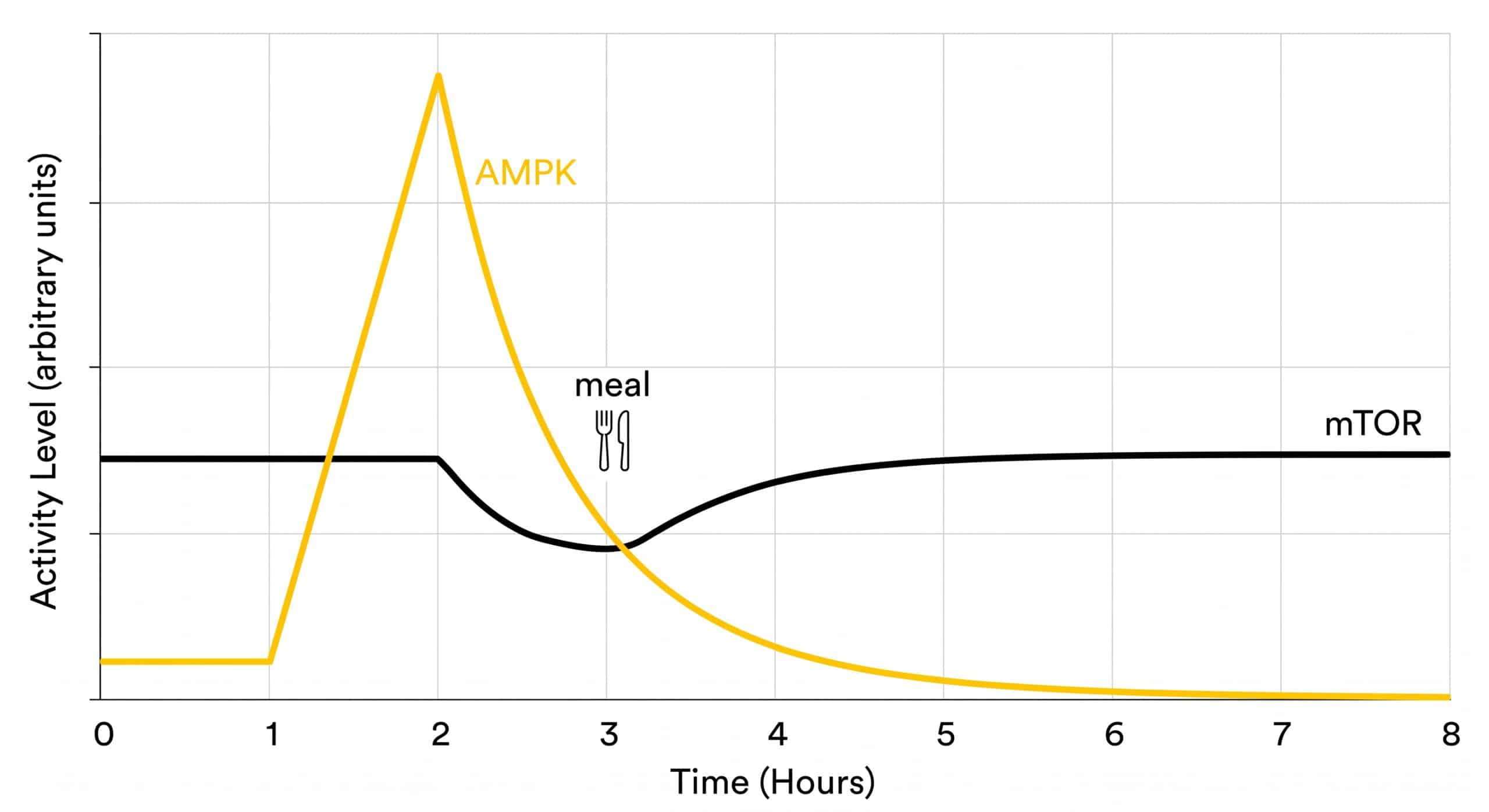
That distinction matters more than almost anything else in this article: it’s a timing and dosage issue, not an incompatibility.
Acute vs. Chronic Interference: Fatigue, Signaling, and CNS Fatigue
There are two separate mechanisms worth untangling here, because they get lumped together constantly.
Acute interference is about residual fatigue and substrate depletion. A hard run leaves neuromuscular fatigue that impairs force production in a lifting session that follows too closely — you simply can’t recruit high-threshold motor units as effectively when you’re still fatigued from cardio (Coffey & Hawley, 2017).
Chronic interference is the genetic-signaling version — the idea that repeatedly competing molecular cascades over weeks and months blunt cross-sectional area growth. This is the piece that’s most often overstated. At moderate, well-programmed volumes, the chronic signaling conflict is minor. At Hickson-level volumes with zero recovery, it’s not.
There’s also a nervous system layer that rarely gets discussed: central nervous system (CNS) fatigue. Endurance training shifts serotonin-to-dopamine ratios in ways that reduce voluntary activation of fast-twitch (Type IIa/IIx) fibers during subsequent heavy lifting (Thomas et al., 2015). This is separate from muscular fatigue — it’s your brain reducing its own drive to recruit muscle. It’s also why explosive power and rate of force development are the most interference-sensitive qualities you have, more so than raw hypertrophy or strength. If you’re a hybrid athlete who’s noticed your vertical jump or sprint speed drop off during a running block, this is why.
What the Modern Meta-Analyses Actually Show
Forget the single 1980 study. What happens when researchers pool decades of real data?
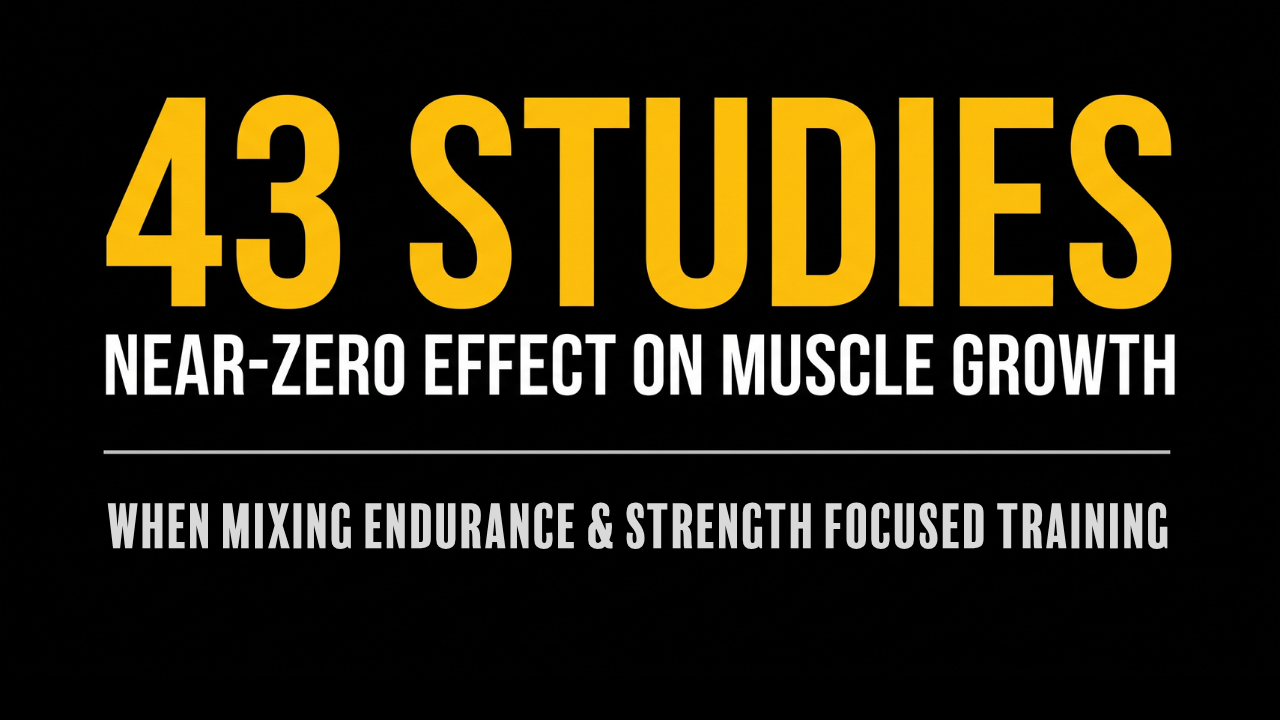
In 2022, Schumann and colleagues ran a meta-analysis across 43 studies comparing lifting-only groups to lifting-plus-cardio groups. The result: no statistically significant difference in whole-muscle hypertrophy, and no meaningful difference in maximal strength. The one quality that consistently did suffer was explosive power, specifically when cardio and lifting were stacked back-to-back with no separation — which lines up exactly with the CNS mechanism above.
A second 2022 meta-analysis from Lundberg and colleagues dug down to the individual muscle fiber level instead of just whole-muscle size. Whole-muscle size stayed protected, but there was a slight blunting effect specifically in Type I (slow-twitch) fibers, and it showed up more with running than cycling. That’s because running carries real eccentric impact — the pounding of foot strike — which creates a small amount of muscle damage that eats into local recovery capacity. Cycling is essentially concentric-only, so it’s far easier to recover from alongside heavy leg training (Wilson et al., 2012; Fyfe et al., 2014).
So is cardio completely free? No. But the effect is small, it’s fiber-specific, and it’s nowhere close to the “cardio blocks all your gains” narrative that’s been repeating since 1980.
I’ll push back on the version of this that gets clipped into a 30-second “cardio doesn’t hurt your gains at all” reel, though — because in my own coaching experience, running real volumes of concurrent cardio and lifting does slow down the rate at which you build muscle. It doesn’t stop it. But it’s slower, and pretending otherwise isn’t honest coaching. I’ve pulled cardio down to a maintenance level for hybrid athletes during a hypertrophy-focused block, watched them build muscle noticeably faster, then reintroduced cardio once they had the base they wanted. The meta-analyses are measuring whether cardio blocks growth — and largely, it doesn’t. “Doesn’t block growth” and “doesn’t slow growth down at all” are two different claims, and real-world hybrid training usually lives somewhere between them.
Cardio Doesn’t Just Fail to Block Muscle Growth — It Can Help Build It
This is the part most people get backwards entirely.
Mitochondrial density and hypertrophy support. Resistance training itself is a potent stimulus for mitochondrial biogenesis — 12 sessions of resistance training alone trigger measurable demethylation of mitochondrial DNA at regions controlling biogenesis, upregulating PGC-1α and TFAM (Seburn, Sharples, & Roberts, 2021). Add endurance work on top, and you compound that adaptation. More and healthier mitochondria mean faster ATP regeneration between sets, less reliance on anaerobic glycolysis, and slower onset of local fatigue — which directly improves the quality training volume you can accumulate in the gym. Since training volume is a primary driver of hypertrophy, better mitochondrial function is a lever for muscle growth, not a competitor to it.
Capillarization. Aerobic training increases capillary density around muscle fibers, improving nutrient delivery and metabolite clearance. In practice, that means your muscles recover between sets and between sessions more effectively — which is part of why advanced lifters with an aerobic base often tolerate higher weekly training volume without stalling.
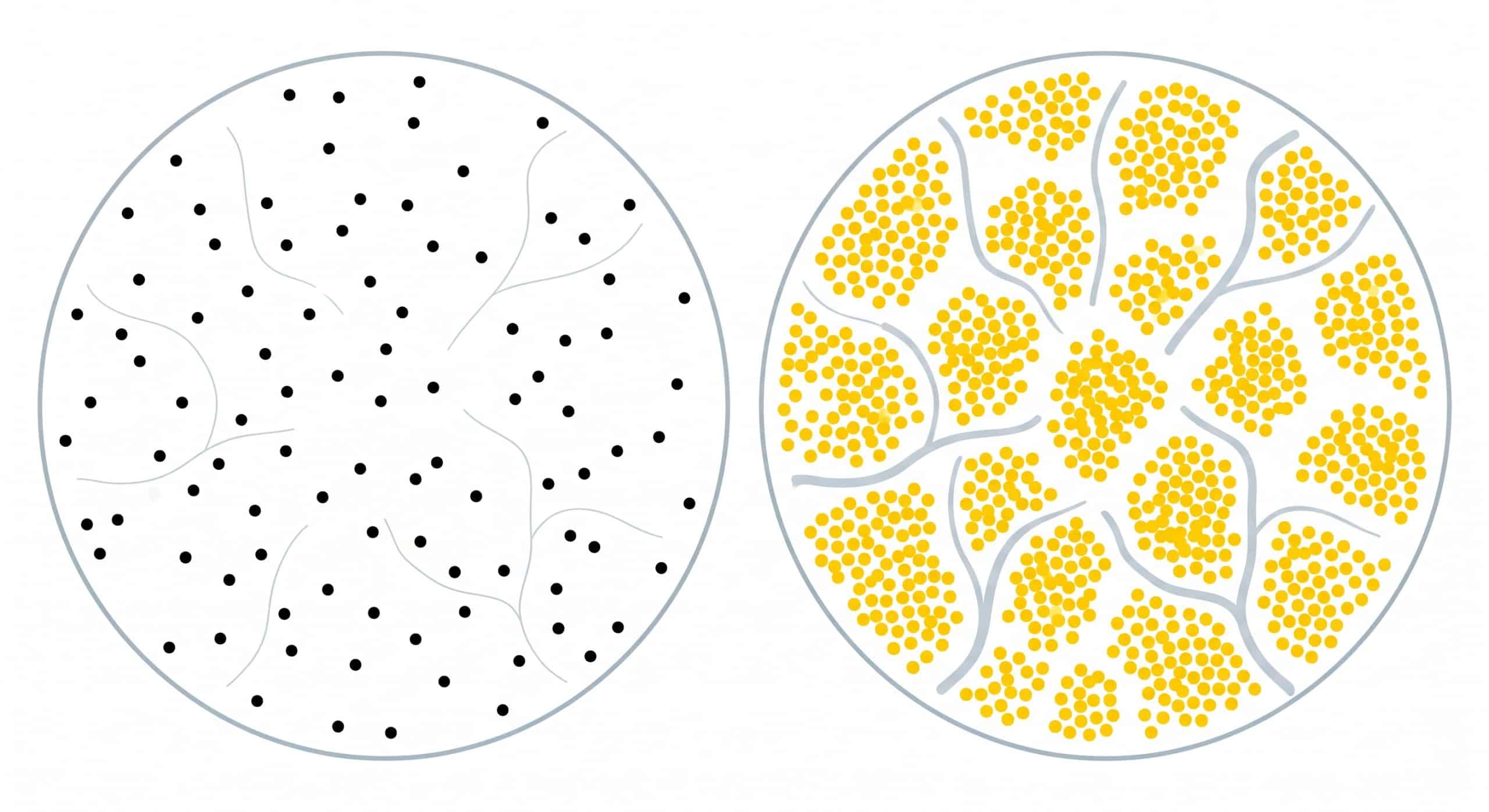
There’s a study worth knowing about here: researchers had the same subjects train one leg with lifting only, and the other leg with lifting plus cycling — same person, same genetics, same everything else. The leg that also did the cycling grew more muscle. That’s not a fluke; it’s the mitochondrial and vascular support mechanism showing up directly in the data.
So Why Do Some Hybrid Athletes Genuinely Struggle to Build Muscle?
If the biology supports both, why does it still feel harder for some people? It almost always comes down to two variables, and neither one is “cardio blocking your gains.”
- Energy availability. Running and cycling burn real calories — often hundreds per hour. If you don’t scale food intake up to match that output, you end up in a caloric deficit without ever deciding to diet. And a deficit makes new muscle tissue harder to build, because your body prioritizes covering its energy debt over building tissue it doesn’t strictly need to survive. This is low energy availability (LEA), and it’s the actual suppressor of muscle protein synthesis in most “failed” hybrid programs — not the run itself. Our TDEE calculator is the fastest way to see where your intake actually needs to sit once cardio volume goes up, and our hybrid athlete nutrition guide walks through how to fuel both sides of training without guessing.
- Poor training volume distribution. Some hybrid athletes spend 75% of their weekly training running and cycling, leaving only 25% of their activity creating mechanical tension in the gym — the only stimulus that actually builds muscle. That’s not a physiological inability to grow. It’s simply not enough dose in the gym to cause growth in the first place. This is also why a lot of people who “used to lift” and now run can maintain the muscle they already built — maintenance requires only a fraction of the volume required to build it in the first place — without adding an ounce more.
How to Program Around the Interference Effect
Here’s where the science becomes application. Our full hybrid athlete training guide breaks down complete split structures — this section covers the specific variables that determine whether interference shows up at all.
Strategy 1 — Manage the molecular buffer window. Separate lifting and cardio sessions by 6–8 hours minimum, or put them on different days entirely. This gives transient AMPK activation time to decay back toward baseline before the opposing pathway needs to fire. If you’re forced to stack them in one day, lift first when hypertrophy or strength is the priority — that way you’re recruiting high-threshold motor units while fresh, and doing cardio on top of accumulated fatigue rather than the reverse.
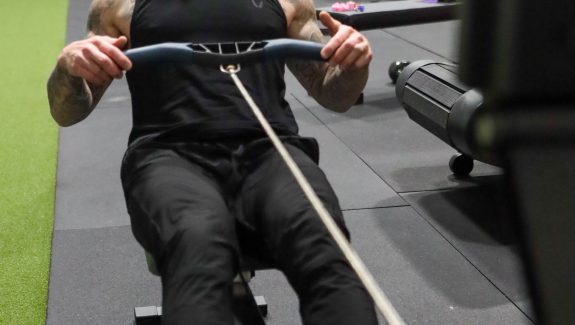
Strategy 2 — Choose your cardio modality deliberately. Cycling and rowing are largely concentric, which avoids the eccentric muscle damage that running’s foot-strike impact creates. If muscle retention is the priority and running isn’t non-negotiable for your goals, biasing toward cycling or rowing measurably reduces the interference you’ll feel in the legs.
Strategy 3 — Structure intensity, don’t just pick a mode. Use sprint interval training (SIT) — think 30-second all-out efforts — rather than long, slow distance work for your harder conditioning sessions. SIT recruits high-threshold Type II motor units, which aligns with what lifting demands, rather than reinforcing a purely aerobic profile that competes with it. Cap high-intensity cardio at roughly 2 sessions per week, and keep the rest of your aerobic volume in Zone 2 — polarized, not muddled in the middle.
Strategy 4 — Prime the signal with nutrition. Fast-acting carbohydrates and 3–5g of leucine peri-workout elevate insulin and activate Akt signaling, which helps override AMPK-mediated mTOR suppression. This is timing on top of total intake — both matter.
Strategy 5 — Periodize instead of maximizing everything at once. Elite hybrid athletes use block periodization rather than chasing a marathon PR and a strength PR in the same eight weeks. During a hypertrophy-focused block, keep running at a maintenance Zone 2 base while pushing lifting volume to 12–20 sets per muscle group weekly. During race prep, let running volume climb and drop lifting to a maintenance dose of roughly 6 sets per muscle group. You don’t need both dials at maximum simultaneously — you need them sequenced.
Molecular Interference Mitigation Matrix
| Variable | Recommendation |
| Session separation | 6–8 hours minimum between endurance and lifting |
| Modality selection | Cycling/rowing over running when muscle retention is the priority |
| Cardio intensity distribution | ~80% Zone 2, high-intensity capped at 2x/week |
| Order (same-day sessions) | Lift first if strength/hypertrophy is the priority |
| Peri-workout nutrition | 3–5g leucine + fast carbs around training |
| Weekly energy balance | Maintenance or slight surplus if muscle is the priority |
The Bottom Line
Pull all of this together and here’s what’s actually true: the interference effect exercise researchers first identified is real in a narrow, mechanistic sense — but it’s dose-dependent, largely reversible with recovery and nutrition, and nowhere close to the “cardio kills your gains” absolute that’s been repeated since 1980. Whole-muscle hypertrophy holds up fine under sensible concurrent programming. What actually derails hybrid athletes is under-fueling and mis-distributed training volume, not a biological switch flipping off.
Can you build muscle while training for endurance? Yes — but it requires the specific programming above, and it requires paying attention to your diet, not hoping it works out. That’s not a hedge. That’s the actual answer, and it’s why generic templates fail hybrid athletes more often than the training itself does.
Blunt call to action, but: if you want this dialed in specifically for your training age, your event calendar, and your recovery capacity, that’s literally what our online coaching is built to do. One clean mention, moving on.
For the mistakes that actually derail most hybrid programs in practice — not the molecular ones, the programming ones — this breakdown is worth reading next. And if you want the studies behind this piece pulled apart further alongside other current sports science, our research round-up covers it in more depth.
(Video: this article pairs with the YouTube breakdown “Does Cardio Really Kill Your Gains?” — embed above the “Where the Myth Came From” section once live.)
Interference Effect FAQ |
| Does cardio kill muscle gains? No. Modern meta-analyses covering more than 40 combined studies show no statistically significant difference in whole-muscle hypertrophy between lifting-only and lifting-plus-cardio groups. The “cardio kills gains” idea traces back to a single 1980 study that tested extreme overtraining, not normal concurrent training. |
| Can I build muscle while training for a marathon or triathlon? Yes, but it requires specific programming: separating hard sessions by 6–8 hours, keeping most cardio in Zone 2, and eating at maintenance or a slight surplus. Without adjusting your food intake to match the added calorie burn, low energy availability — not the cardio itself — is what will actually suppress muscle growth. |
| How long should I wait between cardio and lifting? Aim for a 6–8 hour buffer, or put them on separate days when possible. If you have to do both in one session, lift first if strength or muscle growth is your priority, since residual fatigue from a hard cardio session can reduce force production and motor unit recruitment for several hours afterward. |
| Does running interfere with muscle growth more than cycling? Slightly, yes, specifically in slow-twitch fibers. Running’s eccentric impact from foot strike creates more local muscle damage than cycling’s concentric-dominant motion, which shows up as a small fiber-specific effect in the research — not a difference in overall muscle size. |
| What actually causes muscle loss in hybrid athletes if it’s not cardio itself? The two real culprits are low energy availability (not eating enough to cover the extra calories cardio burns) and insufficient training volume in the gym relative to time spent on cardio. Both are programming and nutrition issues, not signs that concurrent training is biologically incompatible. |