
Strength Training for Runners: 5 Exercises That Fix What Running Can’t
Strength training for runners means adding the specific work running itself never builds: single-leg RDLs, glute ham raises, slow-eccentric hamstring work, hip abductions, and split squats. These five movements correct the imbalances behind most running injuries — hamstring strains, runner’s knee, IT band syndrome — not generic “leg day.”
Most runners manage pain by running less, icing more, or buying new shoes — rarely by lifting. But running only trains your muscles in one direction, at one speed, in one movement pattern, for thousands of reps in a row, which is exactly why so many runners get hurt doing the thing they’re best at.
Why Strength Training for Runners Matters (And Where Running Falls Short)
Running is repetitive, low-force, and almost entirely forward-leaning. Even without any added load, the repetitive downward force of your own bodyweight puts real compression through your joints, mile after mile.
That’s fine on its own. The problem is that running doesn’t build the eccentric strength, single-leg stability, or hip control your body needs to survive that volume long-term.
Runners generally run into two types of injuries. The first is overuse injuries — shin splints, Achilles tendinopathy, plantar fasciitis — which usually come down to poor programming and ramping up mileage too fast. The second is injuries from strength imbalances — hamstring strains, calf strains, low back pain, IT band syndrome, runner’s knee — and these are injuries that running itself can never correct, no matter how smart your mileage progression is.
This article is about the second category. By the end, you’ll have five specific strength exercises, the reasoning behind each one, and the research backing it — not generic “runners should lift” advice.
The goal isn’t to turn every runner into a bodybuilder. It’s to fill in the exact gaps that running can’t, so you can keep doing the thing you love without the aches, pains, and setbacks that tend to come along for the ride.
I’ve coached runners back from torn Achilles tendons who wanted to get back into marathon training, competitive water-ski jumpers rebuilding after ACL tears, and a long list of hybrid athletes chasing Hyrox races and Ironmans who just wanted to keep training hard without getting sidelined. The exercises below are the ones I’ve used to get all of them there.
Exercise #1: Glute Ham Raise — Training the Eccentric Hamstring
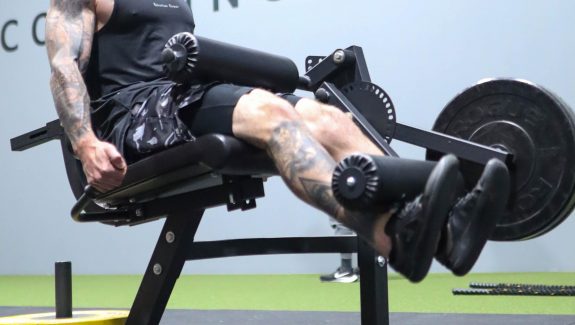
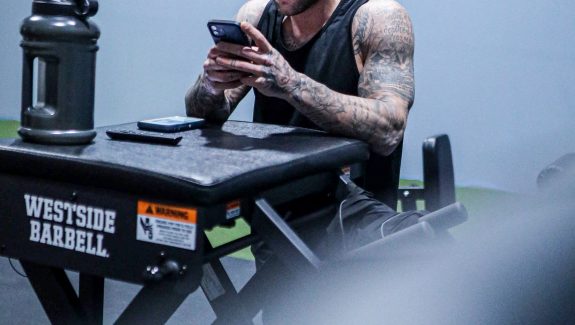
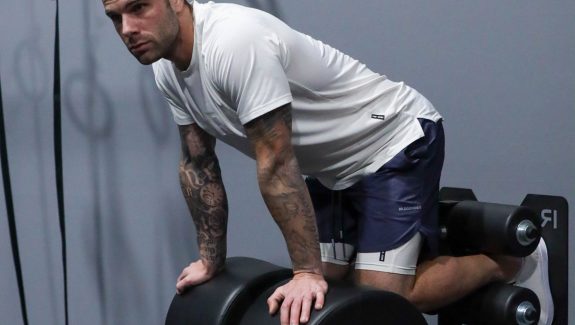
The glute ham raise trains your hamstrings and glutes together, through a full range of motion, with heavy emphasis on the eccentric — the lowering phase — which is where most running-related hamstring injuries actually happen.
EMG research comparing the glute ham raise against good mornings, RDLs, and leg curls found that the glute ham raise produced some of the highest hamstring activation of any exercise tested, while also demanding strong glute engagement to control the descent (McAllister et al., 2014, Journal of Strength and Conditioning Research). In plain English: it’s one of the few exercises that trains your hamstrings and glutes to work together under control, instead of in isolation.
That matters for running because every stride has an eccentric component — your hamstring is lengthening under load with every single step, thousands of times per run. Strong hamstrings alone don’t protect you if your glutes aren’t doing their share of the work alongside them. An exercise that trains both together, under control, gives you a kind of durability that an isolated leg curl machine simply can’t.
Exercise #2: Single-Leg Romanian Deadlift — The Closest Gym Movement to Your Stride
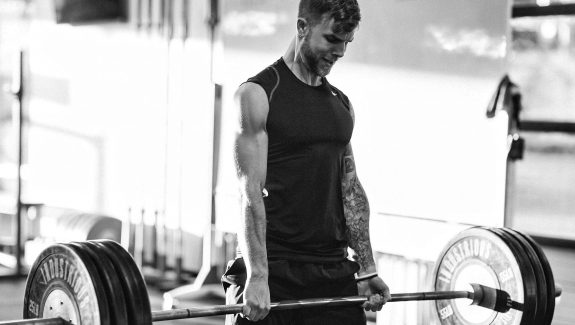
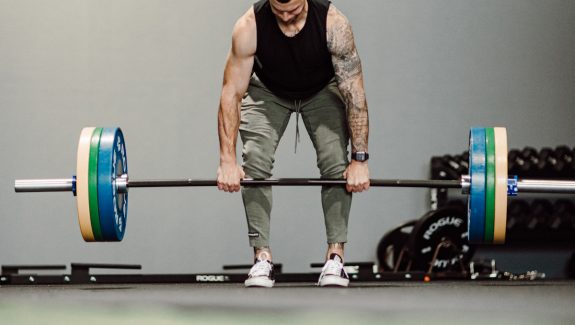
If someone asked me for the single best strength exercise for runners, my answer would be the single-leg RDL. It’s hard to give one answer to a question like that, because like most things in training, it depends. But it would still top my list, because the single-leg RDL is the only lift that trains your hamstrings and glutes on one leg, under load, in a position that closely mirrors your actual running stride.
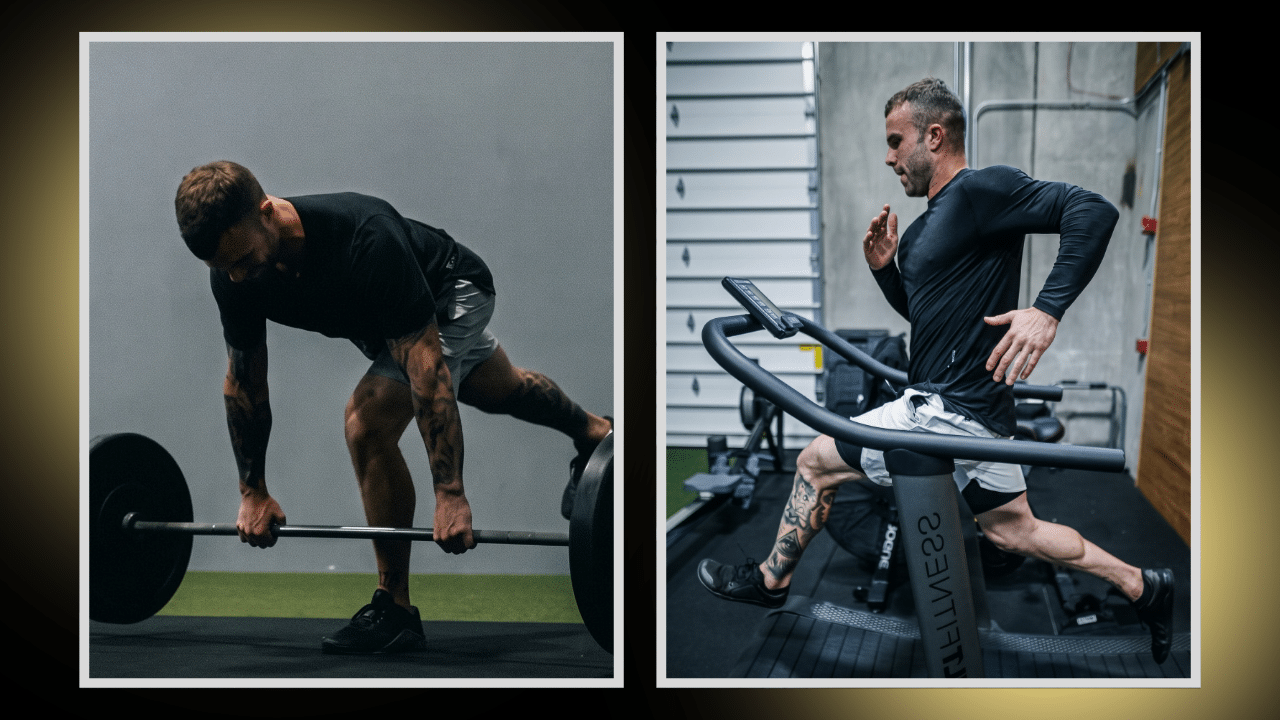
Every step you take is single-leg. On every stride, your standing leg has to resist your hips rotating or dropping sideways, while your hamstring and glute drive you forward. A double-leg deadlift never asks your body to do that. Closed-chain, unilateral, and weight-bearing is the closest a gym movement gets to your actual stride.
Most generic “leg day” programs stop at bilateral squats and deadlifts and call it done. That’s an incomplete approach for runners — it builds general strength, but not in a way your body can express while running, since running never happens on two legs at once.
If you’re new to this movement, progress through it rather than jumping straight to a loaded version: start with a kettlebell staggered RDL, move to a landmine single-leg RDL, then a dumbbell single-leg RDL, and finally a barbell single-leg RDL once your balance and hip control hold up.
Exercise #3: Slow-Eccentric Hamstring Curls & RDLs — Cutting Injury Risk Where It Actually Happens
Here’s the plain answer up front: slowing down the eccentric phase of your hamstring curls and RDLs is one of the better-researched injury-prevention tools in sports science.
A systematic review and meta-analysis of nearly 8,500 athletes found that eccentric hamstring training — like the Nordic hamstring curl — reduced hamstring strain rates by roughly half across multiple sports (van Dyk et al., 2019, British Journal of Sports Medicine). One training adjustment, cutting hamstring injuries by about 50%.
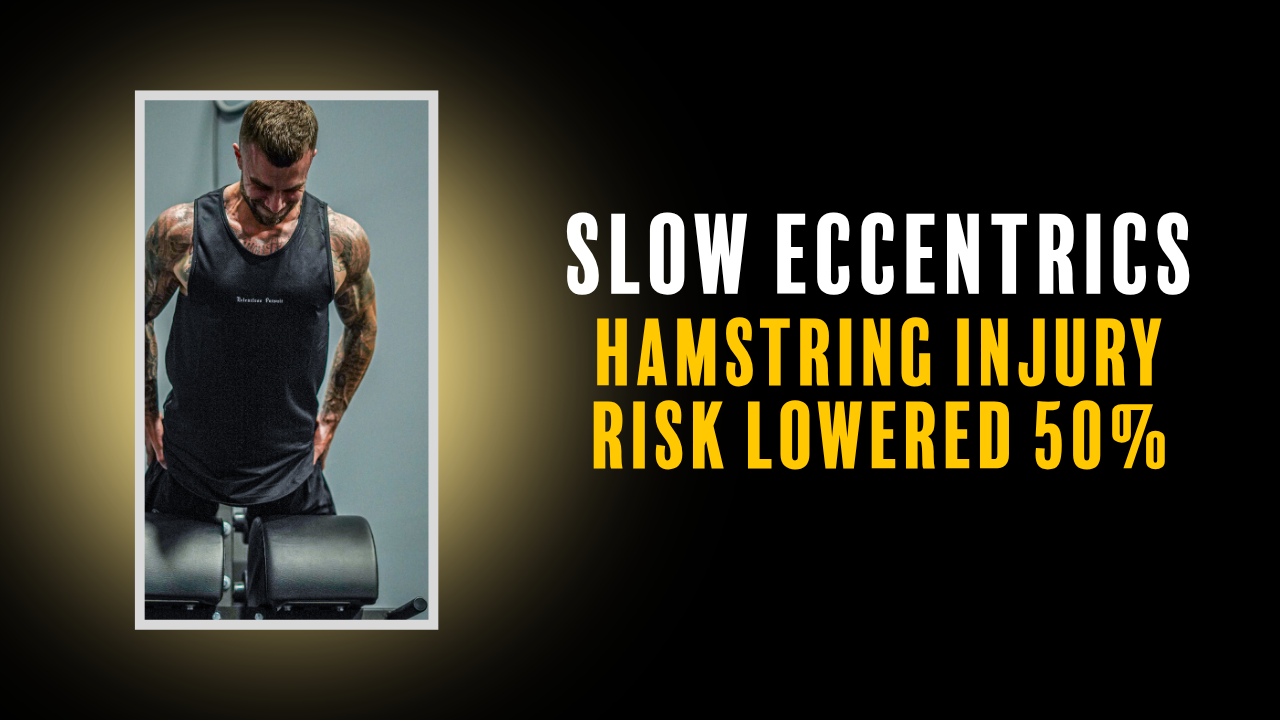
The reasoning holds up: slow eccentric work lengthens your hamstring’s muscle fascicles and builds strength specifically in the range where strains happen most — near full extension, at speed. Most runners only train their hamstrings concentrically, squeezing hard at the top of every rep because that’s where they feel it most. That’s not wrong, exactly — it’s incomplete. The mistake is never controlling the lengthening portion of the rep.
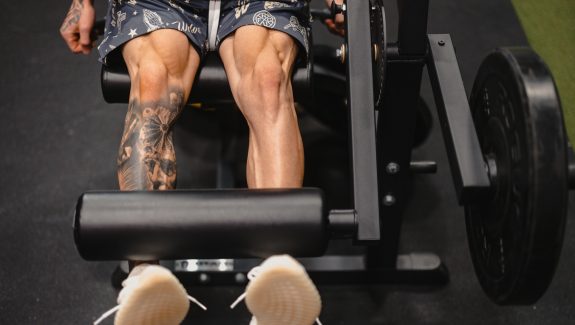
If you only take one thing from this article, make it this: add a 3–5 second eccentric count to at least some of the hamstring curls and RDLs you’re already doing. My three favorites for this are a barbell glute bridge into a slider eccentric leg curl, a single-leg RDL using a bench or rower to guide your hip hinge pattern, and a simple dumbbell single-leg RDL with a toe tap, which lets you slow the eccentric down even further by giving your working leg a soft touch point.
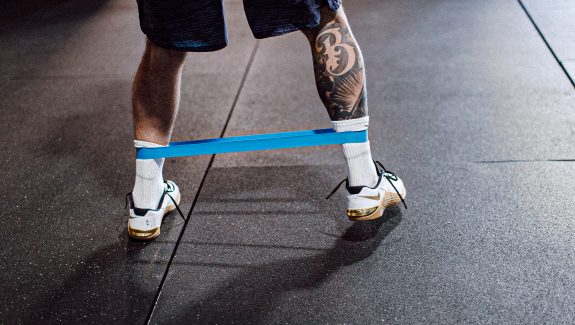
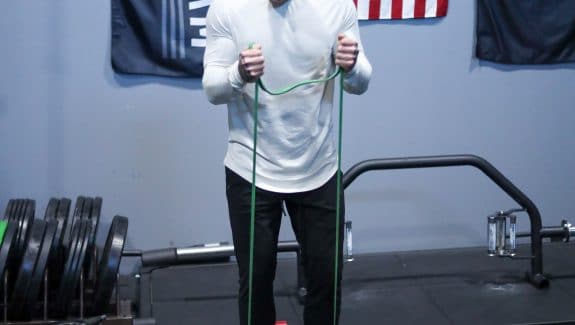
Exercise #4: Hip Abductions — Why Your Knees Hurt When You Run
Hip abductions are usually programmed as a glute-building exercise, and they’re genuinely good for that. But this movement is also tied to one of the most common running-injury questions on the internet: why do my knees hurt when I run?
The usual answer is weak hip abductors, specifically the glute medius. When that muscle is underpowered, your knees are more prone to knee valgus — your knees caving inward on every stride or squat rep — which is closely linked to both runner’s knee and IT band syndrome.
Research on runners with IT band syndrome found their hip abductor strength was measurably weaker on the injured side compared to both their own uninjured leg and healthy control runners, and after six weeks of targeted glute medius strengthening, 22 of 24 injured runners were pain-free (Fredericson et al., 2000, Clinical Journal of Sport Medicine).
Worth being honest about here: that study shows a strong association, not proof that weak hips are the sole cause for every runner’s knee pain, and not every follow-up study has replicated the link as cleanly. Correlation research like this can’t fully untangle cause from effect. What it does tell you is that hip abductor strength and frontal-plane knee control move together often enough, in injured runners specifically, that training it is a reasonable bet — not a guaranteed fix, but a well-supported one.
So if you’ve had nagging outer-knee or hip pain that’s never fully explained itself, hip abduction work is one of the more evidence-backed places to start.
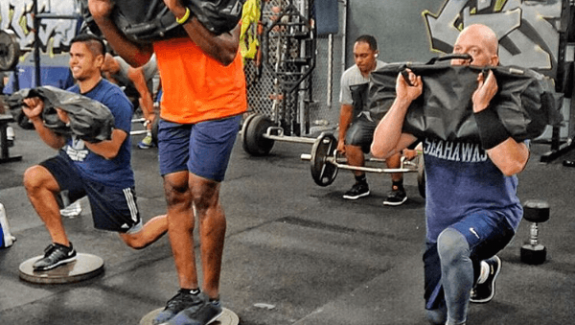
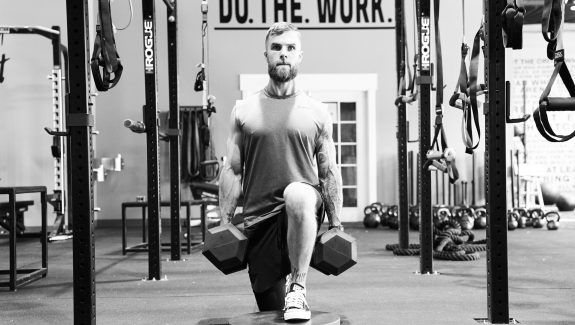
Exercise #5: Split Squats & Lunges — Building Raw Single-Leg Strength and Power
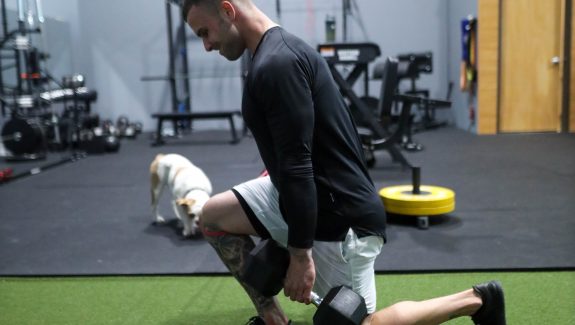
Split squats and lunges are how you build raw single-leg strength and power — the foundation everything else in this article sits on top of.
Research comparing unilateral training, like split squats and rear-foot-elevated split squats, to traditional bilateral squats consistently shows unilateral work drives comparable — sometimes greater — improvements in sprint speed, change of direction, and single-leg power (Speirs et al., 2016, Journal of Strength and Conditioning Research; Zhang et al., 2023, Frontiers in Physiology).
Most lifters default to barbell back squats because that’s the familiar, stereotypical “leg strength” exercise. But if your training only ever loads two legs at once, you’re building strength your body doesn’t get to express while you run, because running never happens on two legs at the same time. Split squats and lunges train single-leg eccentric absorption, strength expression, and power development in one movement — which is exactly what your stride asks of you, rep after rep.
Putting It All Together
Running only trains your muscles in one direction, at one speed, in one movement pattern — and it repeats that pattern for thousands of reps. You’d never do bicep curls or RDLs for that kind of volume and expect zero elbow or low back pain. Yet plenty of runners do the running equivalent and are surprised when they end up injured down the road.
The glute ham raise, single-leg RDL, slow-eccentric hamstring work, hip abductions, and split squats fill in the specific gaps that running never will, because they correct the weak links and lower the risk of the aches and injuries that distance running can cause over time.
You don’t need to overhaul your training or stop running. You need to add these five movements into the program you’re already running. When you do, your running performance has room to improve and your body has a better shot at feeling good while you put in the miles.
If you want this built into an actual weekly plan instead of five exercises floating on their own, that’s exactly what our Hybrid Athlete Training Guide breaks down. Pairing it with how you’re fueling that training matters just as much — our hybrid athlete nutrition guide covers that side of it. And if you want to make sure you’re not sabotaging this work elsewhere in your training, our breakdown of common hybrid training mistakes is worth a read.
Blunt call to action, but if you want this dialed in specifically for you — your mileage, your imbalances, your event — that’s literally what our coaches do.
Strength Training For Runners: FAQ |
|
What is the best strength training for runners? |
There’s no single “best” exercise, but the single-leg RDL comes closest to a universal answer, because it trains your hamstrings and glutes on one leg, under load, in a position that mirrors your actual running stride. Pairing it with glute ham raises, slow-eccentric hamstring curls, hip abductions, and split squats covers the rest of the imbalances running alone can’t fix. |
How often should runners strength train? |
Most runners do well with two focused strength sessions per week, built around the exercises in this article rather than a full bodybuilding split. The goal is consistency without adding so much volume that it interferes with your running recovery, so frequency should flex around your mileage and race calendar. |
Will strength training make me a slower, bulkier runner? |
Not from this type of training. These five exercises are chosen for single-leg strength, eccentric control, and hip stability — not hypertrophy-focused bodybuilding work — and research on unilateral training shows it improves sprint speed and single-leg power rather than adding the kind of bulk that would slow you down. |
Can strength training fix runner’s knee or IT band syndrome? |
Strength training, particularly hip abduction work, is one of the more evidence-backed tools for runners dealing with these issues, with research showing meaningful pain reduction after a focused strengthening block. It’s not a guaranteed fix for every case, and the cause of knee and IT band pain can vary, so persistent pain is worth getting assessed rather than only trained through. |
Do I need to stop running to add these exercises? |
No. These five movements are meant to sit alongside the running you’re already doing, not replace it. The goal is correcting the specific gaps running leaves behind, not overhauling your training or turning you into a different kind of athlete. |