
Hybrid athlete nutrition comes down to eating enough to support two competing demands at once:
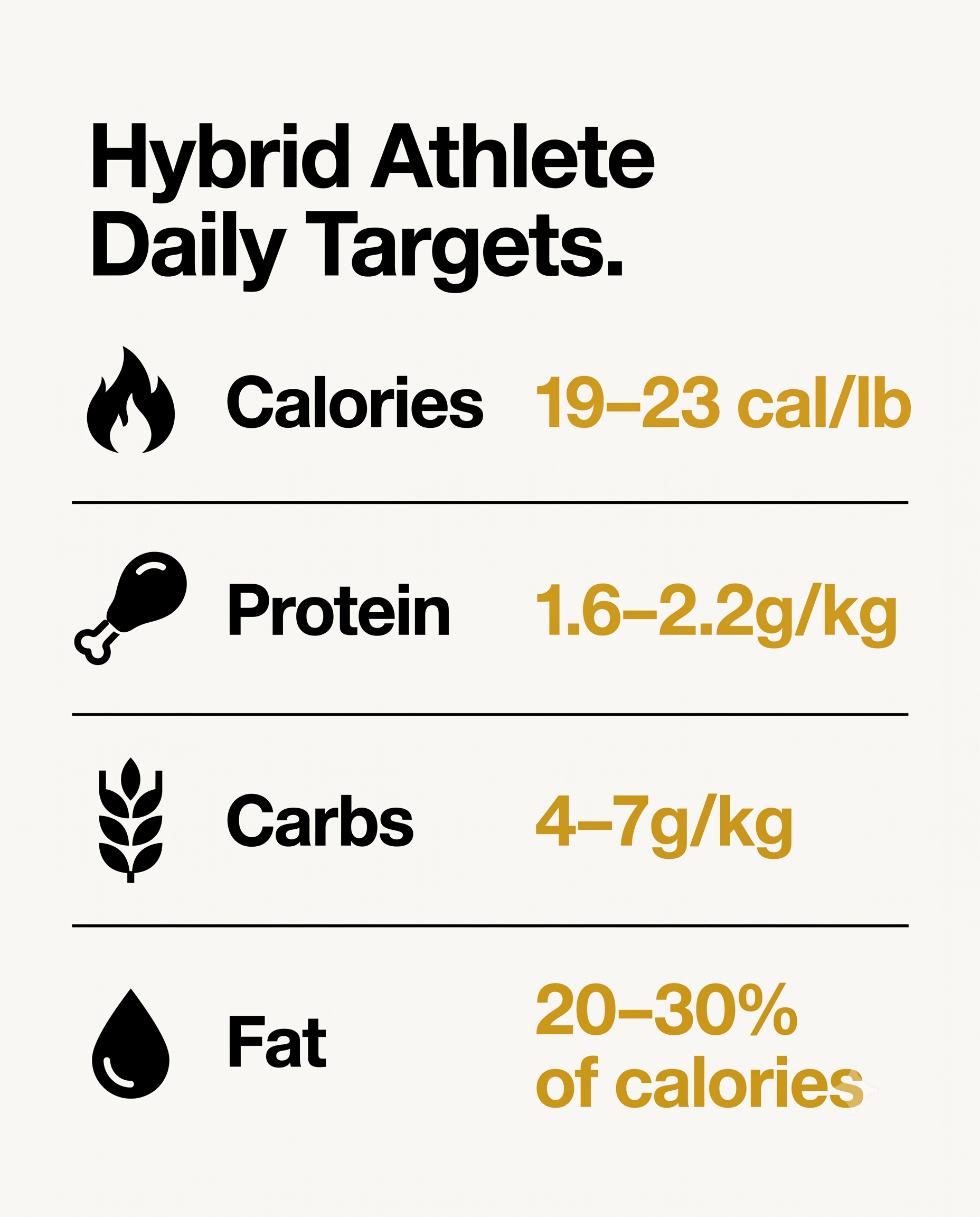
The glycogen turnover of endurance work and the protein synthesis strength training requires. Most hybrid athletes need roughly 19–23 calories per pound of bodyweight, 1.6–2.2g of protein per kg, 4–7g of carbs per kg, and 20–30% of calories from fat — with all of it shifting based on that day’s session load.

Key takeaways:
→ Under-fueling — not bad programming — is the single most common reason hybrid athletes stall, lose muscle, or get hurt
→ Carb and calorie needs for hybrid training aren’t fixed numbers; they should flex day to day based on session volume and how close your next hard effort is
→ Low energy availability is the hidden mechanism behind most hybrid athlete plateaus, and it shows up as fatigue and injury long before it shows up on a scale
If you try to fuel hybrid training like a bodybuilder — steep deficits, low carbs, rigid meal timing — your running falls apart. Fuel it like a distance runner — high carb, light on protein — and you stop building or holding onto muscle. Most of the nutrition content aimed at hybrid athletes just averages the two approaches and calls it a day. That’s not fueling. That’s guessing, and it shows up in your numbers within a few weeks.
I’ve coached lifters, runners, and hybrid athletes for 16+ years, and the hybrid population is the one that gets under-fed most consistently. Not because they’re not trying — because they’re trying to stay lean while asking their body to recover from two separate sports at once. That math doesn’t work, and it’s the first thing I fix with almost every hybrid client who comes to me plateaued or injured.
If you’re new to combining these training styles altogether, start with our hybrid athlete training guide — that piece breaks down how to structure your lifting and running split. This one focuses entirely on how to fuel that workload without breaking down.
Why Hybrid Athletes Can’t Just “Split the Difference” on Nutrition
Strength training and endurance training send different signals to your body, and when you under-fuel, those signals start working against each other.
Here’s the mechanism: heavy lifting stimulates the mTOR pathway, which drives muscle protein synthesis — the process that builds and repairs muscle. Extended aerobic work stimulates the AMPK pathway, which drives mitochondrial adaptations and endurance capacity. Under normal fueling, both pathways can run largely independent of each other. But when energy availability drops too low, AMPK activation actively suppresses mTOR. In plain terms: under-eating while running high mileage doesn’t just fail to build muscle — it actively works against the muscle you already have.
This is why “eat less, train more” doesn’t work for hybrid athletes the way it might for someone doing one discipline. Chronically low energy availability also drives up cortisol, suppresses thyroid output, lowers testosterone, and raises your risk of stress fractures and other overuse injuries. None of that is dramatic or immediate — it’s slow, and most people don’t connect the dots until they’ve been stuck for months or gotten hurt.
The fix isn’t complicated in concept, even if it takes real discipline to execute: eat enough, in the right ratios, timed around your hardest sessions. That’s the rest of this guide.
How Many Calories Do Hybrid Athletes Need?
Calorie needs for hybrid training run higher than most people expect, and higher than what a fitness tracker or a generic calculator will tell you.
Start with a baseline: roughly 14–16 calories per pound of bodyweight covers non-training maintenance for most people. From there, add back the actual cost of your sessions instead of trusting an app’s estimate:
→ Heavy resistance training: roughly 300–500 calories per hour → Zone 2 running: roughly 80–110 calories per mile → Intervals or tempo work: roughly 12–18 calories per minute
On a double-session day — say, a morning tempo run and an evening lower-body lift — your total energy need can run 600–1,200 calories higher than it would on a single-session or rest day. That’s not a rounding error, and it’s the gap that catches most hybrid athletes off guard. Try to hold a moderate deficit through a week like that, and you’ll feel it in stalled lifts, flat runs, and recovery that never quite catches up.
I tell clients this bluntly: if you’re hybrid training and trying to lose fat at the same time, you need a smaller, slower deficit than you’d run doing either sport alone. Trying to cut hard while adding running volume to an already-demanding lifting program is one of the fastest ways to lose strength, tank your running economy, and end up injured. It’s not that it’s impossible — it’s that most people approach it far too aggressively, treating a hybrid cut like a bodybuilding cut.
How Many Carbs Do You Need for Hybrid Training?
Carbs for hybrid athletes aren’t a fixed number — they’re a range that should move with your training load.
- Target 4–7g per kg on most days. Strength athletes typically do well on 4–7g of carbohydrate per kg of bodyweight per day. Endurance athletes often need 6–10g per kg. Hybrid athletes should generally sit in that overlap, scaling toward the top of the range on days with long runs or double sessions.
- Scale carbs to the day, not the week. A lower-volume lifting day doesn’t need the same carb load as a day with a long run and an evening lifting session. Averaging your carbs flat across the week under-fuels your hardest days and over-fuels your easiest ones.
- Choose the right carb for the moment. Slow-digesting carbs — oats, rice, potatoes, whole grains — belong in your main meals. Fast-acting, low-fiber carbs — fruit, bagels, rice cakes, sports drinks — belong around your training windows, when digestion speed matters more than sustained release.
- Don’t fear carbs on lifting-only days. Glycogen replenishment isn’t just for runners. A hard lifting session depletes muscle glycogen too, and low-carb approaches force your body to convert amino acids — muscle tissue — into glucose through gluconeogenesis just to keep up. That’s a direct trade of muscle for fuel you didn’t need to make.
How Should You Fuel Strength and Endurance Sessions on the Same Day?
Fueling hybrid training on a double-session day is less about total calories and more about timing them correctly.
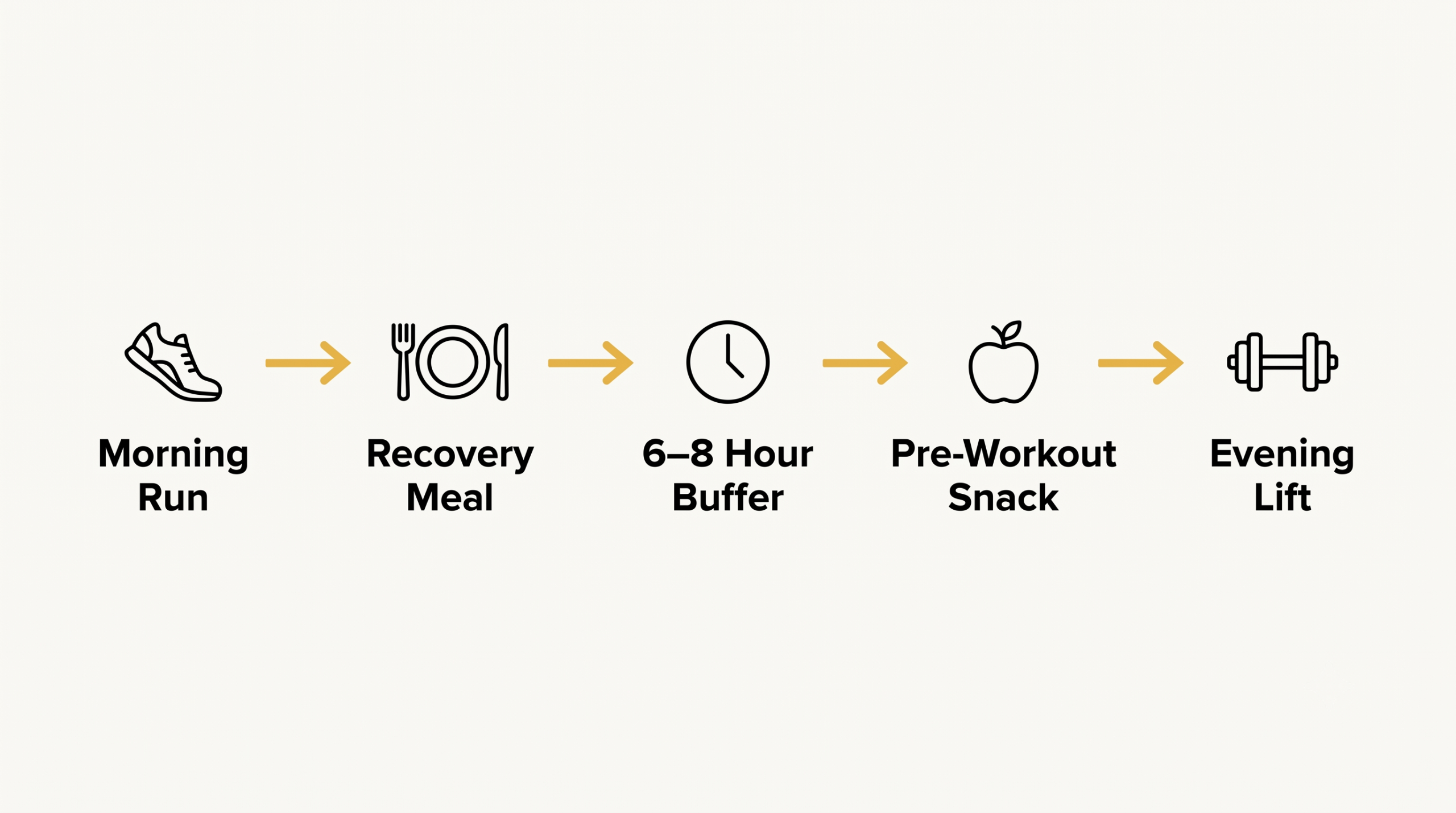
Where possible, put 6–8 hours between your endurance session and your resistance session. That window gives your central nervous system time to recover and lets you partially replenish glycogen before asking your body to perform again. In that gap, prioritize a carb- and protein-rich recovery meal right after session one, then a pre-workout snack with enough lead time — generally 2–3 hours out — before session two.
Session order matters too. Running before lifting tends to cost you more top-end strength than lifting before running costs your endurance, because strength fatigue is more localized while endurance fatigue is more systemic. Neither order is wrong — just understand the trade-off and program your hardest work accordingly.
If your hybrid training is building toward a race — a Hyrox event or a structured endurance test — race-week fueling looks different from day-to-day training fuel. Our Hyrox competition guide covers that separately.
Do You Need Intra-Workout Carbs When Running and Lifting?
Intra-workout carbs for running and lifting are situational — not something every hybrid athlete needs every session.
For sessions under 60 minutes, water and basic electrolytes are typically enough if you’ve eaten adequately beforehand. Where intra-workout carbs earn their place is in longer endurance efforts — generally once you’re past the 60- to 90-minute mark. In that range, 30–60g of fast-acting carbohydrate per hour (cyclic dextrin, maltodextrin/fructose blends, or gels) combined with fluid and sodium helps maintain blood glucose and spares glycogen for the back half of the session.
On high-volume double days specifically, adding 5–10g of essential amino acids or a hydrolyzed protein to your intra-workout drink during the long session can help blunt excess muscle tissue breakdown — useful when you know a lifting session is still ahead of you that same day.

Because there’s a lot of nuance to this topic and it varies quite a lot, depending on the hybrid athlete we’re working with and the type of activity levels being achieved, we’ve put together an entire guide on just this one area of hybrid-athlete nutrition — you can read the Hybrid Athlete’s Intra-Workout Guide, here.
But for now, let’s break down a little bit of what’s going on under the hood and how to calculate how many carbs you may need for your given training situation.
Fueling Double-Session Days & The Intra-Workout Protocol
When combining resistance training with running, understanding how quickly your body depletes glycogen is critical for performance and recovery. Carbohydrate oxidation rates vary dramatically depending on the mode, intensity, and duration of your session.
Carbohydrate Burn Rates by Activity Type
| CARBOHYDRATE OXIDATION RATES | ||
| Activity Type | Est. Carb Burn Rate
(Grams / Minute) |
Duration Threshold Before
Intra-Workout Carbs Needed |
| Heavy Resistance Training | ~0.8g – 1.2g / min | 60 – 75 minutes |
| Zone 2 “Easy” Run | ~0.5g – 1.0g / min | 75 – 90 minutes |
| Tempo / Threshold Run | ~2.0g – 3.0g+ / min | 45 – 60 minutes |
| Long Endurance Run (2+ hrs) | ~1.5g – 2.5g | 60 minutes |
- Heavy Resistance Training (~0.8g–1.2g carbs/min): Weightlifting relies primarily on the fast glycolytic energy system during high-effort sets. However, because lifting includes rest periods between sets, total volumetric carb burn over a 60-minute session is moderately low (~40g–60g total).
- Zone 2 “Easy” Runs (~0.5g–1.0g carbs/min): Lower-intensity steady-state running relies heavily on fat oxidation (lipolysis). Glycogen depletion is slow, meaning your baseline stores can easily carry you through up to 75–90 minutes without needing mid-run fueling.
- Tempo / Threshold Runs (~2.0g–3.0g+ carbs/min): Running at or near your lactate threshold relies almost entirely on carbohydrate oxidation. High-intensity running can burn over 120g to 180g of carbohydrates per hour, rapidly draining liver and muscle glycogen.
- Long Distance Endurance Runs (~1.5g–2.5g carbs/min): While intensity may be moderate, the sheer duration creates massive cumulative glycogen depletion. Without exogenous carbohydrates, performance declines precipitously after 60–90 minutes as muscle glycogen drops below critical thresholds.
The Different Mechanisms: Resistance Training vs. Endurance Fueling
Intra-workout carbohydrate ingestion serves entirely different physiological purposes depending on whether you are holding a barbell or wearing running shoes.
1. Endurance Sessions: Substrate Replenishment for Continuous Output
During long or high-intensity runs, intra-workout carbs are about performance maintenance and glycogen preservation.
- Exogenous carbohydrates (gels, liquid dextrin, or maltodextrin/fructose blends) pass through the GI tract and enter the bloodstream as blood glucose.
- This incoming glucose is oxidized immediately by working cardiac and skeletal muscle, sparing endogenous muscle glycogen and delaying central nervous system fatigue.
- Target: Consume 30g–60g of carbs/hour for runs lasting 60–90 minutes, and scale up to 60g–90g+ of carbs/hour (using a 2:1 glucose-to-fructose ratio) for endurance efforts exceeding 2 hours.
2. Lifting Sessions: Cortisol Blunting & Anabolic Signaling
During a heavy lifting session, you rarely run out of total muscle glycogen unless you entered the gym fasted. Instead, drinking intra-workout carbohydrates targets hormonal regulation and cellular signaling.
- Blunting the Cortisol Response: Prolonged intense lifting elevates systemic cortisol (a catabolic hormone) to mobilize stored energy. Ingesting fast-acting carbohydrates triggers a mild, controlled insulin release, directly blunting excessive cortisol elevation.
- Promoting Anabolism & Muscle Fullness: Insulin is a potent anti-catabolic hormone. By elevating circulating insulin during a workout, you increase amino acid uptake, reduce muscle protein breakdown (MPB), and shuttle glucose directly into the active muscle beds. This preserves muscle cell volume (the “pump”) and maintains high neural drive throughout high-volume hypertrophy sets.
- Target: Consume 25g–40g of fast-acting, low-osmolality liquid carbohydrates (like highly branched cyclic dextrin) combined with 5g–10g of EAAs during lifting sessions lasting longer than 60 minutes.
The 6–8 Hour Buffer Rule for Double Days
If you are running and lifting on the same day, aim for a 6 to 8-hour window between sessions. Consume a post-workout recovery meal containing 0.5g/lb of carbohydrates and 30g–40g of protein immediately following your first workout. This initiates rapid glycogen re-synthesis so your muscles are fueled and ready for session two.

How Much Protein Do Hybrid Athletes Need?
Hybrid athletes need more protein than either a pure lifter or a pure endurance athlete requires on its own — generally 1.6–2.2g per kg of bodyweight per day (roughly 0.8–1.0g per pound).
Here’s the mechanism: protein isn’t just repairing the muscle fibers your lifting sessions break down — it’s also supplying the collagen your tendons and ligaments need after the repeated impact of running. Endurance training increases protein turnover and amino acid oxidation on top of the breakdown you already get from lifting, so you’re drawing on the same amino acid pool for two separate repair jobs.
Spread that intake across 4–5 meals, spaced roughly 3–4 hours apart, with at least 30–40g of high-leucine protein per meal. Protein synthesis responds better to a steady drip than a flood — particularly on days when you’re training twice and need repair happening continuously, not just at dinner.
What About Fat Intake for Hybrid Athletes?
Fat gets treated as an afterthought in most hybrid nutrition plans, and that’s a mistake — it’s doing real work in the background.
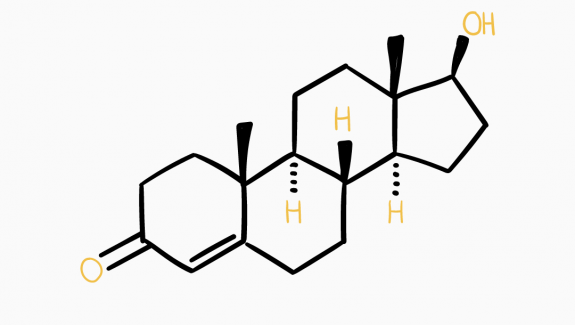
Target 20–30% of total daily calories from fat, and don’t let it drop below roughly 0.6g per kg of bodyweight for any extended stretch. Fat supports the production of testosterone and estrogen, both of which play a direct role in recovery and muscle retention, and it’s required for absorbing fat-soluble vitamins A, D, E, and K. Chronically low fat intake — common in athletes chasing high-carb, high-protein targets on a fixed calorie budget — can quietly undercut hormone production even while your other macros look fine on paper.
Prioritize monounsaturated and omega-3 sources — salmon, extra virgin olive oil, avocado, nuts — which also help manage the systemic inflammation that comes from training two disciplines hard in the same week.
What About Hydration and Electrolytes for Hybrid Training?
Water alone isn’t enough when you’re combining heavy sweat losses from running with the physical demand of lifting.
As a daily baseline, aim for roughly 35–45ml of fluid per kg of bodyweight, then adjust upward around training. For sessions where you’re sweating heavily, replace losses at a rate of 1.0–1.5 liters of fluid per kilogram of bodyweight lost — you can estimate this by weighing yourself before and after a hard session. Include roughly 500–1,000mg of sodium per liter of fluid during extended training to preserve fluid balance and reduce cramping risk.
Sodium losses vary dramatically between individuals — some athletes lose two to three times more sodium in sweat than others under identical conditions. If you’re someone who finishes sessions drenched while your training partner barely sweats, generic electrolyte guidance is probably underdosing you. A 2% loss in bodyweight from fluid is enough to measurably hurt both endurance output and maximal force production, so this isn’t a minor detail to skip.
Common Hybrid Athlete Nutrition Mistakes
- Under-eating carbs out of fear of fat gain. Running high mileage on a low-carb protocol forces your body toward gluconeogenesis — converting muscle tissue into glucose just to keep up with demand. You end up smaller and slower, which is the opposite of the goal.
- Treating intra-workout carbs as “empty calories.” Gels and liquid carbs during long sessions aren’t junk food — they’re performance tools that spare glycogen and blunt systemic fatigue. Skipping them on long efforts just moves the cost to your next session.
- Running an aggressive deficit during a high-volume block. Cutting hard while adding mileage and holding onto heavy lifts is one of the more reliable ways to end up hurt. Shin splints, stalled lifts, and burnout all trace back to this same mistake.
- Underestimating the NEAT drop-off. Non-exercise activity thermogenesis — the calories you burn just moving through your day — tends to quietly decline as systemic fatigue builds from hybrid training. People plan their intake around their workouts and miss that they’re also moving less everywhere else, which throws off calorie math that looked fine on paper.
None of this is complicated in theory. It’s effort — tracking, adjusting week to week, and being honest about whether you’re actually eating enough to support what you’re asking your body to do. Hybrid training rewards consistency in fueling as much as it rewards consistency in training, and most people are more disciplined about the workouts than the plate.
For a full breakdown of all the most common mistakes associated with Hybrid Training, check out our article on the “6 Common Mistakes Lifters Make When Switching To Hybrid Training”.
Blunt plug, but it’s a real one: if you want your calories, carbs, protein, and fat targets built around your actual training split instead of a general range from an article, that’s literally what our coaches do — you can check out TCM’s online coaching if you want that built out for you.
Hybrid Athlete Nutrition FAQ |
| How many calories should a hybrid athlete eat per day? Most hybrid athletes need roughly 19–23 calories per pound of bodyweight per day — noticeably higher than standard strength-training guidelines because you’re recovering from both lifting and endurance work. Double-session days can add 600–1,200 calories on top of that, so this is a starting range to adjust from, not a fixed number. |
| How many carbs do hybrid athletes need per day? Most hybrid athletes do well in the 4–7g of carbohydrate per kg of bodyweight range, scaling toward the higher end on days with long runs or double sessions. Carb needs should track with that day’s training load rather than staying flat across the week. |
| Do I need intra-workout carbs if I’m lifting and running the same day? Intra-workout carbs generally aren’t necessary for sessions under an hour if you’ve eaten beforehand, but they become useful for endurance efforts past 60–90 minutes, especially ahead of a second session later that day. A common starting point is 30–60g of carbs per hour during longer endurance work, adjusted based on gut tolerance. |
| How much protein does a hybrid athlete need? Hybrid athletes typically need 1.6–2.2g of protein per kg of bodyweight per day, higher than what’s needed for either strength or endurance training alone. This accounts for the combined muscle and connective tissue repair from both training styles, and is best spread across 4–5 meals a day. |
| What is low energy availability and why does it matter for hybrid athletes? Low energy availability happens when you’re not eating enough to cover both your daily function and your training cost, and it can suppress the muscle-building signal (mTOR) while activating the pathway associated with endurance adaptation (AMPK). Over time, it also drives up cortisol, lowers testosterone, and raises injury risk — which is why chronic under-fueling causes more hybrid athletes to plateau than bad programming does. |