
Hyrox Training: 4 Mistakes That Ruin Your First Race (and How to Fix Them)
Training for your first Hyrox comes down to four fixes: run as much as you lift, because running makes up roughly 60% of race time; practice every station for efficiency; rehearse race-day conditions like start time, climate, and turf; and build each fitness quality separately instead of doing Hyrox circuits every week.
Here’s the tension. A lot of first-timers train for Hyrox like it’s a strength event. Lift heavy, grind through circuits, maybe a mock race every Saturday… and then blow up somewhere around run five.
Not because they’re weak. Not because they didn’t work hard. Because they trained hard for a different race than the one they signed up for.
I’ve raced Hyrox myself, and I’ve coached a lot of athletes through their first one. The same four mistakes show up over and over. Elite Hyrox athletes would probably name a few of the same ones — they can tell you what went wrong. My job for 16+ years and 2,000+ clients has been figuring out why it goes wrong, and how to fix it for people with jobs, families, and a calendar that’s already full.
What Is a Hyrox Race Actually Testing?
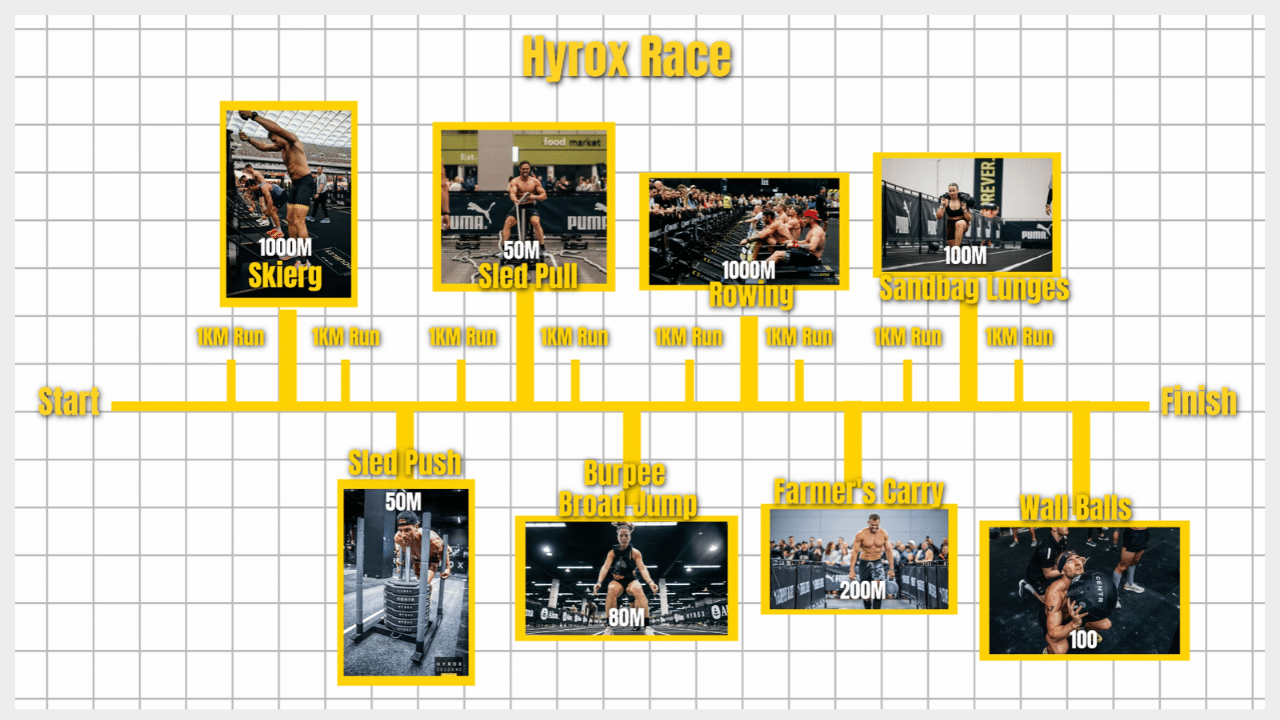
A Hyrox race is eight 1-kilometer runs, each followed by a workout station: SkiErg, sled push, sled pull, burpee broad jumps, rowing, farmers carry, sandbag lunges, and wall balls. Every race uses the same order and standardized loads by division. Nothing is a surprise on paper.
So what does that format actually reward?
The first peer-reviewed study on Hyrox (Brandt et al., 2025, Frontiers in Physiology) put 11 recreational Hyrox athletes through a full simulated race. Median finish time was 86.5 minutes. 51.2 of those minutes were running. All eight stations combined took 32.8.
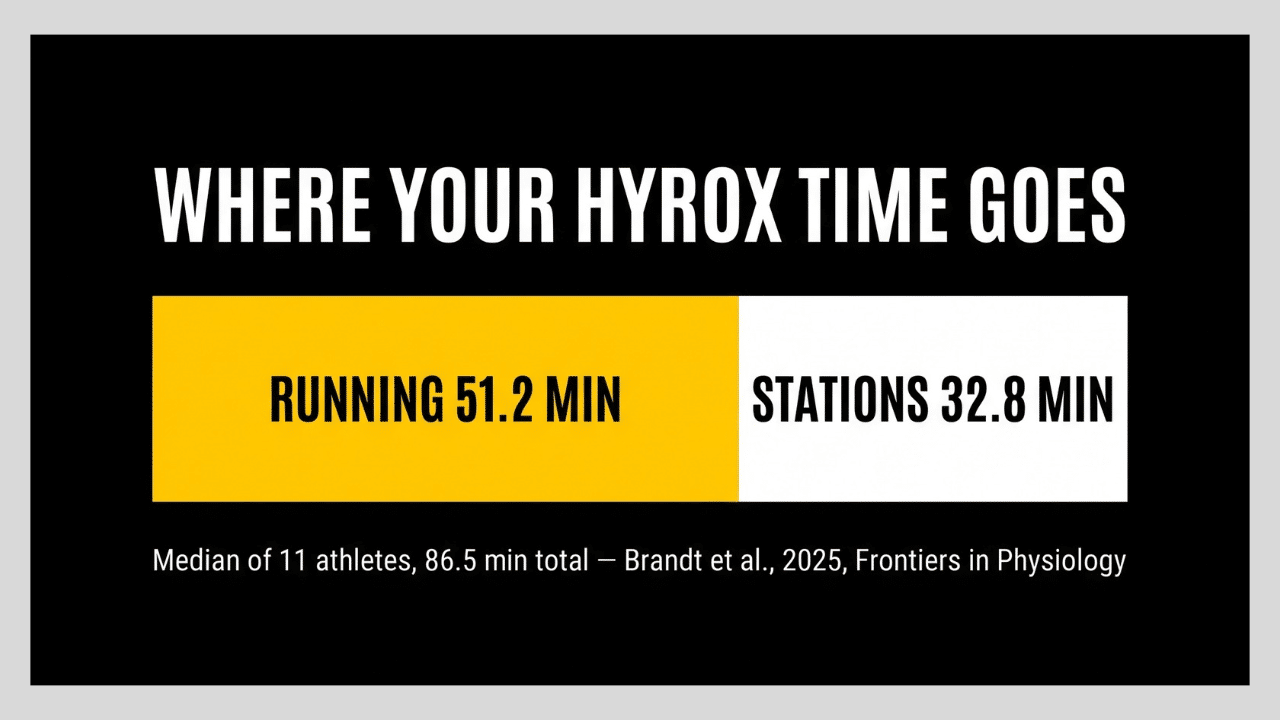
Translation: close to 60% of your race is spent running. Hyrox is a running race with eight strength and conditioning stations in between — not a strength workout with some running mixed in. Hold onto that, because it changes how you should train.
And that run-five blow-up? It isn’t a figure of speech. In the same study, run 5 — the one right after burpee broad jumps — was the slowest run of the race, at a median of 7.4 minutes. That’s where the first half catches up with an engine that wasn’t built for it.
One honest caveat: 11 athletes is a small sample, the runs were on a treadmill, and the sled wasn’t the official competition sled. It’s a starting point, not the final word. But it lines up closely with what I’ve seen coaching athletes for this race.
Mistake #1: Not Running Enough for Hyrox
The first Hyrox training mistake is under-running. Running makes up the majority of race time, it’s the one thing you repeat eight times, and it’s where races get decided. It’s where people fall behind… and where smart athletes reel them back in.
Look at the top of any Hyrox leaderboard and you’ll find athletes who built a big aerobic engine first. A lot of them were runners before they ever pushed a sled.
The research backs this up. In the Brandt study, faster finish times correlated with higher VO2max (ρ = −0.71) and more weekly endurance training (ρ = −0.68). Grip strength, muscle mass, and resistance training volume showed no meaningful correlation with finish time at all.
Here’s the part that should make you pause. Those athletes were lifting more than they were running — a median of 4 hours of resistance training per week vs. 3 hours of endurance work. And the variable that tracked with their finish times was the running, not the lifting.
(Correlation isn’t causation, and you still need enough strength to move the sled. But if you’re spending limited training hours chasing a bigger deadlift for Hyrox, you’re likely investing in the wrong place.)
Why your aerobic engine is your recovery system
Your aerobic system isn’t just what gets you through the runs. It’s what recovers you from everything else.
A bigger engine means you clear lactate faster, your heart rate comes back down sooner after each station, and you lean less on the expensive anaerobic system that burns you out. In the Brandt data, blood lactate and perceived effort were significantly higher during the stations than the runs (peak lactate 8.5 vs. 7.7 mmol/L). That means the runs are where you’re supposed to recover — while still moving at race pace.
So a small engine doesn’t just make your runs slow. It means you arrive at every station still paying off the last one… and that debt compounds for eight rounds.
Here’s a hypothetical example of how that plays out. Picture an athlete who can push a heavy sled and deadlift twice her bodyweight, but hasn’t run more than twice a week in years. She hits every station feeling strong… then her runs drift from 5:30 to 7:00 per kilometer in the back half, because her heart rate never comes down enough between efforts to recover. Her stations were never the problem. Her engine was, and that’s exactly what more running is meant to fix.
The fix: run as much as you lift
If you want to be competitive in Hyrox, you need to be running as much as you’re lifting. That doesn’t mean every run is hard. Build three types into your week:
- Easy aerobic runs. Conversational pace. This builds the engine, and the bulk of your running volume should live here.
- Threshold work. Intervals at a hard-but-controlled pace — think 1 km repeats slightly faster than goal race pace, with short rest. This raises the pace you can hold before fatigue starts to spiral.
- Compromised running. Running right after a station: off the sled, off the rower, off wall balls. That’s what the race actually asks of you. Brandt’s team flagged this specifically, because running economy drops when your legs are already loaded and your blood flow is still redistributing from the station you just finished.
One caveat, because it matters for anyone with an injury history: ramping running volume too fast is a well-documented injury risk (Fields et al., 2010). If your joints aren’t ready for more pounding, put some aerobic volume on the rower or SkiErg — same engine, less impact — and build running gradually.
And if you’re worried more running means losing muscle, it doesn’t have to. That’s a programming problem, not a dealbreaker — here’s how hybrid athletes build muscle while running.
Mistake #2: Ignoring Hyrox Station Technique
The second Hyrox training mistake is skipping technique work on the stations because the movements look simple.
And they are simple. A rower. A SkiErg. A burpee. This isn’t Olympic lifting, and the Brandt team classified Hyrox’s technical demands as relatively low compared with other functional fitness formats.
But simple isn’t the same as efficient.
Picture two athletes side by side on the rower. Same split. Same finish time on the monitor. One is breathing easy. The other’s heart rate is pinned.
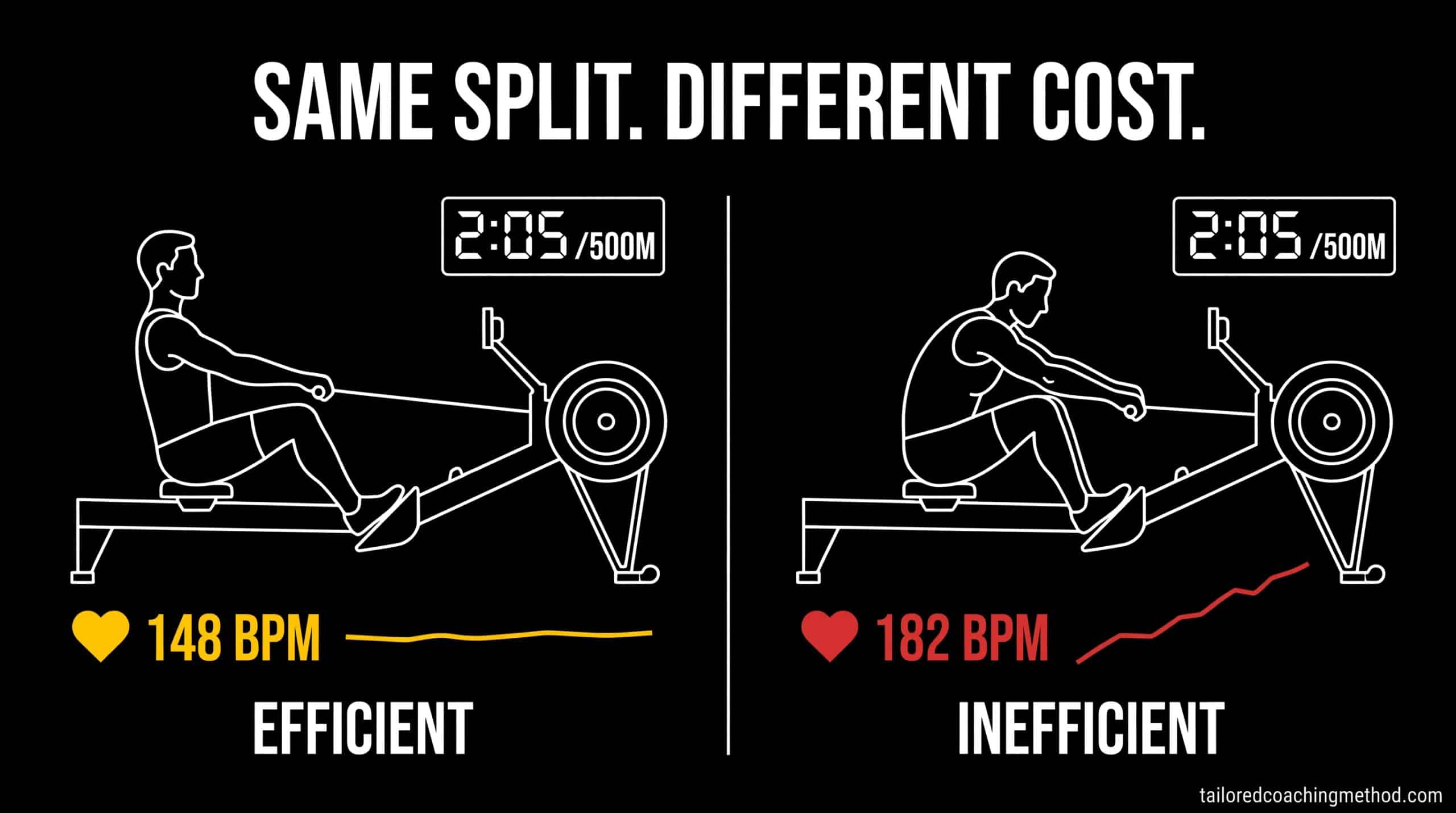
Neither one is fitter or stronger. One just spent less energy to get the same job done — that’s movement economy. And in Hyrox, the extra cost doesn’t reset. You carry it into the next run, then the next station, then the next run. Station by station, the less efficient athlete slides backward, and usually never figures out why.
The researchers made the same point from the other direction. Because Hyrox loads are fixed, once your strength clears what the race requires, more strength stops paying off — and efficiency, pacing, and muscular endurance start separating athletes. (Sloppy reps also earn “no reps” from judges, which costs you time and energy.)
If you’re racing doubles, this matters even more. One partner may be far more efficient on the rower thanks to longer limbs; the other may move through wall balls with less effort from more practice. Split stations by who does each one at the lower energy cost, not just by who’s stronger.
The fix: practice each station fresh, then under fatigue
Practice each Hyrox station for efficiency while you’re fresh, not only when you’re exhausted. Film yourself and dial in the basics:
→ Rower: legs, then hips, then arms on the drive. Reverse it on the way back.
→ SkiErg: drive with your hips and trunk, not just your arms.
→ Sled push: low body angle, arms locked out, short driving steps.
→ Burpee broad jumps: find a rhythm you can repeat for the full distance instead of sprinting the first 20 meters.
→ Wall balls: throw with your legs, and catch the ball straight into your next squat.
Clean reps first. Speed second. Once a movement holds up fresh, start testing it at the end of a run.
Mistake #3: Not Preparing for Hyrox Race-Day Conditions
The third Hyrox training mistake is preparing only for your own gym instead of the conditions you’ll actually race in. Almost nobody thinks about this until race morning.
A few of the variables I see trip people up:
→ Start time. You always train at 7 a.m. Your heat is at 3 p.m. You’ve never done a hard session at that hour, on that day’s food, after that many hours of sitting around thinking about it.
→ Climate and travel. You live and train in the Pacific Northwest. Your race is in Dallas or Phoenix. Now add a flight, a hotel bed, and a packed venue that doesn’t always stay cool.
→ Surface. Your gym turf is smooth and your sled glides. Race turf can grab and drag, and suddenly your “normal” push feels far heavier than the number on the sled.
→ Fuel. You’ve never eaten your race-morning meal before a hard effort, and you find out mid-race that your stomach disagrees.
None of that is about fitness. It’s about readiness.
How to train for race-day variables
- Move your training times. In the final weeks, do some hard sessions at your actual heat time. Body temperature, digestion, and caffeine timing all shift across the day, and time-of-day research suggests performance adapts partly to the hour you train at (Chtourou & Souissi, 2012).
- Rehearse your fueling. Eat your race-day meal before real training sessions. Plan hydration ahead, especially if you’re traveling somewhere warmer.
- Start heat prep early if you need it. A systematic review (Daanen, Racinais & Périard, 2018) found five or more days of heat exposure produce stable drops in exercise heart rate and core temperature — and roughly 2.5% of those gains fade for every day without heat. Translation: you can’t fix it the week of the race, and you can’t do it once and coast. If your venue is well climate-controlled, this matters less. You’ll find out by asking people who’ve raced there.
- Overload the sled. Push heavier than race weight, or train on rougher turf when you can find it, so a sticky surface doesn’t shock you.
- Practice running fatigued. The compromised runs from Mistake #1 do double duty here.
Mistake #4: Doing Hyrox Circuits and Simulations Every Week
Should you do Hyrox workouts in circuits every week? No. Doing Hyrox-style circuits or full mock races several times a week, week after week, is a mistake I see constantly — and it’s sneaky, because it feels like smart, specific training.
Mock races matter. You need them. Just not on repeat.
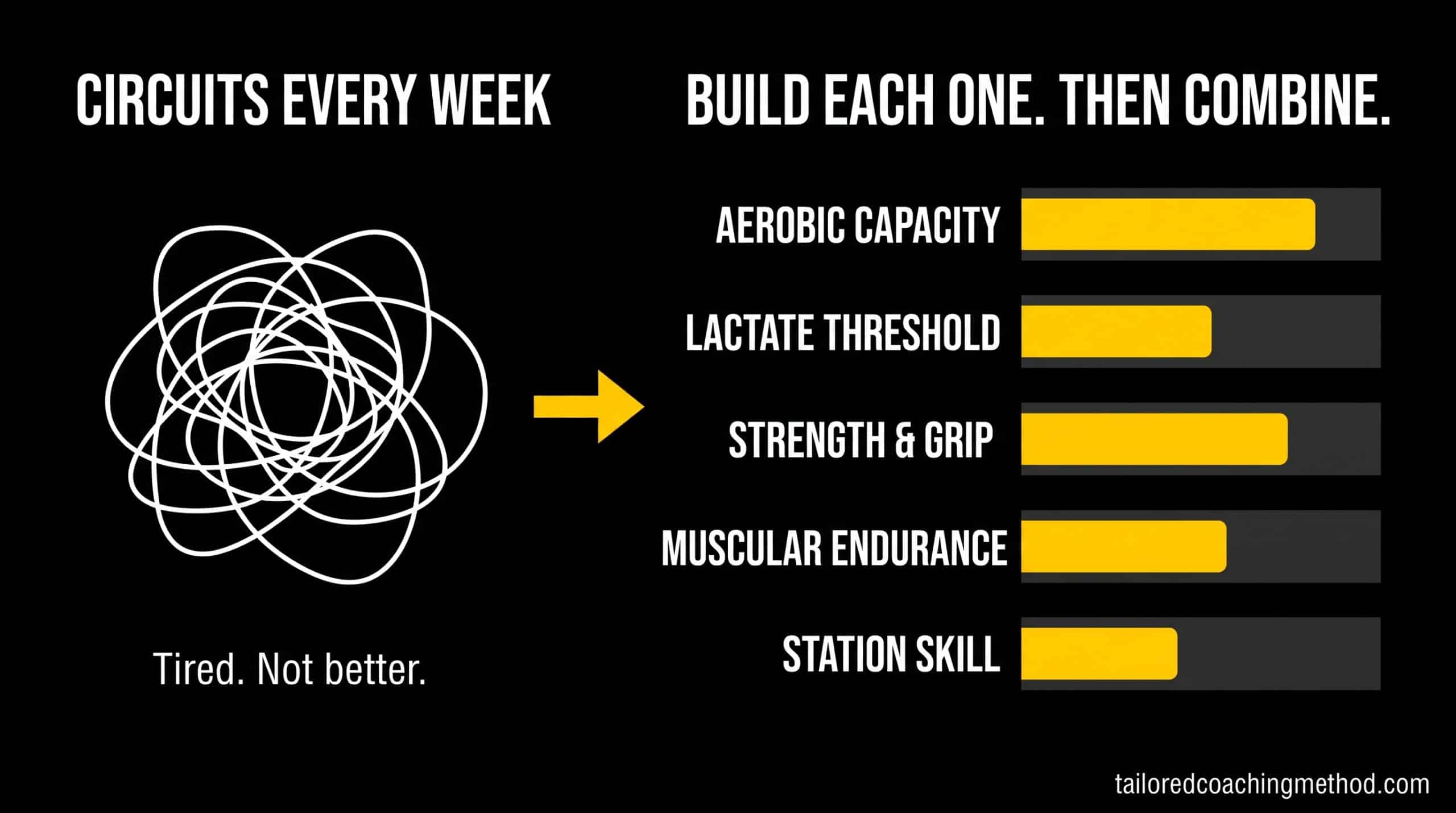
Here’s why. Hyrox tests a stack of separate qualities: aerobic capacity, lactate threshold, grip strength, muscular endurance, and station skill. A high-intensity circuit hits all of them at once… but it doesn’t build any of them particularly well.
When everything’s mixed together, fatigue hides your weak spots. You can’t tell whether your grip failed or your lungs did. You can’t track clean progress on any single quality, because the variables change every session. So you end up wrecked every week, but not much better.
Think of it like building a car. You don’t build an engine by driving the car into the ground every day. You build the engine, the brakes, and the transmission separately — then you take it out for a road test.
There’s a physiology reason, too. Stacking hard endurance and strength work creates an interference effect: a meta-analysis by Wilson et al. (2012) found concurrent training blunted strength and power gains compared with strength training alone, and running interfered more than cycling. The Brandt team, citing concurrent-training research (Methenitis, 2018), recommended separating resistance and endurance work into distinct sessions where you can. If you want the full breakdown of how to manage that, read the science of hybrid training.
Now the other side, because circuits aren’t the enemy. The same researchers noted that short sessions mixing running with Hyrox stations can hit several goals at once and sharpen your transitions. The problem isn’t doing them. It’s making them the whole program.
The fix: build each quality, then combine them
- Aerobic capacity: easy, steady running, plus some rower or SkiErg volume.
- Lactate threshold: interval runs at hard, controlled paces.
- Strength and grip: lower-body strength, sled-specific pushes and pulls, and heavy carries — the same foundation we lay out in strength training for runners.
- Muscular endurance: higher-rep work on lunges and wall balls.
- Station skill: technique practice while fresh.
Then bring it together. A full or half simulation is your road test — it shows you what’s working and what needs more focused time. For a first race, I’d rather see one or two full simulations in the final 4–6 weeks, with shorter run-plus-station blocks in between, than a mock race every Saturday.
Blunt plug, but this is exactly what our coaches build: the plan around your schedule, your injury history, and your weak links. If you want it dialed in for you specifically, apply for coaching here.
What Does a Hyrox Training Week Look Like?
Here’s a starting template for an athlete with a basic running and lifting base, 8–12 weeks out. Treat it as a framework, not a prescription — your schedule, recovery, and injury history should move pieces around.
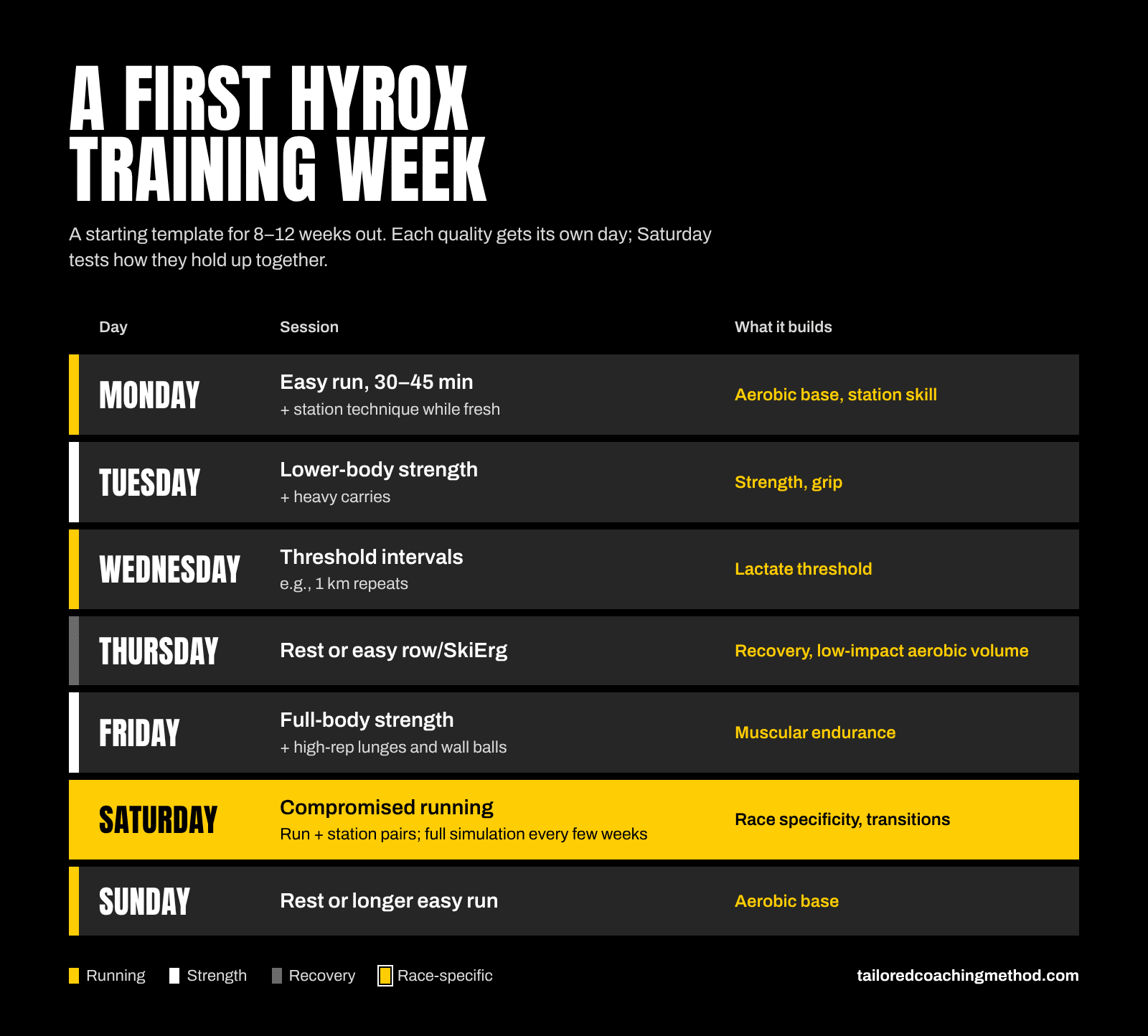
Notice what’s not in there: three mock races. Each quality gets its own day to progress, and Saturday is where you test how they hold up together.
How to Train for Your First Hyrox: The Short Version
Go back to the athlete blowing up at run five. They didn’t lack effort. They lacked a plan.
Their engine was too small for a race built on running. Their stations cost more energy than they needed to. Race day threw conditions at them they’d never practiced. And they spent months doing circuits that made them tired, not better.
To train for Hyrox: build your aerobic engine, own your station technique, rehearse race-day conditions, and train each quality on its own before you combine them.
None of that is a shortcut. It’s harder in the places that actually matter — more running than feels comfortable if you think of yourself as a lifter, boring technique reps when you’d rather go fast, and the patience to build each piece before you test the whole thing.
Hyrox Training FAQ |
|
How long should I train for my first Hyrox? |
If you already run and lift consistently, 8–12 weeks of structured Hyrox training is a realistic window. If you’re coming in with only one side — a lifter who doesn’t run, or a runner who doesn’t lift — give yourself 12–16 weeks so you can build the missing piece without rushing it. Consistency across those weeks matters more than any single hard session. |
How much of Hyrox is running? |
Every Hyrox race includes 8 km of running, split into eight 1 km runs. In the first peer-reviewed Hyrox study, running took 51.2 of 86.5 total minutes — close to 60% of race time. That’s why aerobic fitness and endurance training volume tracked with faster finishes, while grip strength and muscle mass didn’t. |
How often should I do Hyrox simulations? |
Every few weeks, not every week. For a first race, one or two full simulations in the final 4–6 weeks is plenty, with shorter run-plus-station blocks in between. Simulating constantly piles on fatigue and makes it hard to see which quality is actually limiting you. |
Do you need to be strong to do Hyrox? |
You need enough strength to handle the race loads for your division without grinding — especially on the sled push and pull. Beyond that threshold, extra maximal strength showed little link to finish time in the research. Strength endurance, aerobic fitness, and efficient technique matter more for your result. |
Can beginners do Hyrox? |
Yes. The Open division, Doubles, and Relay formats let newer athletes race the full event at manageable loads or share the work. If you race Doubles, assign stations by who does each one more efficiently, not just who’s stronger. |