
Hybrid training mistakes almost always come from lifters treating running like an extra conditioning circuit instead of its own discipline — running every session too hard, keeping their bodybuilding leg day unchanged, under-fueling to “make room” for the new cardio, and ignoring early warning signs until they’re hurt. Each one is fixable with a specific programming change, not a personality overhaul.

I’ve coached lifters through this exact transition more times than I can count, and the pattern is almost identical every time. Someone spends years building a strength base, decides they want to run a 5K or sign up for a Hyrox, and applies the same “more is better, push through it” mentality that built their squat to their new running volume. Four to six weeks later, they’re dealing with shin splints, a knee that won’t calm down, or lifts that have quietly stalled while they wonder why “adding a little cardio” wrecked their training.
Running isn’t just extra conditioning bolted onto a lifting split. It introduces real eccentric impact forces, systemic nervous system demand, and its own recovery timeline — and if you don’t account for that, it doesn’t just fail to complement your lifting, it actively competes with it.
Below are the six mistakes I see most often when a dedicated lifter starts hybrid training, and the specific fix for each. If you haven’t already, our hybrid athlete training guide covers the full periodization and split structure — this article is about the execution errors that undo that structure before it has a chance to work.
Mistake #1: Treating Every Run Like a Conditioning Test
Lifters are conditioned to push near failure every session — that’s how you build a squat. So when they start running, the instinct is to run hard, every time.
Why it destroys progress. Running at a high, glycolytic-dominant intensity spikes cortisol and burns through glycogen fast — glycogen your lifting sessions also depend on. It also maximizes what’s known as the interference effect: the AMPK signaling pathway activated by hard endurance work can suppress mTOR, the pathway responsible for muscle protein synthesis, when the two stressors stack without adequate recovery or fuel between them.
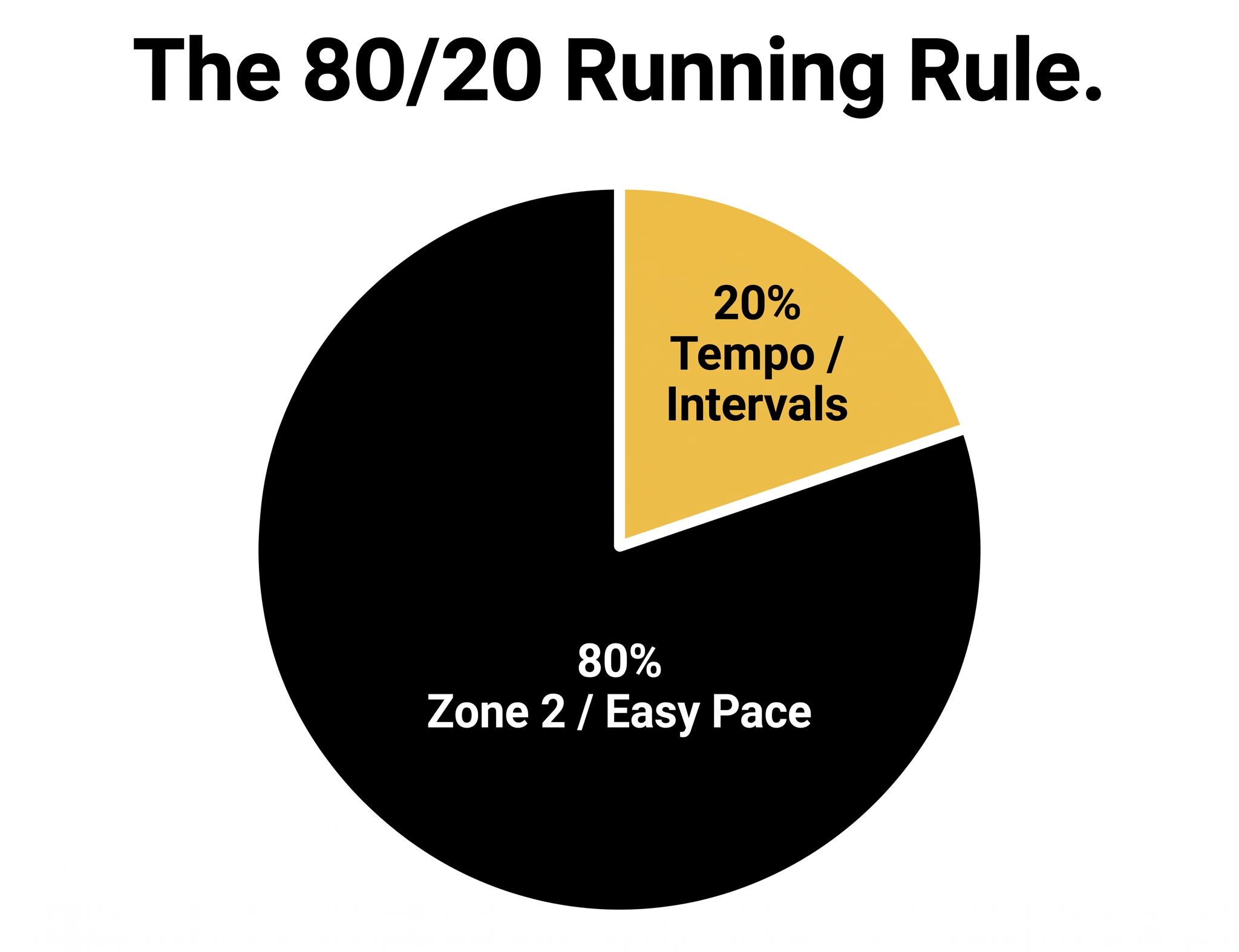
The fix. Most elite endurance athletes train using something close to an 80/20 intensity split — roughly 80% of running volume at a genuinely easy, conversational pace (true Zone 2), with the remaining 20% or less reserved for tempo work or intervals. Research on polarized training distribution has repeatedly found this split produces better aerobic adaptation with less systemic fatigue than training that lives in the “moderately hard” middle zone most people default to. For a hybrid athlete specifically, this matters even more — your easy runs need to actually be easy, because your nervous system is already covering the cost of your lifting.
Mistake #2: Clashing High-Stress Days Instead of Consolidating Them
A common setup: heavy leg day Monday, a hard tempo run Tuesday, heavy deadlifts Wednesday, intervals Thursday. On paper it looks balanced. In practice, it means your central nervous system never gets a real day off.
Why it destroys progress. Spreading high-intensity stress across most of the week keeps your body in a low-grade sympathetic state without ever dropping into deep parasympathetic recovery. You end up chronically tired without ever having a single day that was actually a rest day.
The fix. Consolidate your hardest efforts onto the same days instead of spreading them out — pair your heaviest lower-body lift with your hardest run (tempo or intervals), separated by 6–8 hours if you’re doing both, and keep everything in between genuinely light or off. This is the same logic behind high/low training models used across endurance sports: hard days hard, easy days easy, nothing in the middle diluting your recovery. If you’re stacking sessions like this, fueling the gap between them isn’t optional — our intra-workout nutrition guide covers exactly what to eat and drink between a double session.
Mistake #3: Keeping Your Bodybuilding Leg Day Unchanged
This is the one I see cause the most injuries, and it’s the one lifters resist changing the most, because it feels like giving something up.
Why it destroys progress. A traditional high-volume leg day — heavy back squats, leg press, walking lunges, all taken close to failure — puts real compressive load on your spine and knees on its own. Running adds to that bill: the patellar tendon alone experiences roughly 4.7 to 6.9 times bodyweight in force during running, concentrated at mid-stance and push-off. Stack that on top of an unmodified bodybuilding leg day and you’re asking already-loaded tissue to absorb more, with no adjustment to account for it. That combination is where runner’s knee, lower back tightness, and hip flexor irritation usually come from.
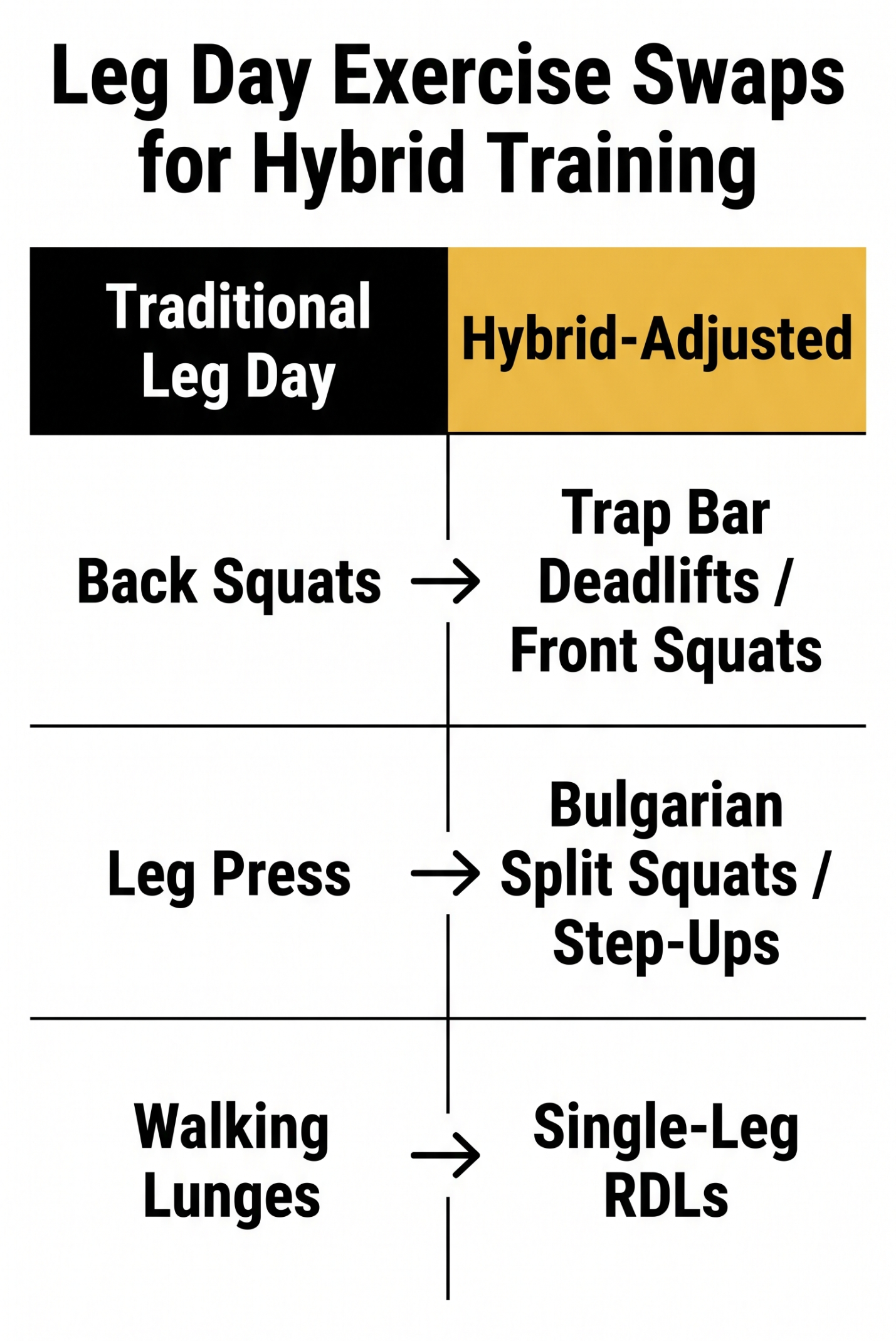
The fix. During your higher-mileage running phases, shift some of your leg volume toward unilateral work and the posterior chain. Bulgarian split squats, step-ups, and single-leg RDLs address the side-to-side strength imbalances that running exposes — since you’re literally spending most of a run on one leg at a time — while strong hamstrings and glutes act as a brake during the landing phase of your stride, taking load off the knee. This isn’t about abandoning heavy bilateral lifts entirely; it’s about not running the exact same leg day at the exact same volume once running is also on your plate.
Mistake #4: Under-Fueling Carbs Out of Fat-Loss Fear
A lot of lifters start hybrid training specifically to lose fat, and the instinct is to run a steep deficit while also adding several days of running mileage. It feels efficient. It backfires.
Why it destroys progress. When carbohydrate and total energy intake drop too low relative to your output — a state called low energy availability — your body starts converting amino acids into glucose through gluconeogenesis just to keep up. That’s muscle tissue being broken down for fuel, the opposite of what a lifter wants. It also meaningfully raises your risk of bone stress injuries, since chronic under-fueling disrupts the hormonal signaling bone remodeling depends on.
The fix. Treat carbohydrate as performance fuel for the running you’re now doing, not just a calorie category to cut. Scale intake to your actual output — generally 4–7g of carbohydrate per kg of bodyweight on higher-volume training days — and keep protein high (1.6–2.2g per kg) to protect the muscle you’ve already built. Our hybrid athlete nutrition guide breaks down the full calorie and macro math for concurrent training if you want the complete picture.
Mistake #5: Ramping Mileage Fast and Trusting the Wrong Rule
Most lifters have heard of the “10% rule” — never increase weekly mileage by more than 10% — and assume following it protects them. It’s worth being honest about what the evidence actually says here, because it’s not quite what most people think.
Why it destroys progress. The 10% rule was never validated in a controlled trial — it started as coaching intuition and stuck because it’s easy to remember. A large cohort study tracking over 5,200 runners over 18 months, published in the British Journal of Sports Medicine, found that weekly mileage totals predicted injury barely better than chance. What did predict injury was a sudden jump in the length of a single run compared to your longest run in the previous 30 days. In other words, it’s not your weekly total creeping up gradually that gets you hurt — it’s the one long run that jumps too far, too fast, relative to what your tissue has recently handled.
There’s a second layer to this mistake specific to lifters: your tendons adapt on a much slower timeline than your muscles do. Meaningful tendon stiffness changes take roughly 16 weeks of consistent loading, compared to 6–8 weeks for noticeable muscle hypertrophy. Your cardiovascular fitness and leg strength can make you feel ready to run fast well before your Achilles and patellar tendons have actually adapted to repeated impact — which is exactly how lifters end up with shin splints, plantar fasciitis, or tendonitis despite feeling perfectly capable.
The fix. Don’t obsess over your weekly total — pay closer attention to how much any single run jumps past your recent longest effort, and keep those jumps modest. Separately, respect that tendon adaptation runs on its own clock regardless of how strong your legs already are; build mileage gradually even when your fitness says you could go faster. And here’s the part that should actually work in your favor: strength training is one of the most evidence-backed tools for reducing overuse running injuries, with meta-analysis data showing roughly a 50% reduction in injury risk for runners who strength train consistently. As a lifter, you’re not starting this transition at a disadvantage — you already have the single best injury-prevention tool in your toolkit. You just need to stop overriding it with an unmodified leg day (see Mistake #3) and an unmanaged mileage ramp.
Mistake #6: Ignoring Biofeedback Until It’s Too Late
Lifters are used to pushing through a bad session and being fine by the next one. Hybrid training doesn’t always forgive that the same way, because fatigue is now accumulating from two directions — axial loading from the weight room and impact loading from running — at the same time.
Why it destroys progress. Ignored fatigue compounds quietly: resting heart rate creeps up, sleep gets worse, joints feel achy during warmups that used to feel fine, and motivation drops before performance visibly does. By the time your lifts are obviously suffering, you’ve usually been in the hole for a while.
The fix. Track more than one signal, and don’t lean on any single number as gospel. Heart rate variability can be a useful piece of the puzzle, but the research on HRV in isolation is genuinely mixed — some reviews find it’s a reliable overreaching indicator, others find resting HRV barely moves even during real overreaching, particularly in aerobically trained athletes. Combine it with resting heart rate, sleep quality, and plain subjective feedback (how heavy do your legs feel in a warm-up set that’s normally easy) rather than waiting for one metric to confirm what your body’s already telling you. If two or three days in a row all point the same direction, that’s your signal to drop intensity or volume for a few days — not grit through it and hope it resolves on its own.
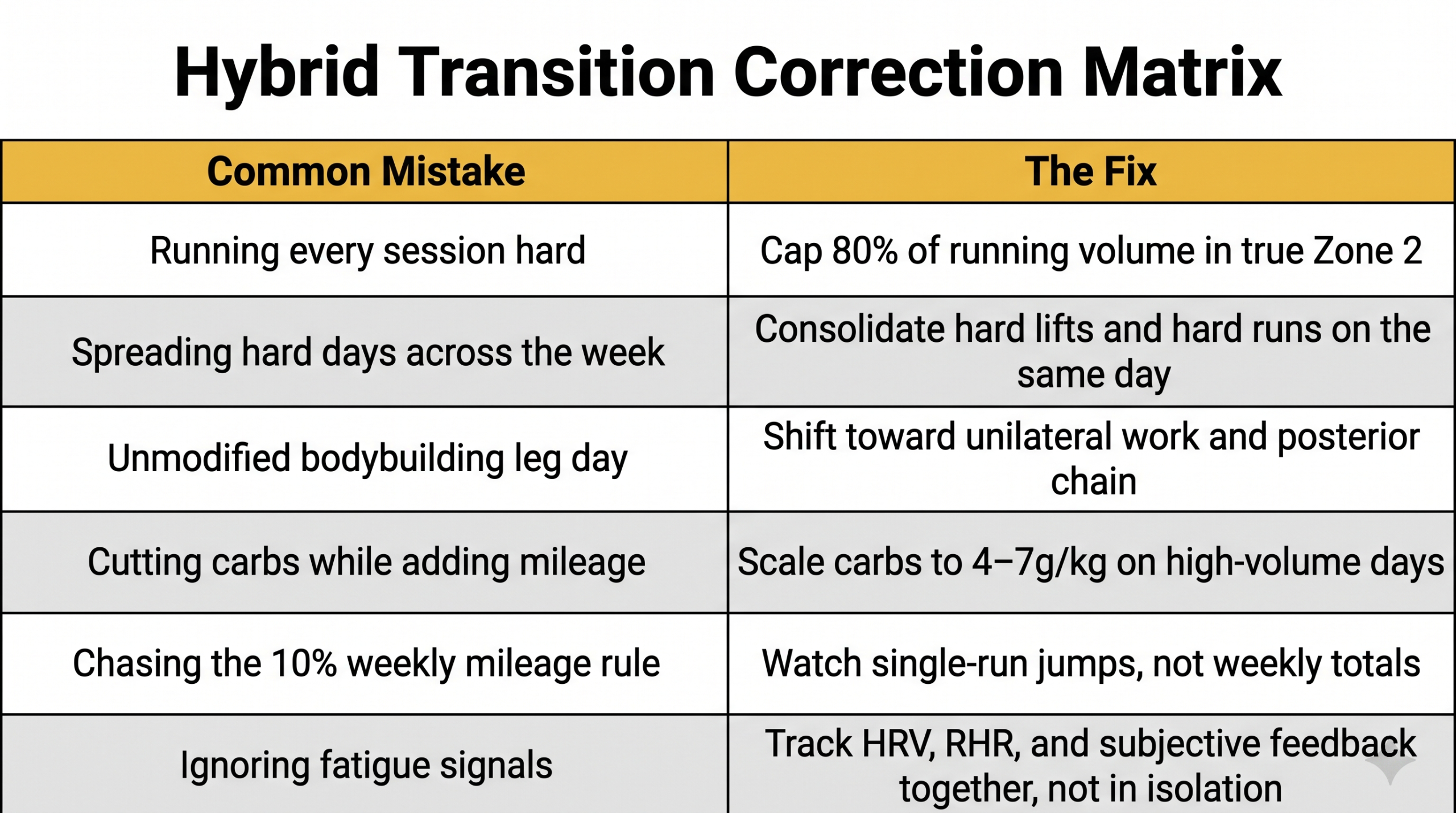
The Hybrid Transition Correction Matrix
Making the Transition Without Losing What You Built
None of these fixes require abandoning the identity of being a lifter — they require running with the same intentionality you already bring to programming a lifting block. The lifters who make this transition well aren’t the ones who run the least or the most; they’re the ones who stopped treating running as an afterthought bolted onto their real training.
If you’re stuck, dealing with a nagging injury, or just don’t want to spend the next six months figuring this out through trial and error, building a hybrid periodization plan around your specific lifting background and running goals is exactly what our coaches do — you can apply for TCM’s online coaching if you’d rather have that built for you
Hybrid Training FAQ |
| Why does running ruin my lifts when I first start hybrid training? Running too hard, too often spikes cortisol and depletes the glycogen your lifting sessions also rely on, and can trigger the interference effect — where the AMPK pathway activated by hard endurance work suppresses mTOR, the pathway responsible for muscle growth. Keeping most of your running at a genuinely easy pace (roughly 80% of total volume) largely avoids this conflict. |
| Is the 10% rule for increasing running mileage actually true? Not quite as it’s usually presented — a large study of over 5,200 runners found weekly mileage increases predicted injury barely better than chance, while a sudden jump in the length of a single run compared to your recent longest run was the stronger predictor. The rule isn’t useless as a general pace-yourself heuristic, but it’s not the precise safety net most people assume it is. |
| Do I need to stop doing heavy squats if I start running? Not entirely, but an unmodified high-volume bodybuilding leg day combined with new running mileage is a common cause of knee and lower back issues, since running already places roughly 4.7–6.9 times bodyweight in force through the patellar tendon. Shifting some leg volume toward unilateral work and posterior chain exercises during high-mileage phases reduces that combined load without eliminating heavy lifting altogether. |
| How do I know if I’m overtraining from combining lifting and running? Watch for a cluster of signs together rather than one metric alone — rising resting heart rate, declining heart rate variability, joints that feel heavy or achy during normally easy warm-up sets, and dropping motivation. If several of these line up for two or three days in a row, that’s a signal to reduce volume or intensity rather than push through it. |
| How much protein and carbs do I need when I start running on top of lifting? Most hybrid athletes do well around 1.6–2.2g of protein per kg of bodyweight daily, with carbohydrate scaling up to 4–7g per kg on days with higher running volume. Cutting carbs aggressively while adding running mileage is one of the more common mistakes lifters make in this transition, since it can force the body to break down muscle tissue for fuel. |