
Metabolism Myths: 5 Lies That Are Holding You Back From Fat Loss
If you’ve ever said—or thought—
“My metabolism is slow.”
“I’ve dieted too much and broke my metabolism.”
“Once you hit your 30s or 40s, fat loss is basically impossible.”
You’re not alone.
These beliefs are everywhere in the fitness industry. Coaches repeat them. Influencers profit from them. Diet culture thrives on them.
But most of what people believe about metabolism is either wrong or missing critical context.
And those misunderstandings don’t just confuse people—they actively hold them back from seeing results.
By the end of this article, you’ll understand:
-
What metabolism actually is (and what it isn’t)
-
Why metabolism is adaptive, not fragile
-
What really happens to your calorie burn during fat loss
-
Why plateaus are usually behavioral—not metabolic
-
How to stop fearing your metabolism and start working with it
Let’s start by clearing the biggest confusion of all.
While understanding your metabolism is crucial, it’s only one piece of the puzzle. To bypass the different potential plateaus entirely, you need a customized, high-touch strategy. We break down exactly how this works step-by-step in our comprehensive guide to online fitness and nutrition coaching.
What Metabolism Actually Is (And Why Most People Get It Wrong)
Metabolism is not a thing you “break,” “damage,” or permanently ruin.
Metabolism is the sum total of all the chemical processes in your body that convert energy (calories) into life.
That includes:
-
Keeping you alive at rest (breathing, heartbeat, organ function)
-
Digesting and processing food
-
Fueling movement and exercise
-
Supporting recovery, repair, and adaptation
From a fat-loss perspective, metabolism is best understood as:
How many calories your body burns per day
This is called Total Daily Energy Expenditure (TDEE).
So when someone says “my metabolism is slow,” what they usually mean is:
“One or more parts of my daily calorie burn has gone down—and I don’t know why.”
That distinction matters, because metabolism is dynamic, responsive, and changeable—not broken.
The 4 Components of Metabolism (TDEE Explained Simply)
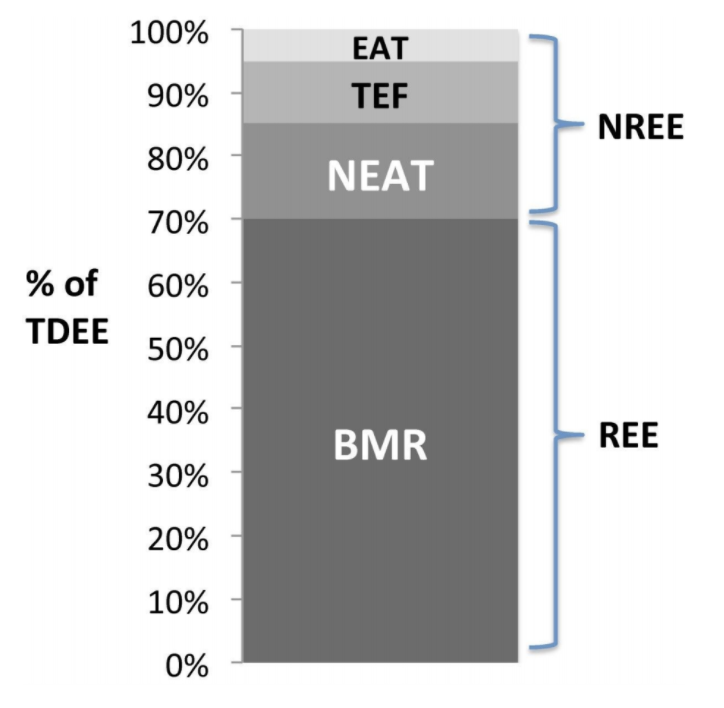
Your total daily calorie burn is made up of four components:
1. Resting Metabolic Rate (RMR)
Calories burned just to keep you alive at rest
– Organ function
– Breathing
– Nervous system activity
This typically accounts for ~60–70% of daily energy expenditure.
2. Thermic Effect of Food (TEF)
Calories burned digesting and processing food
Usually about ~10% of intake
Higher with protein than carbs or fats
3. Exercise Activity
Planned workouts and training sessions
– Lifting
– Cardio
– Sports
Important—but usually not the biggest variable.
4. Non-Exercise Activity Thermogenesis (NEAT)
All movement outside the gym:
-
Steps
-
Standing
-
Fidgeting
-
Posture
-
Daily tasks
This is the most variable and most underestimated part of metabolism. Which is why when fat loss stalls, NEAT is often the first thing to quietly drop.
If you need help figuring out a rough estimate of what your TDEE, Total Daily Energy Expenditure, is⏤you can use our Free Calorie Calculator.
Critical Clarification: Metabolism Is Adaptive, Not Fragile
Metabolism is not a single switch you flip on or off.
It adapts to:
-
Body size
-
Muscle mass
-
Activity levels
-
Calorie intake
-
Stress and sleep
-
Dieting history
This adaptability is not a flaw—it’s a survival feature.
Which brings us to the concept that scares people the most.
Metabolic Adaptation (Adaptive Thermogenesis) Explained Without Fear
Fact #1: Weight Loss Automatically Lowers Calorie Burn
When you lose weight:
-
You have less total mass to maintain
-
You have less mass to move
-
You may lose some fat-free mass if training/protein aren’t solid
This creates an expected, obligatory drop in calorie needs.
That is not metabolic damage. That is physics + physiology.
Fact #2: Adaptive Thermogenesis Can Occur—But It’s Variable
Adaptive thermogenesis means:
Your energy expenditure drops more than predicted from body size changes alone.
Key points:
-
It’s usually modest on average
-
It varies widely person-to-person
-
It shows up most in NEAT and non-resting activity, not just RMR
This is real—but it’s not the apocalypse the internet makes it out to be.
Fact #3: The Bigger Issue Is Appetite + NEAT
After dieting, biology often pushes back by:
-
Increasing hunger and food reward
-
Reducing spontaneous movement (NEAT) without you noticing
Those two together can erase a calorie deficit fast.
For most people, plateaus aren’t caused by a “broken metabolism”—they’re caused by silent behavioral drift.
Because this is such a large topic that is commonly discussed at lengths, often incorrectly, we created a full guide on Metabolic Adaptation, that’s written by Chief Science Officer Dr. Brandon Roberts. You can read it for free, HERE.
Top 5 Metabolism Myths
Ok, now that we’ve laid down the foundations of what the metabolism is, how it adapts while dieting and losing weight, and the basics of what you should know before getting into a dieting protocol⏤we can begin to discuss the myths that have circulated the diet industry and exactly why they’re just that, MYTHS.

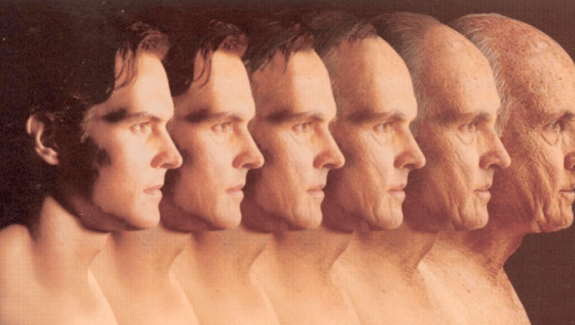
Myth #1: “My Metabolism Is Slow Because of My Age”
What Research Actually Shows
The research we’ll look to for disproving the myths in this article, are based on large datasets that use doubly-labeled water. Doubly-labeled water is the gold standard method inside of research to accurately measure Total Daily Energy Expenditure (TDEE) in humans and animals. It measures TDEE by tracking isotope elimination to determine CO2 production and calorie burning in real-world conditions. It’s also used to assess body composition (body fat/lean mass) and water turnover, offering insights into metabolism, hydration, and the effectiveness of diets or exercise.
Here’s what the large datasets using doubly-labeled water show us:
-
Energy expenditure is remarkably stable through most of adulthood
-
The most significant declines occur much later in life—not starting at 30 or 40, but rather at and beyond the age of 60-65 years old.
What’s Really Changing With Age
Usually:
-
People move less
-
NEAT drops
-
Muscle mass declines if resistance training stops
Those reduce TDEE—but they’re modifiable.
What To Do
-
Lift 2–4x per week
-
Keep steps intentional
-
Prioritize protein and sleep
Age doesn’t break metabolism—lifestyle drift does.
Which sucks if you’re leaning on that as your excuse, but doesn’t suck at all if you’re in a position of wanting to lose body fat at an mid-life or older age. Because this is proof that you can control your body composition at nearly any age.
Myth #2: “I’m Overweight Because My Metabolism Is Slow”
The reality here is that people in larger bodies typically have higher absolute energy expenditure.
Which can actually seem like common sense, once you consider that it takes more energy to:
-
Maintain more tissue
-
Move more mass
There is individual variability in resting metabolic rate—but it’s rarely the whole story.
The Real Challenge
Over time:
-
Intake creeps up
-
Activity drifts down
-
Hunger cues get louder
-
Habits get less structured
That’s not a slow metabolism—that’s energy balance drifting out of alignment.
And if you’re overweight, there’s a high likelihood that you do not have a slow metabolism. Rather, you just have to form better habits, find better accountability, and get help developing a plan that works for you and your routine, with where you’re at in life.
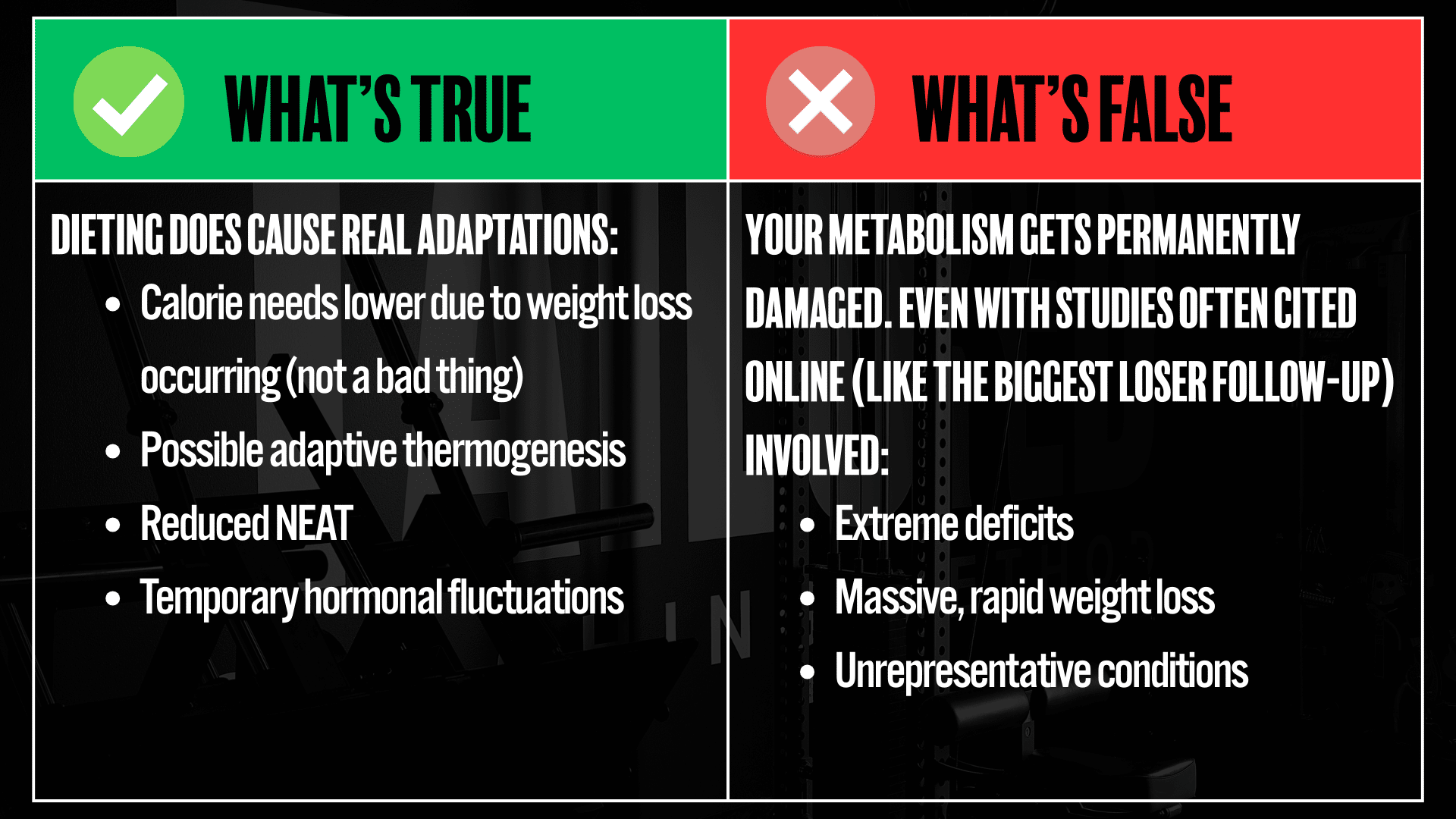
Myth #3: “I’ve Dieted So Much That My Metabolism Is Broken”
The Correct Model
Your body adapts to weight loss because it’s designed to protect energy stores.
That’s not damage—that’s biology.
This is fully supported by recent data compiling the physiology of weight loss plateaus. The National Center for Biotechnology Information (NCBI) confirms that resting metabolic rate (RMR) drops disproportionately to your new weight during long-term deficits, which is exactly why a tailored approach—rather than just cutting calories indefinitely—is mandatory to sustain fat loss.
What Actually Helps
-
Tracking steps during fat loss
-
Planned maintenance phases to reduce diet fatigue
Myth #4: “I’m Too Stressed—My Metabolism Is Dysfunctional”
What Stress Really Affects
Stress primarily influences:
-
Appetite
-
Cravings
-
Sleep quality
-
Routine consistency
-
Training quality
Not thermodynamics.
Cortisol doesn’t magically shut off fat loss—but stress can absolutely make adherence harder.
What To Do
-
Treat sleep and stress as compliance tools
-
Use minimum-effective habits during high-stress seasons:
-
Protein targets
-
Steps
-
2–3 lifting sessions
-
Myth #5: “If I Cut Calories Too Low, I’ll Hurt My Metabolism”
The Truth
Energy expenditure will drop in a deficit. Some adaptation may occur. But that’s expected—and reversible.
What Actually Backfires
-
Excessive hunger
-
NEAT collapse
-
Poor training performance
-
Burnout and rebound eating
The real risk isn’t metabolic injury—it’s unsustainability.
The Better Rule
Choose the largest deficit you can sustain while maintaining:
-
Good training
-
Decent sleep
-
Manageable hunger
-
Stable steps

Key Takeaways (Save These)
-
Metabolism is adaptive, not fragile
-
Adult metabolism is more stable than most people think
-
Larger bodies usually burn more calories than smaller ones
-
Weight loss lowers calorie needs by design
-
NEAT is one of the biggest hidden drivers of plateaus
-
Stress affects fat loss mostly through behavior, not metabolism
Want Help Applying This Without Guesswork?
Understanding metabolism is one thing.
Applying it consistently—through real life stress, plateaus, and busy schedules—is another.
At Tailored Coaching Method, we don’t just hand you a calorie target and hope for the best.
We help you:
-
Set up sustainable deficits
-
Protect muscle and metabolism
-
Manage NEAT and appetite
-
Navigate plateaus without panic
-
Build results that actually last
👉 If you’re tired of fearing your metabolism and want a plan built around real physiology—not myths—apply for coaching today.