
Hybrid athlete mobility is the practice of managing joint range of motion and tissue recovery across two conflicting demands — the stiffness needed for heavy lifting and the compliance needed for running. It requires a split approach: dynamic warmups before training, targeted soft tissue and breathing work after, and daily focus on the ankles, hips, and thoracic spine. Done consistently, it’s what keeps hybrid athletes training instead of rehabbing.
That’s the direct answer. Now here’s why almost nobody does this correctly.

The Real Problem: Your Joints Are Getting Conflicting Instructions
Nobody warns you about this part. You start hybrid training because it sounds like the best of both worlds — get strong, get fast, look and feel athletic. What they don’t tell you is that lifting and running are, mechanically speaking, fighting each other for control of your joints.
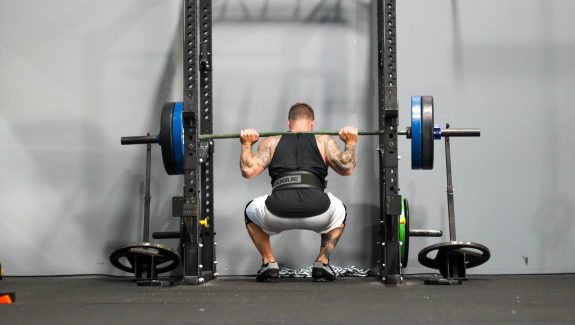
Heavy lifting builds structural tension. You want stiffness under a loaded barbell — a rigid trunk, tight hips, a spine that doesn’t move when it shouldn’t. Running wants the opposite. It demands elasticity, compliance, and the ability to absorb and redirect force at high speed, over and over, for miles. Ask your joints to be rigid and springy on alternating days and something eventually gives.
This isn’t a hunch. Research on powerlifters and strength athletes has repeatedly found unusually high rates of chronic joint tightness and subacute overuse issues in populations that train almost exclusively for stiffness and load tolerance (Bengtsson et al., 2018; Strömbäck et al., 2018). In plain English: training for pure strength, without addressing range of motion, quietly grinds your joints down even if nothing ever “pops.” Stack running volume on top of that stiffness and you’ve built the exact setup for an overuse injury.
I’ve coached this pattern more times than I can count — a lifter adds running volume, doesn’t touch their mobility work, and six to eight weeks later they’re dealing with a nagging shin, hip, or knee issue that “came out of nowhere.” It didn’t come out of nowhere. It was baked in from week one.
If you haven’t dialed in your actual weekly training split yet, that’s a separate conversation — our Ultimate Hybrid Athlete Training Guide covers how to program the lifting and running volume itself. This guide is about keeping your joints durable under whatever volume you’re running.
The Top 3 Mobility Bottlenecks in Hybrid Athletes
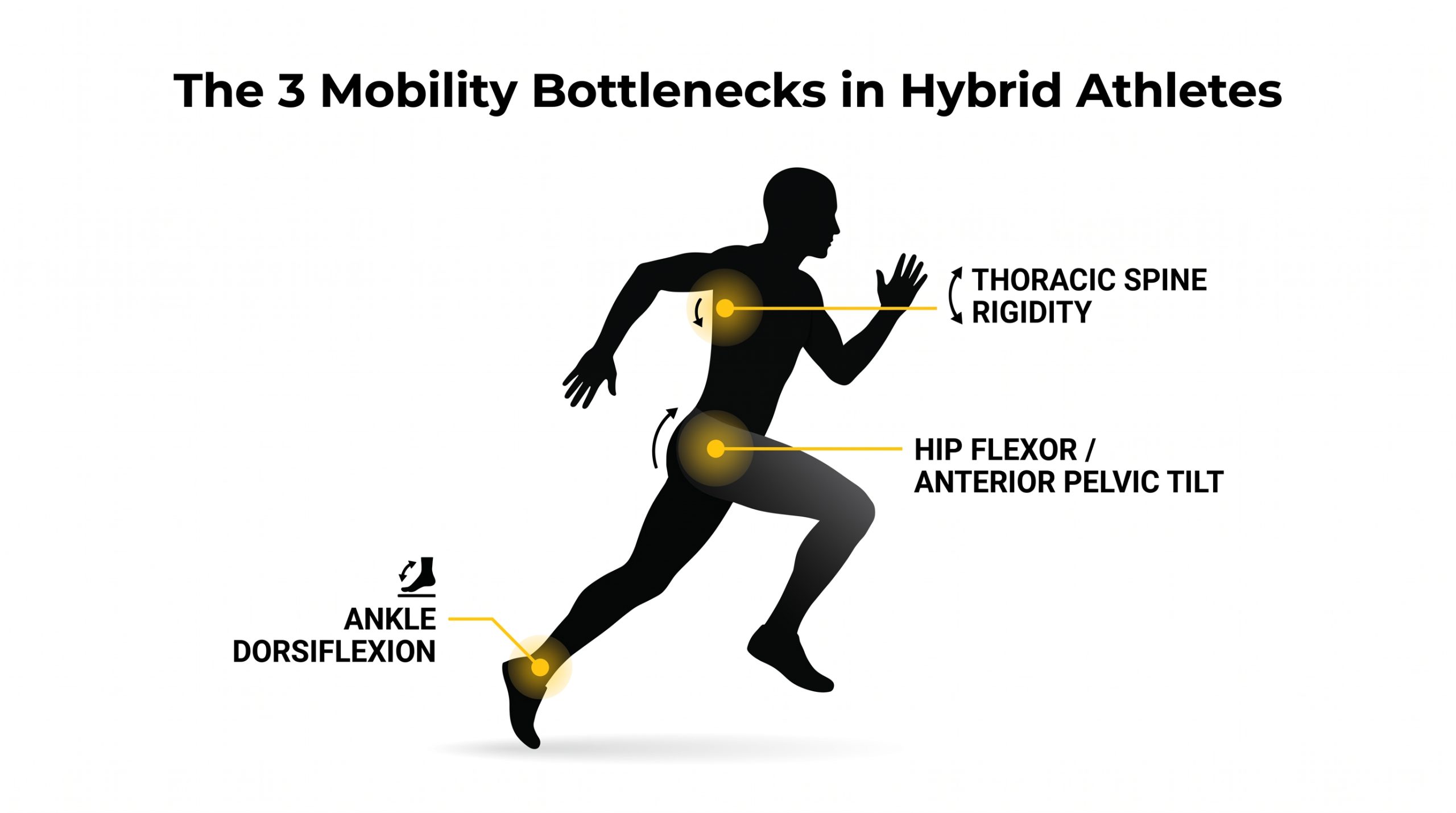
Almost every hybrid athlete I’ve worked with breaks down in one of the same three places. It’s not random — it’s a direct result of what concurrent training demands.
1. Ankle Dorsiflexion Every time your foot hits the ground running, you need roughly 20+ degrees of ankle dorsiflexion to absorb that impact cleanly. If your ankles are locked up from squatting and deadlifting in a narrow range, your body doesn’t just refuse to move — it compensates. Usually that means over-pronation, which sends the shock somewhere it wasn’t built to go. Research on restricted ankle dorsiflexion shows it directly alters landing mechanics and increases the ground reaction forces transmitted into the shin and knee (J Athl Train. 201). That’s the mechanism behind a lot of “mystery” shin splints in hybrid athletes — it’s rarely mysterious.
2. Hip Flexor and Pelvic Tilt Stiffness Heavy axial loading from squats and deadlifts, combined with thousands of repetitive hip-flexor contractions from running, pulls the pelvis into anterior tilt over time. Once that happens, hip extension gets restricted — and that’s not a minor cosmetic issue. Research has linked restricted hip extension directly to shorter stride length, worse running economy, and higher hamstring strain risk (Schache et al., 2000). You’re literally running less efficiently and more dangerously because your hips can’t open up anymore.
3. Thoracic Spine Rigidity This one gets ignored constantly. A stiff upper back limits how well you can breathe under load during long runs, and it caps your overhead and front-rack positioning in the weight room. It’s the connective-tissue equivalent of trying to do two jobs with one hand tied behind your back.
None of these show up overnight. They build slowly, which is exactly why most hybrid athletes don’t take them seriously until something forces the issue.
Pre-Workout Protocols: Dynamic Warmups for Run Days vs. Lift Days
Here’s where a lot of people are still doing this wrong: static stretching before training. Holding a stretch for 30+ seconds pre-workout has been shown to reduce peak force production and muscle-tendon stiffness in the short term (Behm & Chaouachi, 2011) — which means you’re walking into your session weaker, not more prepared. That’s the opposite of what you want before a heavy squat session or a fast run.
Dynamic warmups do the job static stretching can’t. They raise core temperature, increase nerve conduction velocity, and prime the motor units you’re about to ask to fire. A systematic review on structured dynamic warmups found they meaningfully reduce injury rates and improve lower-body power and performance compared to static or passive warmup protocols (Herman et al., 2012). This isn’t a “nice to have.” It’s the difference between showing up ready and showing up stiff.
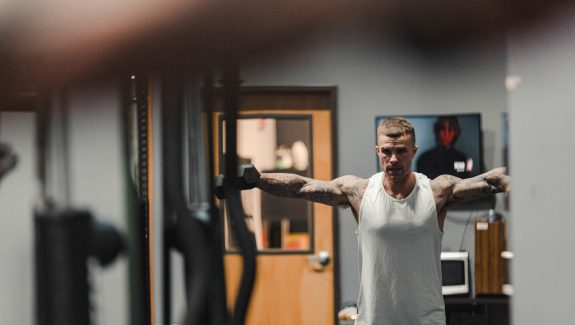
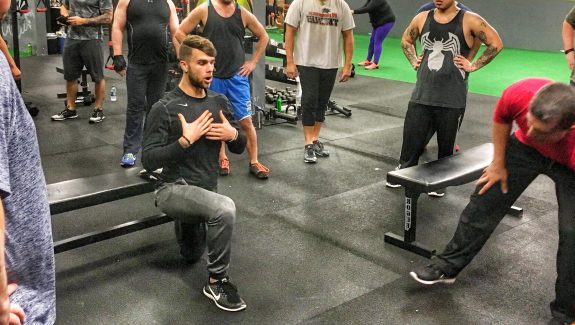
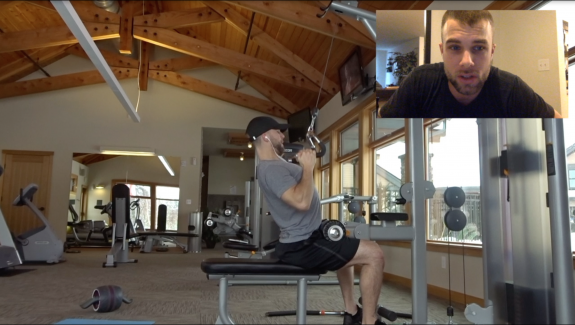
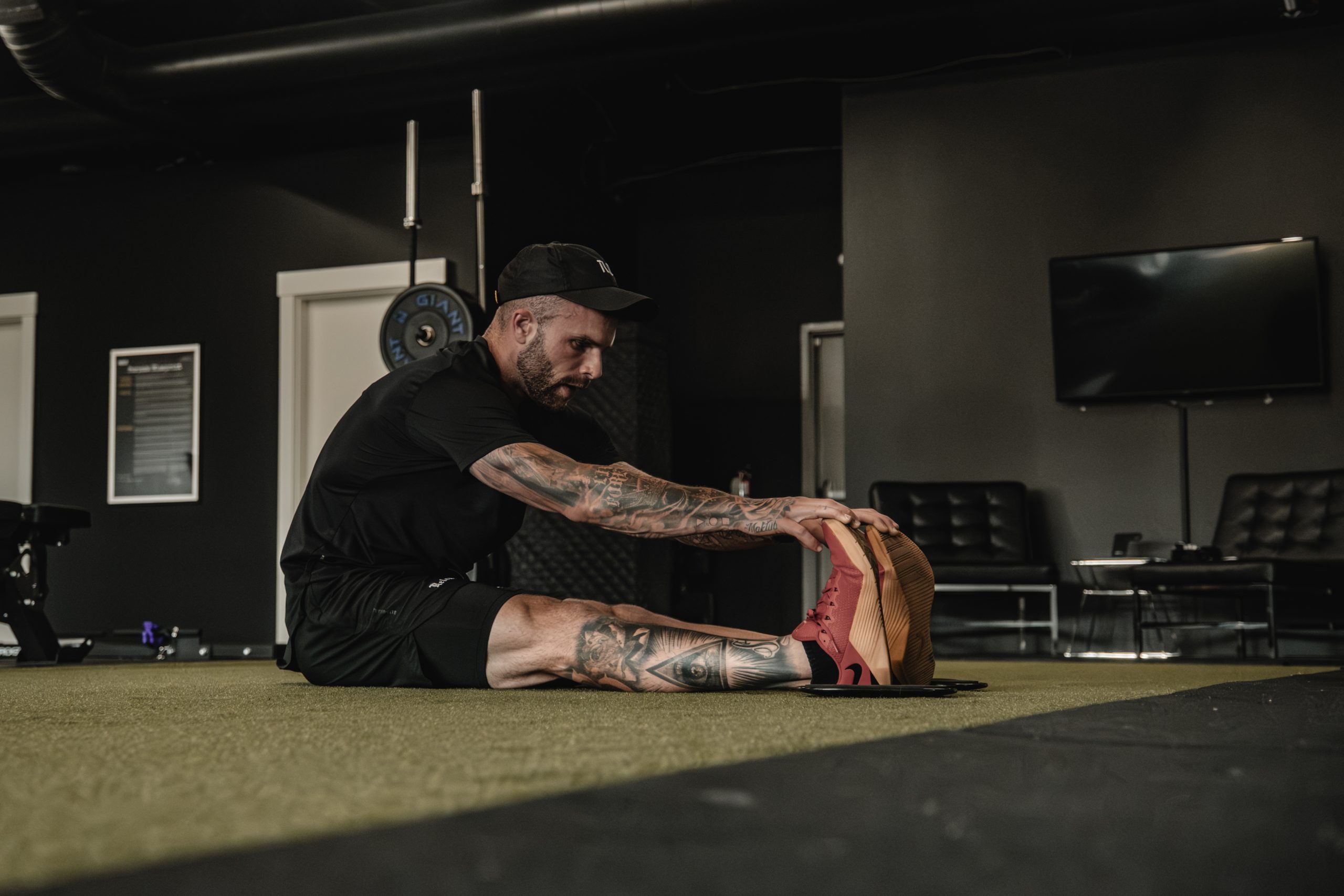
Follow along with me in the video below as I walks through the exact 6-minute dynamic warmup sequence prescribed to TCM’s hybrid clients — primarily designed for lift days, but can be used as a full body protocol prior to runs as well.
The short version, if you’re building your own: → Lift days: 90/90 hip switches, T-spine rotations, banded ankle mobilizations → Run days: Psoas marches, ankle pumps, leg swings, walking lunges with a reach
And if you want to be specific to your lifting session, rather than painting a broad scope brush for the warm up, use one of the lifting specific warm up protocols below:
→ GPP Day
Post-Workout Protocols: Down-Regulation and Tissue Work
What you do in the 20 minutes after training matters almost as much as the session itself, and this is the part almost everyone skips.
Right after a hard session, your nervous system is still in a sympathetic, fight-or-flight state. Recovery — metabolically and structurally — happens faster once you shift into a parasympathetic, rest-and-digest state. Research on slow, paced breathing (roughly five to six breaths per minute with a longer exhale than inhale) shows it produces immediate increases in vagal nerve stimulation and heart rate variability, speeding up that parasympathetic shift (Van Diest et al., 2014; Laborde et al., 2016). Three to five minutes of box breathing after a session isn’t a wellness gimmick — it’s a lever you’re currently leaving on the table.
Foam rolling belongs here too, though not for the reason most people think. A systematic review on self-myofascial release found it temporarily increases joint range of motion without reducing muscle performance (Cheatham et al., 2015). It’s not going to “break up scar tissue” the way it gets marketed — but it does buy you usable range of motion without costing you strength, which makes it a genuinely useful post-session tool for a hybrid athlete managing two competing demands on the same joints.
Active Recovery: Why Movement Beats Total Rest
Complete rest sounds appealing. It’s also not doing what you think it’s doing.
When you’re completely sedentary, blood flow stagnates and metabolic byproducts clear more slowly. Low-intensity movement — a flush session — uses the muscle pump to enhance venous return and speed up clearance, without adding any real structural load. A study comparing passive recovery to active recovery in elite athletes found active recovery significantly sped up blood lactate clearance and reduced subjective muscle soreness (Gill et al., 2006). A separate position statement on overtraining found light active recovery supports neuro-endocrine recovery better than total sedentary rest does (Meeusen et al., 2013).
This isn’t permission to train hard every day — that’s a different mistake with the same ending. It’s permission to move on your “off” days instead of sitting completely still. Twenty to thirty minutes of Zone 1 walking, cycling, or swimming plus some light mobility work does more for a hybrid athlete’s recovery than a full day on the couch.
The Sleep and HRV Connection Nobody Wants to Hear
This is the part of the protocol most hybrid athletes actively resist, because it’s not a drill or a stretch — it’s discipline around bedtime. And it matters more than almost everything above it.
Performance drops rarely come from one rough night of sleep before a heavy session or a race. They come from cumulative sleep debt that builds over three to seven days. A landmark study on Stanford athletes found that extending sleep duration to nine-plus hours a night produced measurable improvements in sprint times, reaction time, and daytime mood and fatigue scores (Mah et al., 2011). Separate research on cumulative sleep restriction — under six hours a night for consecutive nights — found it impairs muscle glycogen resynthesis, raises injury risk, and suppresses autonomic recovery (Fullagar et al., 2015).
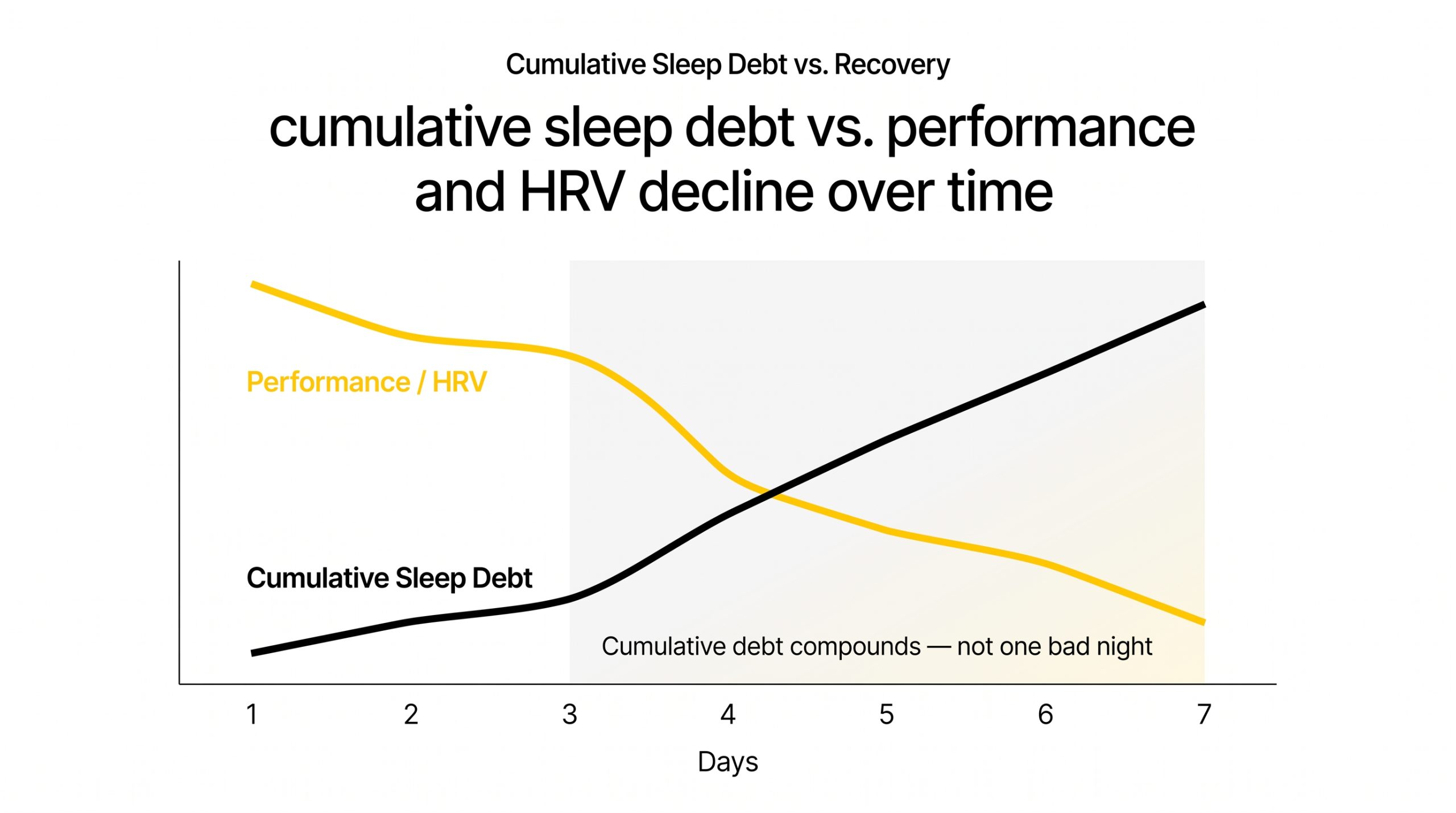
If your resting heart rate is trending up or your HRV keeps dropping despite what feels like “enough” sleep, don’t just add more mobility work on top of the problem. Go read our guide on the 6 Critical Mistakes Lifters Make When Switching to Hybrid Training — sleep debt is usually a symptom of a volume or intensity problem further upstream.
Hybrid Mobility and Recovery Matrix
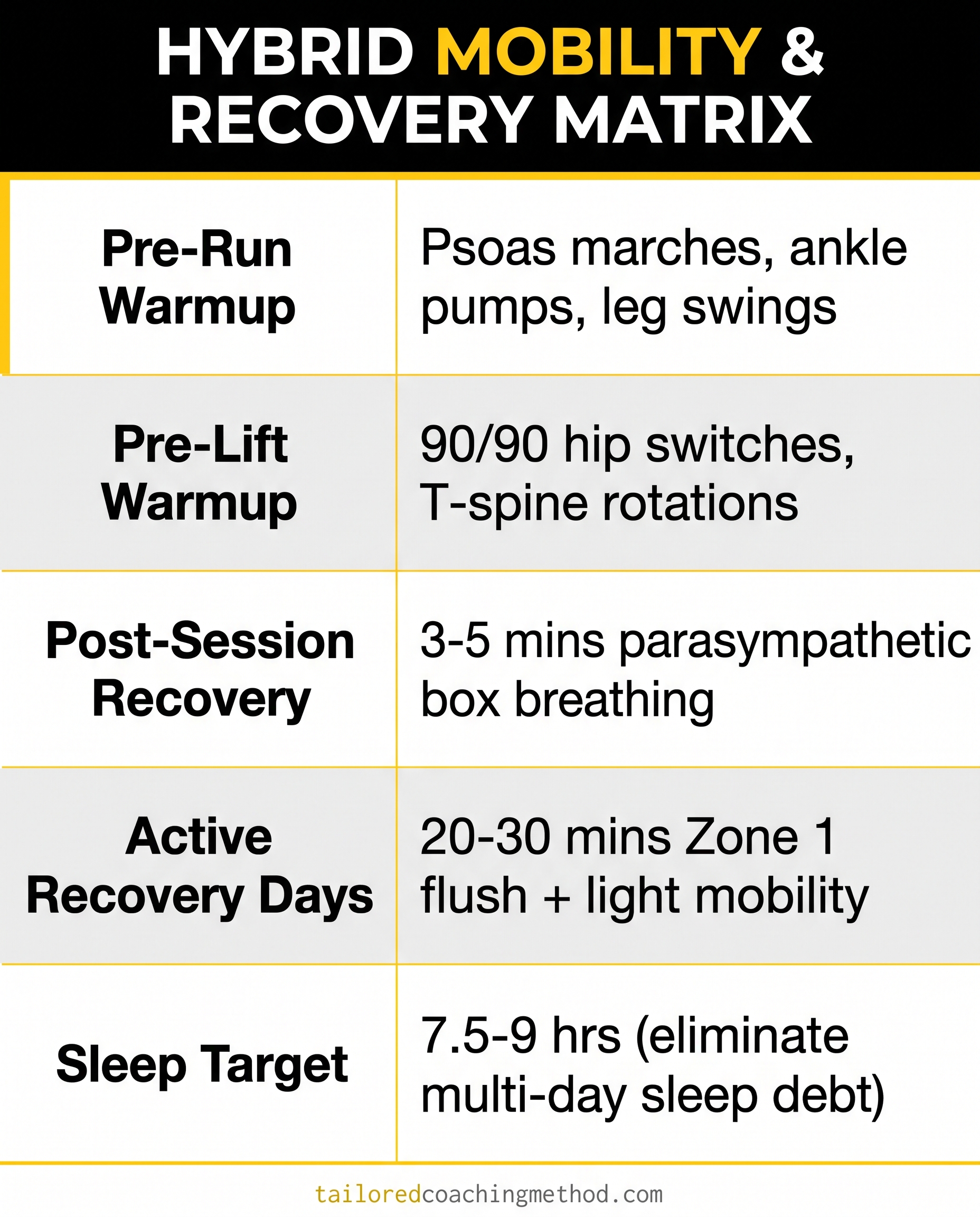
Print this. Tape it to your gym bag. This is the boring, unglamorous part of hybrid training that actually keeps you training — nobody posts a highlight reel of their box-breathing routine, but it’s the reason the people who post the highlight reels are still healthy a year later.
Where This Fits Into Your Bigger Hybrid Plan
Mobility and recovery don’t work in isolation — they’re downstream of how you’re fueling and how you’re training in the first place. If you haven’t looked at how your nutrition needs to shift around two-a-days or back-to-back run/lift sessions, check out our guides on hybrid intra-workout nutrition and hybrid athlete nutrition. The recovery protocols above will only get you so far if your fueling strategy is fighting against them.
And if you’re dealing with persistent joint pain, tightness, or fatigue that isn’t resolving with what’s outlined here — that’s genuinely what individualized coaching is for. Generic protocols can only go so far when your specific training history, injury pattern, and recovery capacity are unique to you. That’s literally what our coaches build around at TCM Online Coaching.
Choose hard. Lead by example. No shortcuts — and that includes the recovery work, not just the training.
Hybrid Athlete Mobility & Recovery FAQ |
| What is the best mobility routine for hybrid athletes? There isn’t a single universal routine — hybrid athletes need one warmup emphasizing hip and ankle prep before lifting, and a different one emphasizing hip flexor and ankle dorsiflexion work before running. The consistent thread across both is dynamic, not static, movement pre-workout. |
| How often should hybrid athletes do mobility work? Daily, in some form. Dynamic warmup work belongs before every training session, while dedicated tissue work (foam rolling, targeted stretching) is most useful post-workout or in the evening, 3–5 times a week depending on training volume. |
| Does foam rolling actually help hybrid athletes recover? It can temporarily increase joint range of motion without reducing muscle performance, which makes it a legitimate tool for managing the competing stiffness/compliance demands of hybrid training. It’s not a substitute for addressing training volume or sleep debt, though. |
| Is static stretching bad before a workout? Static stretching held for 30+ seconds pre-workout has been shown to temporarily reduce peak force output and muscle-tendon stiffness, which isn’t ideal right before a heavy lift or a fast run. Dynamic warmups are the better pre-workout choice; static stretching still has a place post-workout or on rest days. |
| How much sleep do hybrid athletes need for recovery? Most research points to 7.5–9 hours as the target range, with cumulative sleep debt over several days doing more damage than any single short night. Consistency across the week matters more than any one “perfect” night before a big session. |