
Muscle Hypertrophy Myths: What Actually Builds Muscle
You’ve probably been chasing the wrong signals in the gym. The pump, the soreness, the “shocking your muscles,” the DNA test that was supposed to tell you if you’re a hard gainer — most of it doesn’t do what you think it does. Mechanical tension is the primary, evidence-backed driver of muscle hypertrophy, while soreness, the pump, and hormone spikes are mostly byproducts, not causes. Progressive overload, adequate volume, and consistency drive growth far more than any of the tricks people obsess over.

I’ve been coaching for 16-plus years and worked directly with over 2,000 clients through Tailored Coaching Method. In that time I’ve watched the same myths resurface over and over — not because coaches are lying to people, but because a lot of the “science” floating around fitness content got frozen in the early 2000s and never got updated. So let’s actually update it. I recently sat down and dug through the current hypertrophy literature — the kind of research review I do on my own time because I genuinely find it interesting — and I want to walk you through what’s actually proven versus what’s just gym folklore that refuses to die.
What Actually Builds Muscle? (It’s Not the Pump)
For years, the story was that hypertrophy comes from a “triad”: mechanical tension, metabolic stress (the burn, the pump), and muscle damage (soreness). That triad gets repeated in certifications, in influencer content, everywhere. The problem is that when researchers actually isolated each variable in human trials, two-thirds of that triad fell apart.
Metabolic stress doesn’t independently drive growth.
When researchers infuse lactate directly into people during resistance training, it does not enhance muscle protein synthesis compared to a placebo. That “gnarly pump” feeling is a byproduct of the tension you created, not a separate growth mechanism you need to chase on top of it. I actually train some of my competitive athletes to buffer lactate more efficiently for performance reasons — and that pump sensation can throw off their pacing more than it helps them.
Muscle damage doesn’t independently drive growth either.
Concentric-only training — which minimizes the soreness and structural damage most lifters associate with a “good workout” — builds muscle just as effectively as training that includes the eccentric (lowering) portion. Soreness is a side effect of doing something your muscle isn’t adapted to yet, not a growth signal you should be trying to manufacture (Roberts et al., 2023).
What’s left standing is mechanical tension: real, hard, progressively overloaded effort.
Roughly 80% of what you do in the gym needs to be built around creating and increasing that tension over time — heavier loads, harder sets, more total challenging reps. If you want a deeper breakdown of picking movements that actually create tension where you need it, we’ve got a full guide on choosing the right exercises for your goals.
What’s Actually Happening Inside the Muscle Fiber?
Here’s a myth that even sounds scientific: that muscle fibers just “get bigger” as one uniform blob. That’s not really what’s happening at the cellular level.
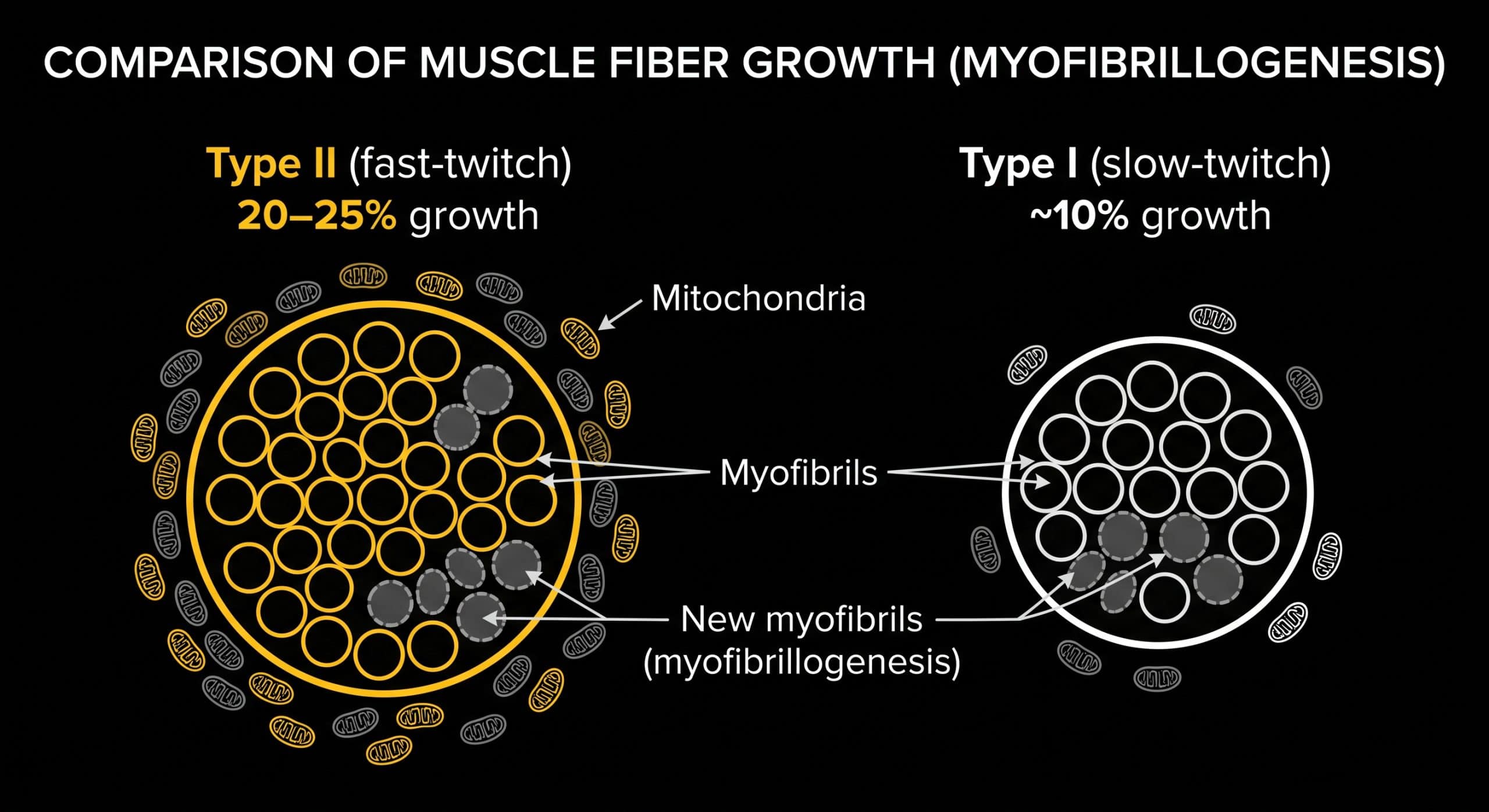
Growth is driven largely by myofibrillogenesis — you’re building new parallel contractile units (myofibrils) inside the existing fiber, not just inflating the ones already there. And it’s not distributed evenly:
- Fast-twitch (Type II) fibers grow the most — 20–25% cross-sectional area gains — because they’re the fibers recruited when a set actually gets hard.
- Slow-twitch (Type I) fibers grow less — closer to 10% — since they’re built for endurance, not force output.
- Mitochondria expand right alongside the muscle, not the other way around. There’s a common myth that building size “dilutes” your aerobic engine. It doesn’t — the mitochondrial network expands to keep pace with the new tissue (Ruple et al., 2021; Haun et al., 2019).
The practical implication: if you’re training at a weight that never gets genuinely hard, you’re not recruiting the Type II fibers with the highest growth ceiling. Comfortable weight, comfortable reps, comfortable effort — that’s the recipe for staying the same size.
Does Stretching Under Load Actually Matter?
This one gets slept on. Most lifters think about tension purely as “squeezing” a muscle during the contraction. But loading a muscle while it’s stretched — lengthened partials, deficit work, full range of motion — appears to trigger a separate growth pathway: adding sarcomeres in series along the fiber, rather than just widening it. That pathway runs through different signaling than standard mTOR-driven radial growth (Warneke et al., 2022).
Practically, this means training through a genuinely full range of motion matters, and for a body part that’s stubbornly behind the rest, deliberately emphasizing the stretched position of an exercise is worth testing. If you’ve got a muscle group that just won’t respond no matter what you throw at it, we’ve written specifically about why stubborn body parts stall out and what to do about it.
Are “Non-Responders” Even Real?
I want to be blunt here because this myth causes real damage: people quit on themselves over it. Older research floated the idea that up to 30% of people are “non-responders” who just can’t build meaningful muscle. That number gets repeated constantly, and it’s wrong.
Modern large-cohort trials put true non-responders at under 5% of the population — and even that’s likely generous. In my own coaching practice, working with well over 2,000 clients, I can count on one hand the people who genuinely didn’t respond to correctly programmed, progressively overloaded training. What actually happens with most “low responders” is they still build strength through neural adaptation, and once their training volume increases, they move into moderate-to-high hypertrophy response.
So what actually separates high responders from everyone else? Two internal factors, not luck:
→ Baseline satellite cell density and activation — essentially, how many muscle stem cells someone has on hand and how well those cells activate and fuse in response to training. → Ribosome biogenesis — high responders increase their total ribosome content by roughly 32% after training, meaning they build far more of the cellular machinery needed to synthesize new protein. Low responders show closer to an 8% increase (Mobley et al., 2018).
That’s genetics playing a real role, sure — but it’s not a hard ceiling, and it’s definitely not something a $150 DNA kit can tell you. If a client isn’t growing, the fix is almost never “you’re just not built for this.” It’s almost always volume, effort, or consistency, in that order. Increase working sets before you assume you’re a hard gainer.
Do Hormones or DNA Tests Predict Your Muscle-Building Potential?
Short answer: no, and this is one of the more expensive myths in the industry.
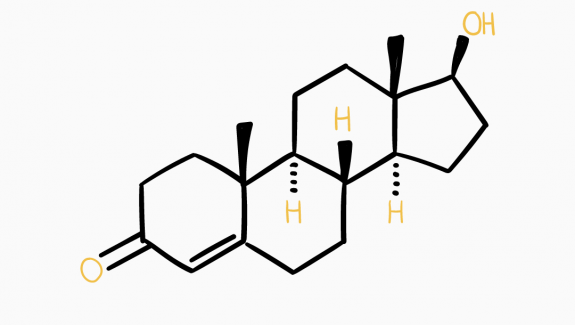
Within normal physiological ranges, basal or post-workout spikes in testosterone, growth hormone, cortisol, or estrogen don’t predict individual hypertrophy outcomes. Local androgen and estrogen receptor density in healthy adults isn’t strongly tied to growth either (West & Phillips, 2012; Morton et al., 2018). The exception is medical — someone in a genuinely hypogonadal state, or someone using super-physiological (steroid-level) doses, will see hormone-driven differences. Outside of those two scenarios, chasing a “hormonal optimization” strategy for hypertrophy is mostly wasted effort. We break down where hormones actually do and don’t matter for body composition in our guide on how hormones influence fat loss and muscle growth.
As for direct-to-consumer genetic testing — the kind that claims to tell you your ideal training style from a cheek swab — commercial SNP-based tests are measuring against more than 20,000 protein-coding genes and trying to extract meaning from one or two. Genome-wide association data shows single genes explain less than 1–10% of the variance in hypertrophic potential. Growth is polygenic, and for nearly every gene variant that might nudge you toward more growth, there’s likely another pulling you back toward baseline (Vann et al., 2022). Save the money. Put it toward better programming and more food instead.
How Many Sets Do You Actually Need Per Week?
Volume follows a dose-response curve, and both ends of it get misused.
As few as 6 sets per muscle group per week can produce measurable growth — that’s the floor, not something to aim for if you’re serious. 12–20 sets per week appears to be the sweet spot for most trained lifters. Push past 20–30+ sets and you typically tip into overreaching: mood disturbance, water retention, and junk fatigue without added myofibrillar growth on top of it (Haun et al., 2018).
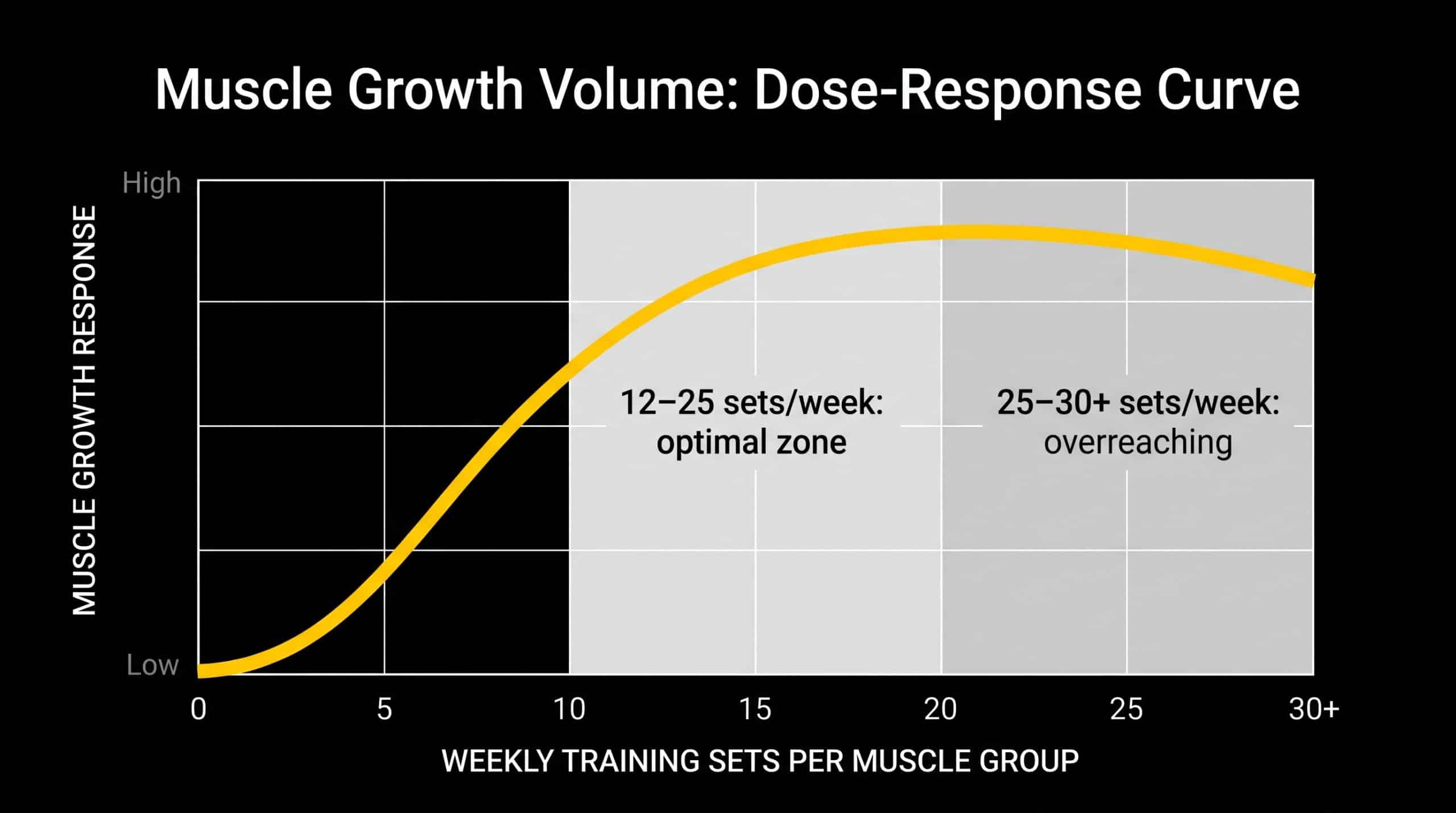
If you’re stuck at 25+ sets per muscle group and still not growing, more volume isn’t the fix — recovery, actual proximity to failure, or nutrition almost certainly is. For a broader look at where to spend your training effort, our guide on maximizing muscle growth covers this in more depth.
Heavy Weight or Light Weight — Does Load Actually Matter?
Here’s a genuinely nuanced one, and I’m not going to pretend it’s simpler than it is.
Training near failure at roughly 30% of your one-rep max (around 30–40 reps) produces essentially the same muscle protein synthesis, mTORC1 signaling, and hypertrophy as heavy training at 80% of your one-rep max (around 8–12 reps) — as long as both are taken close to failure (Mitchell et al., 2012). The load itself isn’t the deciding variable for size. Proximity to failure is.
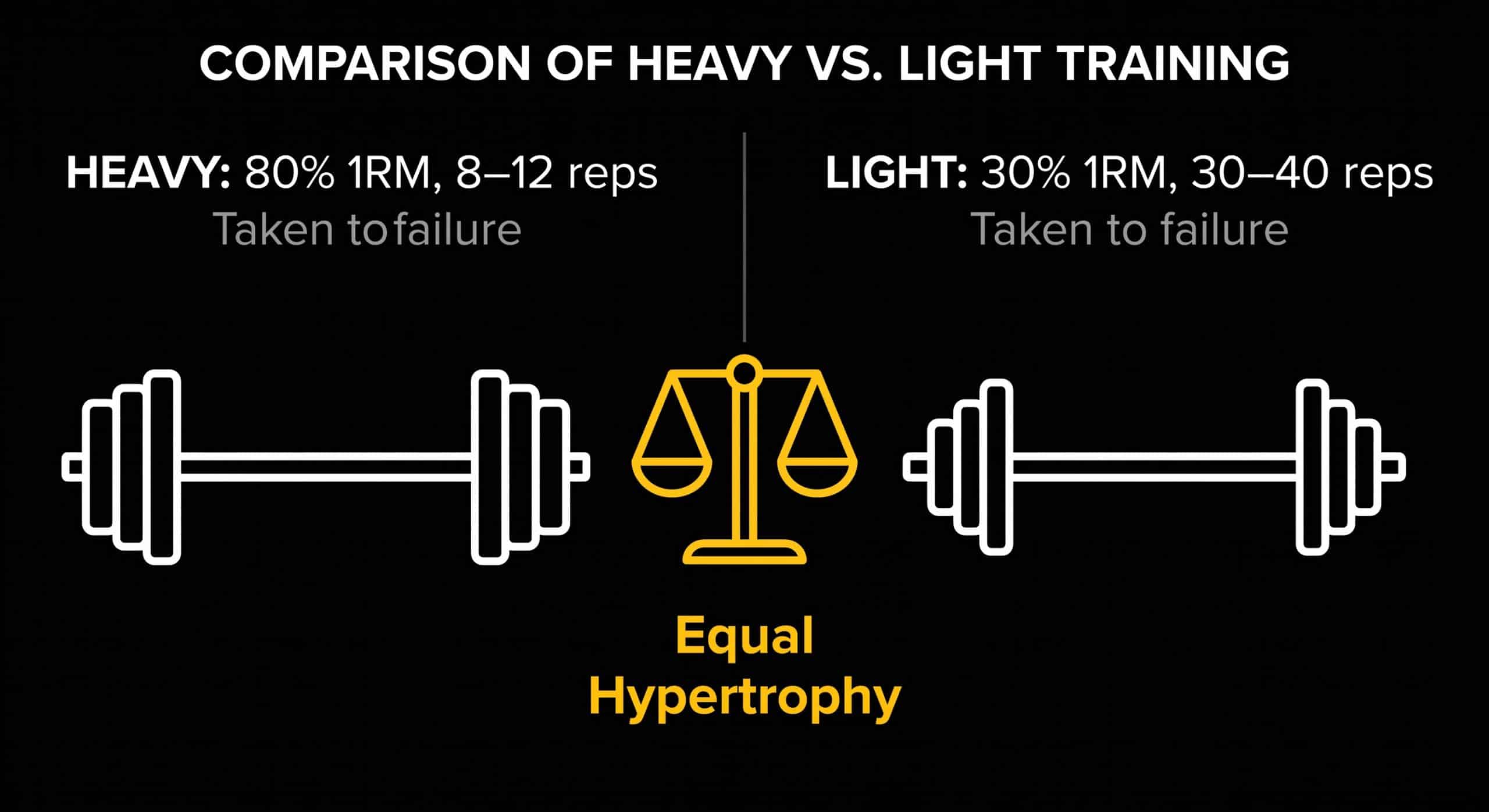
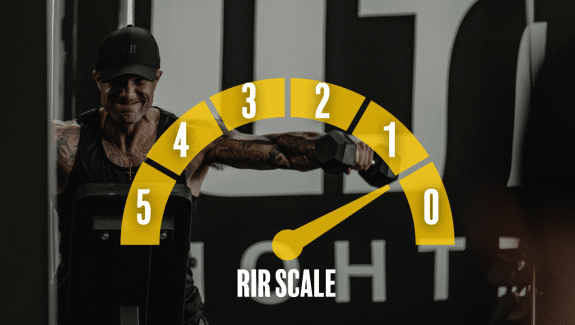
Where load does matter is strength and neural adaptation — heavy loading still wins there, no argument. So the honest answer is: for pure hypertrophy, both light-and-hard and heavy-and-hard work, and which one you pick should come down to what’s sustainable for your joints and what you’ll actually stick with. If you train in the 30-rep range, you have to actually get close to failure — this is where understanding reps in reserve matters, because “close to failure” is doing all the work in that sentence, and most people stop further away from it than they think.
Do You Lose Your Gains If You Take Time Off?
This myth keeps people training through injuries they shouldn’t, and it keeps people who’ve taken a break from ever coming back. Neither is necessary.
Myonuclei — the additional cell nuclei your muscle fibers accumulate as they grow — are retained even during atrophy or extended time off. They don’t disappear when the muscle shrinks. When you retrain, those already-built nuclei drive faster, accelerated rebuilding, often surpassing your previous baseline faster than it took to build it the first time (Gundersen, 2016; Seaborne et al., 2018).
So if life happens — injury, travel, a health issue, a brutal work stretch — the muscle you built isn’t gone. It’s dormant, not deleted. Coming back is measurably faster than starting from zero, which is worth remembering the next time guilt is the thing keeping you from restarting.
Does Cardio Kill Your Gains?
This is the one I get asked about the most, and it’s also where I think a lot of content oversimplifies in both directions — so let’s actually sit in the nuance.
Where the myth came from: Hickson’s landmark 1980 study is the origin of “cardio kills your gains.” Untrained subjects did 5 days of heavy leg training plus 6 days of intense running — 11 hard sessions a week, zero rest days — for 10 straight weeks. Around week 7, the concurrent-training group’s strength plateaued and dropped while the strength-only group kept climbing. What Hickson actually measured was overreaching and systemic fatigue from an absurd volume of training with no recovery, not a biological rule against combining lifting and cardio.
The molecular myth that followed: Early literature framed AMPK (activated by cardio) and mTOR (activated by lifting) as a binary light switch — flip on AMPK, and mTOR shuts off. Modern biopsy data shows AMPK spikes acutely during a run and drops back down within hours. Once you eat protein and carbs, mTOR signaling proceeds normally.
What the modern meta-analyses actually show: Pooling 43 studies, researchers found no statistically significant difference in whole-muscle hypertrophy or maximal strength between lifting-only groups and lifting-plus-cardio groups (Schumann et al., 2022). The one thing that consistently does suffer is explosive power — vertical jump, rate of force development — when cardio and lifting are stacked back-to-back with no separation. A closer look at the fiber level shows a minor blunting effect specifically in Type I fibers, and it’s more pronounced with running than cycling, likely because running’s eccentric impact drains local recovery capacity that cycling’s concentric-only motion doesn’t touch (Lundberg et al., 2022).
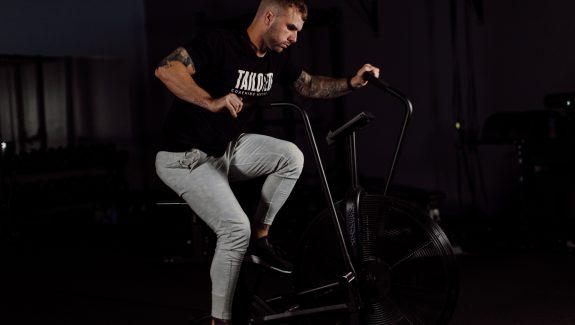
Now here’s where I’ll push back on the version of this story that gets clipped into a 30-second “cardio doesn’t hurt your gains at all” reel: in my own coaching experience, running real volumes of concurrent cardio and lifting genuinely does slow down how fast you build muscle. It doesn’t stop it — but it does suck, and pretending otherwise isn’t honest coaching. I’ve taken hybrid athletes, pulled cardio down to a maintenance level for a training block, watched them build muscle significantly faster, and then reintroduced cardio once they had the base they wanted. That’s not a contradiction of the research above — the meta-analyses are measuring whether cardio blocks growth, and it largely doesn’t at moderate, well-programmed volumes. But “doesn’t block growth” and “doesn’t slow growth down at all” are two different claims, and real-world hybrid training usually lives somewhere between them, especially past a certain running volume.
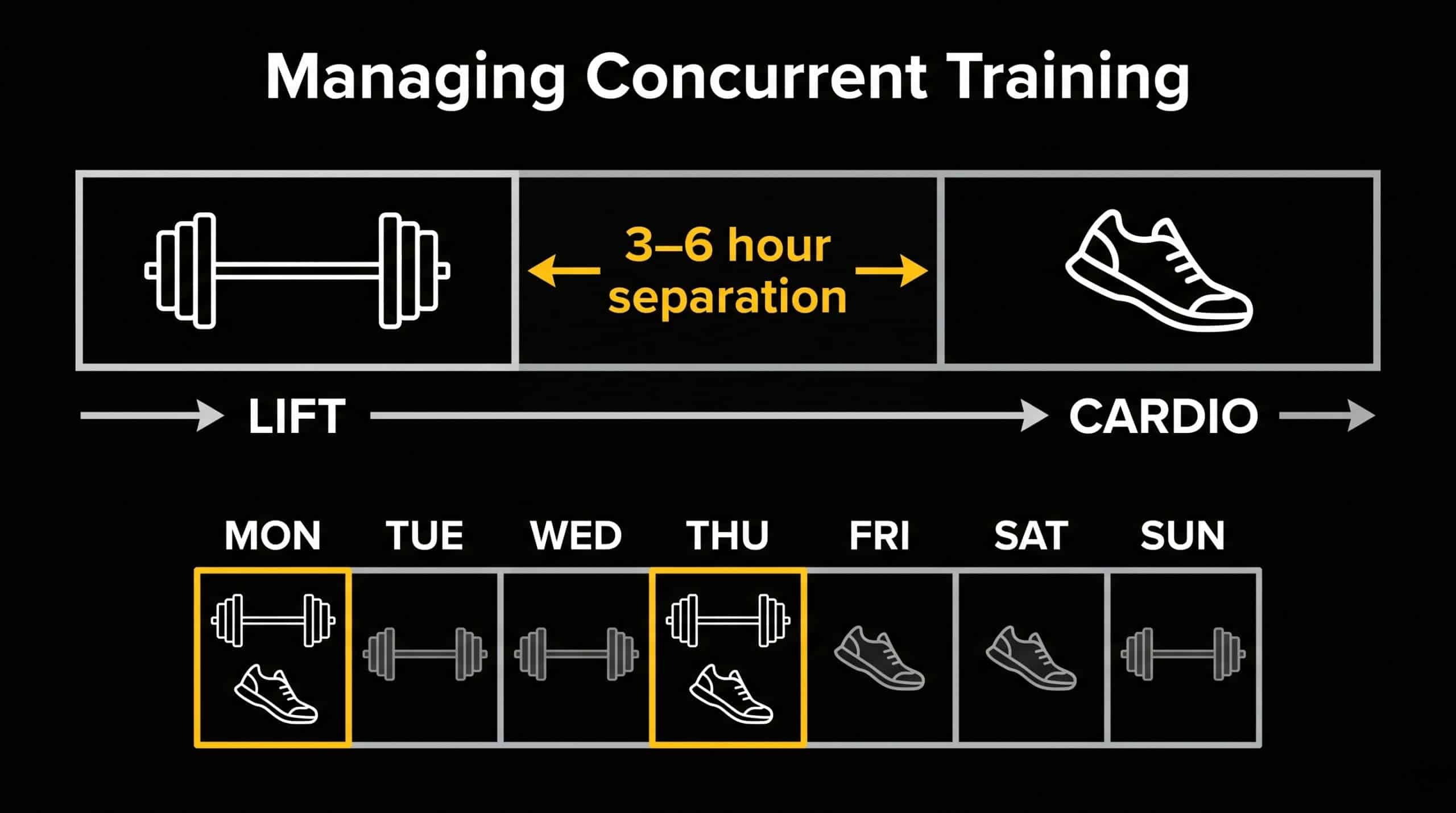
If you’re actually trying to build muscle while training for endurance, here’s how to manage it:
- Separate your sessions by 3–6 hours, or put them on different days entirely. If you have to stack them, lift first.
- Moderate your cardio volume — lean on sprint-interval or Zone 2 work, cap higher-intensity cardio at roughly twice a week, and cut the junk miles that add fatigue without adding fitness.
- Eat enough. Low energy availability — not the run itself — is what actually suppresses muscle protein synthesis. Stay at maintenance or a slight surplus if muscle is the priority. Our guide on optimizing nutrition for muscle growth walks through exactly how to set that up.
- Periodize by block. During a hypertrophy-focused block, keep cardio at maintenance and push lifting volume to that 12–20 set range. During race prep, let running volume climb and drop lifting to a maintenance dose of roughly 6 sets per muscle group.
Muscle Hypertrophy: Myth vs. Reality, Fast
| Myth | Reality |
|---|---|
| Soreness = growth | Soreness is a byproduct of novel tension, not a cause of growth |
| The pump/burn drives size | Lactate infusion doesn’t boost muscle protein synthesis — tension is the real driver |
| You’re a “hard gainer,” it’s genetics | True non-responders are under 5% of people; it’s almost always volume or effort |
| Get a DNA test to optimize training | Single genes explain less than 1–10% of hypertrophy variance |
| More sets is always better | 12–20 sets/week is the sweet spot; 20–30+ often backfires |
| You need heavy weight to grow | Light-to-failure and heavy-to-failure build muscle equally well |
| Time off erases your gains | Myonuclei are retained — muscle memory makes rebuilding faster |
| Cardio kills your gains | Whole-muscle hypertrophy holds up when programmed correctly, though heavy cardio volume can still slow the pace |
The Bottom Line: Muscle Growth Made Simple
None of this is complicated once you strip the myths out, but “not complicated” isn’t the same as “easy.” Building muscle still takes progressively harder training sessions, consistent volume, enough food, and months — not days — of actually showing up. There’s no pump you can chase, no DNA test you can buy, and no genetic excuse that replaces putting in the work over time.
If you want this dialed in specifically for your body, your schedule, and your training history rather than piecing it together yourself, that’s literally what our coaches do — you can apply for coaching here.
FAQ Block |
| Does soreness mean my workout actually built muscle? No. Soreness is a byproduct of doing something your muscle isn’t yet adapted to, not a cause of growth. Concentric-only training, which produces far less soreness, builds muscle just as effectively as training that includes eccentric loading. Use progressive tension and load, not next-day soreness, as your signal that a session worked. |
| How many sets per week do I actually need to build muscle? Research shows a dose-response curve: as few as 6 sets per muscle group per week can trigger measurable growth, while 12–20 sets per week appears optimal for most trained lifters. Pushing past 20–30+ sets often causes overreaching and fatigue without additional muscle growth, so more isn’t automatically better. |
| Are non-responders to muscle building real? True non-responders make up under 5% of the population, and that number is likely generous. Most people who feel stuck are actually low responders who still gain strength and typically shift into normal hypertrophy response once training volume increases. Genetics affects the rate of growth, not whether growth is possible. |
| Does cardio kill your muscle gains? Modern meta-analyses show no significant difference in whole-muscle hypertrophy between lifting-only and lifting-plus-cardio groups at moderate, well-programmed volumes. That said, high volumes of concurrent cardio can still slow the rate of muscle growth in practice, which is why separating sessions, managing cardio volume, and eating enough matter if size is the priority. |
| Can a DNA test tell me how to train for muscle growth? No. Commercial genetic tests typically isolate one or two genes out of more than 20,000 protein-coding genes involved in hypertrophy, and single genes explain less than 1–10% of the variance in muscle-building potential. Muscle growth is polygenic, and no consumer test currently captures enough of that picture to prescribe a training approach. |